

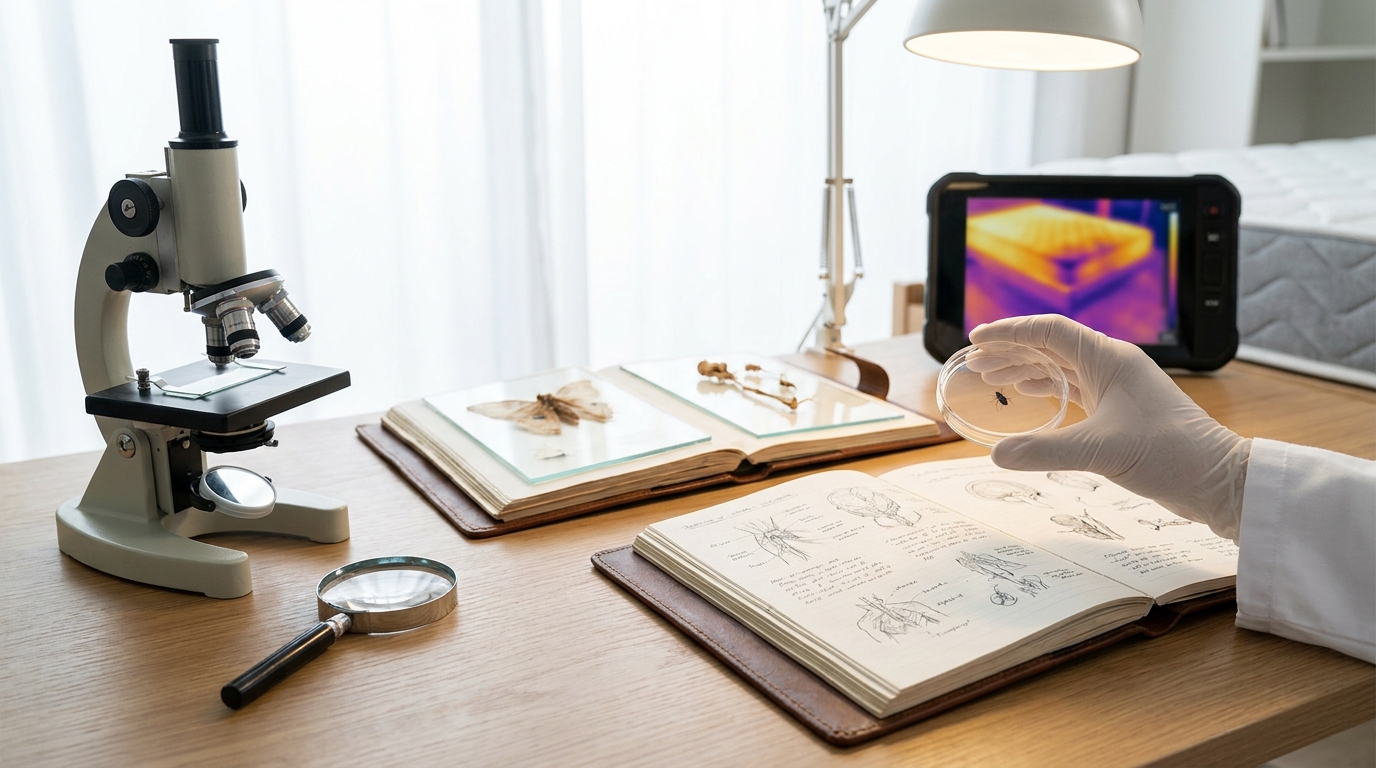
10 Fascinating Facts About Bedbugs: Everything You Need to Know
Contents
-
Biology and Survival: How a Virtually Invincible Insect Works
-
Behavior and Detection: Explaining the Habits of this Stealthy Pest
We talk about them in hushed tones, as if they were something to be ashamed of. Bed bugs are something of a taboo in modern apartments. Yet they have nothing to do with a lack of hygiene, and are just as at home in a five-star palace as in a student studio. What's really fascinating is that we've been fighting them for millennia, and they're still with us. More resistant than ever, in fact.
Things to remember
-
More than just a list, this article deciphers the fascinating biology of bedbugs to explain their modern resilience.
-
Punaisesdelitbruxelles' approach combines scientific popularization and field expertise to transform fear into understanding and effective prevention.
-
The Historical Basics of Bedbugs
-
How an Almost Invincible Insect Works
At Punaisesdelitbruxelles, we visit affected households every week. And by dint of observing them, tracking them down and understanding their biology, we've accumulated a wealth of knowledge that surprises even our most informed customers. This top 10 list of interesting bedbug facts is our way of sharing that knowledge. Not to scare, but to turn panic into understanding. Because a pest we understand is a pest we can eliminate better.
So, are you ready to find out what makes this insect so fearsomely effective? Some of these unusual facts about bedbugs will probably change the way you look at these millimeter-sized creatures.
Origins and Evolution: The Historical Basics of the Bedbug
100 million years ago, the ancestors of bedbugs were already feeding on blood. Not ours: that of bats, in the caves where our own prehistoric ancestors eventually settled. It was this forced proximity that started it all. The bugs changed hosts. And they've been with us ever since.
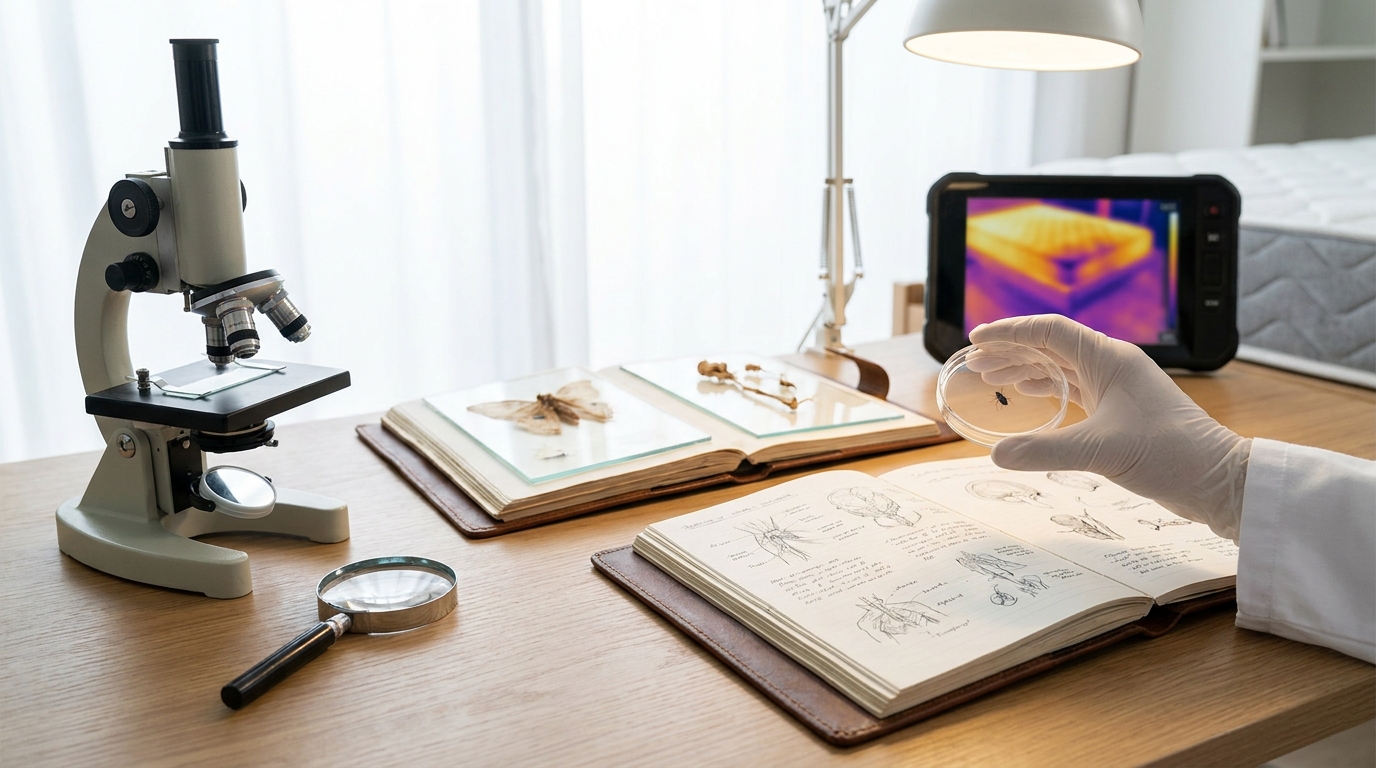
The history of bedbugs is closely linked to that of humankind. Traces of Cimex lectularius, their scientific name, in archaeological sites in Egypt dating back 3,500 years. The Romans knew them well. Pliny the Elder even attributed medicinal virtues to them: they were crushed in potions supposed to cure snakebites or ear infections. Appetizing.
In the Middle Ages, they flourished all over Europe. Straw mattresses, shared beds, no centralized heating to dry out the air: everything worked in their favor. No one was really surprised. It was as common a bedfellow as fleas or lice.
The real turning point came in the 20th century. After the Second World War, the massive use of DDT virtually eradicated bedbugs in Western countries. For 50 years, they were forgotten. Dermatologists no longer recognized their bites. Exterminators stopped seeing them. We honestly thought we were done.
A monumental mistake. As early as the late 1990s, Cimex lectularius has made a comeback. Why is this? A combination of factors. The ban on DDT (toxic to humans and the environment), the explosion in international travel, the second-hand furniture trade. Bedbugs traveled in our suitcases, boxes and clothes. They have recolonized the world's major cities in less than two decades.
What's remarkable about this story is their ability to adapt. The species didn't just survive: it evolved. Today's populations are genetically different from their pre-war counterparts. They have developed resistance mechanisms that their ancestors did not have. We'll come back to this later, but remember this: every attempt at eradication has made them tougher. It's almost like natural selection accelerated before our very eyes.
In Brussels, as in all major European cities, the phenomenon is very real. Consultations for bedbug problems have increased fivefold in ten years. This is not a fad, but the massive return of an insect that has known us since the dawn of time.
Biology and Survival: How a Virtually Invincible Insect Works
Five millimeters. That's the size of an apple seed. And that's all it takes for the bedbug to make your life miserable. But behind this insignificant appearance lies a biology formidably optimized for survival. When you delve into the details, you'll soon understand why this insect gives the best professionals in the business a run for their money.
Let's start with their mode of reproduction, because it's probably the most surprising fact on this list. Bedbugs practice what is known as traumatic insemination. The male doesn't use conventional reproductive methods: he literally pierces the female's abdomen with his reproductive organ to deposit his spermatozoa. It's brutal, it's unique in the insect world, and it's terribly effective. A single fertilized female can lay between 200 and 500 eggs in her lifetime. Can you see the problem? One bug in a suitcase is potentially an entire colony in a matter of weeks.
Traumatic reproduction led females to develop a specific organ, the sperm cell, to limit the damage caused by violent fertilization. Evolution has had to find a compromise between the brutality of the male and the survival of the female. The biology of bedbugs is a concentration of extreme strategies.
How long does a bedbug live? Between 6 and 24 months, depending on conditions. But the figure that should really grab your attention is this: an adult bedbug can survive without feeding for 12 to 18 months. A year and a half without a drop of blood. That's why leaving your apartment for a few weeks in the hope of starving them out never works. They wait. Patiently.
Their resistance to insecticides is another fascinating chapter. Modern bedbugs have developed several defense mechanisms. Some produce enzymes that break down chemical molecules before they reach their nervous system. Others have a thicker cuticle (their outer «skin»), which absorbs less product. Recent studies show that some strains have become up to 1,000 times more resistant to pyrethroids, the most commonly used family of insecticides. A thousand times. It's no longer resistance, it's immunity.
This is exactly why chemical treatments alone are increasingly failing. At Punaisesdelitbruxelles, we systematically combine several approaches: heat treatment (bedbugs die at 48°C and above, and there's no resistance there), targeted chemical treatment with latest-generation molecules, and rigorous monitoring. Insecticide resistance is the number-one problem in the industry today, and we have to take it seriously.
A final detail that speaks volumes about their resilience: bedbugs can withstand temperatures ranging from -10°C to +45°C. They resist dehydration. They can squeeze through a crack the thickness of a bank card. Every aspect of their physiology seems designed to persist, come what may.
Behavior and Detection: Explaining the Habits of this Stealthy Pest
You're asleep. It's 3 a.m. Your body gives off CO2 as you breathe, body heat, and chemical compounds through perspiration. For a bedbug lurking in the seam of your mattress, this is a signal as clear as a neon sign. Bedbugs' attraction to their hosts is based on these three elements combined: carbon dioxide, heat and certain body odors. They can hardly see, but they find you every time.
What exactly is it that attracts bedbugs? Not dirt, as many still believe. A spotless apartment can be infested. What attracts them is you. Your physical presence, your night-time breathing, your temperature. They feed exclusively on human (or animal, failing that) blood, and have optimized their behavior so as never to be spotted while feeding.
Their saliva contains an anesthetic and an anticoagulant. The result: you feel nothing during the bite, which lasts between 5 and 10 minutes. The blood flows freely, the bug gorges itself, then goes back into hiding. Itching doesn't appear until hours later, sometimes the very next day. That's why many people take weeks to figure out what's going on. They think it's allergies, mosquitoes or eczema. Meanwhile, the colony grows.
Why shouldn't you crush bedbugs when you find one? Two reasons. Firstly, a visible bedbug is just the tip of the iceberg: there are probably dozens more hidden away. Crushing it solves nothing. Secondly, a crushed female may release viable eggs. It's best to capture it (a piece of tape does the trick) and keep it for identification, then call a professional.
Detecting bedbugs is quite a job. With the naked eye, we look for clues: small black spots on mattresses (their droppings), traces of blood on sheets, translucent moult skins, and of course the insects themselves, flat and brown, hiding in seams, box spring slats, electrical sockets, behind skirting boards, in picture frames. They can lodge in any crack near a sleeping area.
Dog detection has changed the game in recent years. A specially trained dog can detect live bedbugs and their eggs with a reliability rate of over 95%. By comparison, a visual inspection by a technician, even an experienced one, has a success rate of between 30 and 40% for light infestations. The dog detects the characteristic scent of bedbugs, even through walls or floors. This is an invaluable tool, especially for confirming or refuting a suspicion before launching an expensive treatment.
What role do bedbugs play in the ecosystem? Frankly, science has yet to identify any major ecological role for them. They don't pollinate anything, decompose anything or regulate any other population. Some researchers suggest that they serve as prey for a few predators (spiders, certain mites), but nothing significant. They are pure parasites, adapted to a single way of life: feeding on us.
One final point worth emphasizing: bedbugs do not transmit any known disease. Despite the fact that they feed on blood, no study has demonstrated the transmission of pathogens to humans. The impact is primarily psychological (insomnia, anxiety, social isolation) and dermatological (allergic reactions to bites). But it's not all harmless. People who experience an infestation know that it has a profound effect on their daily lives.
Conclusion
These ten facts about bedbugs ultimately tell a single story: that of an insect that has co-evolved with man for millennia and has no intention of disappearing. Their biology, their behavior, their ability to resist chemical treatments - everything is calibrated for persistence.
Understanding how they work means regaining some control. Knowing that they detect CO2, that they can survive for months without eating, that conventional insecticides are no longer sufficient: this information changes the way we approach the problem. We stop panicking and start acting intelligently.
If you suspect their presence in your Brussels home, don't wait for the colony to settle in. Contact an exterminator in Brussels who has mastered the latest techniques. At Punaisesdelitbruxelles, we intervene quickly, we combine methods, and above all, we explain each step to you. Because an informed customer is a customer who doesn't get reinfested.
Frequently asked questions
Where do bedbugs come from historically?
100 million years ago, the ancestors of bedbugs fed on the blood of bats in caves. It was when the first prehistoric humans shared these same habitats that the parasite changed host, adapting definitively to humans.
Why did bedbugs make a comeback after the 1990s?
Their massive reappearance is linked to the ban on DDT (an ultra-powerful but toxic insecticide), combined with the explosion in international tourism and the second-hand furniture market. These factors have enabled them to travel in suitcases and recolonize major cities in less than two decades.
Are bedbugs the same today as they were in the Middle Ages?
No, the species has undergone accelerated natural selection to adapt to our extermination methods. Modern populations are genetically different and have developed biological defense mechanisms that their ancestors did not possess.
How do bedbugs reproduce?
Bedbugs practice traumatic insemination, a brutal mode of reproduction in which the male pierces the female's abdomen directly to deposit his spermatozoa. This fearsome process enables a single fertilized female to lay between 200 and 500 eggs in her lifetime.
How long can a bedbug survive without eating?
An adult bedbug is exceptionally resilient, and can survive without a single blood bite for 12 to 18 months. This is why leaving your home for a few weeks in the hope of starving them out is a totally ineffective strategy.
Why do conventional insecticides no longer work on them?
Modern bedbugs have developed immunity by thickening their carapace to reduce product absorption, and by secreting enzymes that destroy chemical molecules. Some strains are now up to 1,000 times more resistant to traditional chemical treatments, making heat treatment (at over 48°C) essential.
What really attracts bed bugs to a room?
Contrary to popular belief, dirt does not attract bed bugs. They detect human presence exclusively, guided by the carbon dioxide ($CO_2$) we emit when we breathe, our body heat and the odours of our perspiration.
Why can't I feel bedbug bites at night?
When it bites, the bedbug injects a special saliva containing an anesthetic to numb the skin and an anticoagulant to thin the blood. This ploy enables them to feed quietly for 5 to 10 minutes without ever waking their host.
Is canine bedbug detection really effective?
Yes, the nose of a trained truffle dog has a reliability rate of over 95 % for spotting live insects and eggs, even those hidden behind walls or floors. In comparison, a human visual inspection is generally only 30 to 40 % successful in the early stages of an infestation.

 French
  English
  Dutch
Dutch