


Ultrasonic Bed Bug Repellents: A Local Expert’s Straightforward Opinion
Contents
-
How Ultrasonic Bed Bug Repellent Plugs Work and What They Promise
-
The Effectiveness of Ultrasound: Scientific Evidence vs. Real-World Experience
-
Prevention Strategies and Curative Treatments: The True Long-Term Solutions
You’ve probably seen these ads: a small plug you plug into the wall, and presto—no more bedbugs in the bedroom. It sounds good. Too good, even. Here in Brussels, we get calls every week from people who tried this kind of gadget first before calling us—often after wasting several weeks and ruining their nights.
Things to remember
-
An honest analysis by a local expert in Brussels
-
We contrast manufacturers’ marketing claims with the biological reality of bed bugs, while clarifying the crucial distinction between the desire for prevention and the need for professional curative treatment
-
How Ultrasonic Bed Bug Repellent Plugs Work and What They Promise
-
The Effectiveness of Ultrasound in Light of Scientific Evidence and the Reality of …
So let’s ask the question straight out: Do ultrasonic devices really work against bed bugs? Or are you just being sold a bunch of hot air in pretty packaging? I’m going to be blunt, because when it comes to this topic, honesty is better than a polite sales pitch.
In this article, I break down the manufacturers’ promises, comparing them to what science says and what we see on the ground every day in Brussels homes. And most importantly, I’ll explain what actually works once bed bugs have taken hold.
How Ultrasonic Bed Bug Repellent Plugs Work and What They Promise
The principle is simple on paper. A bed bug ultrasonic device emits very high-frequency sound waves that are inaudible to the human ear. What do the manufacturers claim? These waves are so disturbing to the insects that they’ll flee your home. No chemicals, no odor, nothing to clean up. You plug it in, forget about it, and nature does the rest.
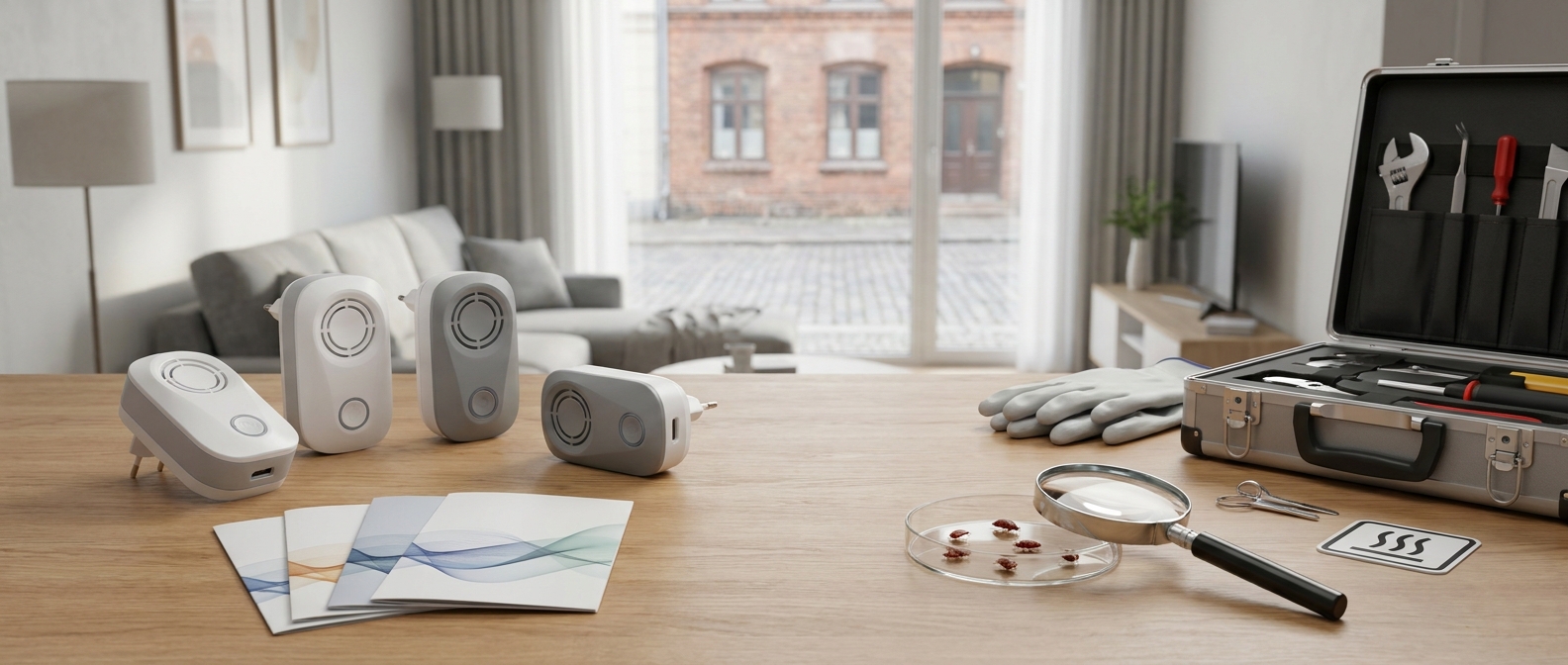
In practical terms, the bed bug repellent plug is a small device that plugs into a standard electrical outlet. Some models feature flashing LEDs or combine multiple frequencies to target «all pests»: mosquitoes, mice, cockroaches, and bed bugs. The marketing pitch is well-rehearsed. They talk about «ultrasonic barriers,» «natural repellents,» and «patented technology.» Prices range from 15 to 60 euros depending on the brand, and the packaging promises protection covering several dozen square meters.
I completely understand why it’s so appealing. When you wake up to find bites and panic at the thought of an infestation, the idea of a non-toxic solution that doesn’t require drastic measures is reassuring. Especially in a bedroom where a child or baby sleeps. We want to avoid insecticides; we want something clean and unobtrusive. And a plug-in device checks all those emotional boxes.
Manufacturers are actually quite adept at playing on this point. They often lump repellents for crawling insects and flying pests together in the same product description, which keeps things vague. You read «effective against bed bugs,» and you assume it’s proven. After all, it’s sold in pharmacies, on major e-commerce platforms, and sometimes even at home improvement stores. That inspires confidence.
But there’s one question worth asking before you pull out your credit card: What exactly is this promise based on? Are there any serious studies backing up these bed bug ultrasound devices, or are they simply capitalizing on your distress and your desire for an easy solution? That’s precisely where the problem lies, and I’ll explain why in the next section.
The Effectiveness of Ultrasound: Scientific Evidence vs. Real-World Experience
Zero. That’s the number of independent studies demonstrating that ultrasound is actually effective against bed bugs. I’m choosing my words carefully. The universities that have tested these devices—particularly in the United States—all reach the same conclusion: the bed bugs don’t move, don’t flee, and don’t die. They just carry on with their daily routine as if nothing had happened.
Why? Because bed bugs aren’t guided by sound. What attracts them to you is the CO₂ you exhale, your body heat, and certain molecules on your skin. It couldn’t care less about noise. Emitting high-frequency waves in its direction is a bit like trying to scare away a mosquito by singing a song to it. The insect simply doesn’t have the biological receptors to be bothered by that.
The effectiveness of ultrasound against bed bugs therefore does not stand up to any rigorous testing. The well-known American consumer magazine even issued an official warning to several manufacturers of these types of products, precisely because their claims were not supported by evidence. That should be enough to settle the debate.
Out in the field in Brussels, I see the same thing week after week. People proudly show me the device they’ve had plugged in for a month, and right next to it, bed bug infestations have multiplied in the bed frame and baseboards. While the device hummed away in the corner, the bugs were quietly laying eggs. A female can lay 5 to 7 eggs a day. Do the math for four wasted weeks.
So when I read certain reviews of bed bug ultrasound devices that tout miraculous results, I’m always skeptical. Often, these are testimonials where the person also washed their laundry at 60°C, vacuumed everywhere, and threw out a mattress. It wasn’t the device that did the trick—it was those other actions. Correlation does not imply causation. And the origins of many of these positive reviews are frankly questionable.
My firm opinion on these devices? They’re a placebo for the buyer, but never for the insect. Worse yet, they waste your precious time. With every day you wait, the infestation grows and becomes more expensive to eliminate. I’d rather be upfront with you than give you false hope.
Prevention Strategies and Curative Treatments: The True Long-Term Solutions
Well, now that we’ve debunked that myth, let’s talk about what really works. And here, we need to make a distinction that many people confuse: prevention is not the same as treatment. They are two completely different approaches.
When it comes to prevention, there are a few useful steps you can take. Inspect the seams of your mattress regularly, use bed bug-proof covers that trap the insects, wash any suspicious linens at high temperatures, and be careful about what you bring back from a hotel or shared living space. Certain essential oils or sprays marketed as bed bug repellents may discourage them from settling in, but that’s about it. A repellent is good for deterrence, but it never eliminates an existing colony. Don’t rely on it if you’ve already been bitten.
And that’s exactly the heart of the problem. When you search for «how I got rid of my bed bugs in two days,» you’re looking for a cure, not prevention. But no gadget, no plug-in device, and no supermarket spray will eliminate an established infestation. Bed bugs hide in hard-to-see places: cracks, baseboards, bed frames, electrical outlets, and behind wallpaper. A surface treatment will never reach them all.
The only truly reliable treatment for bed bugs is a thorough professional treatment. In practice, this involves heat treatment (temperatures above 55°C kill the insects and their eggs) or targeted applications of professional-grade products, often requiring multiple treatments to break the reproduction cycle. All of this is preceded by a thorough, room-by-room inspection. It’s a methodical process—it’s not magic.
When we’re called in as bed bug exterminators in Brussels, the first thing we do is assess the true extent of the infestation. Is it just one room, or the entire apartment? How long has it been going on? That changes the entire strategy. Then we take action, explain what you need to prepare, and come back to make sure no eggs have survived. Because if even one egg is missed, the whole thing starts over.
My advice, as a local expert: don’t waste money or lose sleep over solutions that don’t work. If you’re in the prevention phase, a few good habits are all it takes. But if you have bed bugs, call a local professional right away. A bed bug exterminator in Brussels knows the local housing stock and building types and can respond quickly. When it comes to this issue, time is of the essence—it makes all the difference between a quick fix and a nightmare that lasts for months.
Conclusion
Ultrasound for bed bugs? No way. There’s no evidence, no biological logic, and no real-world results. It’s a product that reassures the buyer but lets the bugs thrive. If you were thinking about buying one, now you know where you stand: save your money.
The real question isn’t «which gadget should I buy?» but «am I taking preventive measures, or am I already infested?» In the first case, taking the right precautions is enough. In the second, only professional treatment will get you out of this problem for good. Don’t let the infestation get out of hand—every day counts.
Do you have any concerns, or notice any suspicious punctures or marks on your mattress? Contact us. As a local team in Brussels, we’ll provide an accurate assessment and tell you honestly what you need—without trying to sell you something you don’t need. That’s what it means to be close to our customers.
Frequently asked questions
Is ultrasound effective against bed bugs?
No. Available studies have not shown that ultrasonic devices can repel, kill, or permanently disrupt bed bugs. While the device is running, the insects generally continue to feed, hide, and reproduce.
Can a bed bug plug eliminate an infestation?
An ultrasonic device cannot eliminate an infestation, even a mild one. It does not reach bed bugs hiding in cracks and bed frames, nor does it reach their eggs. Above all, using it risks delaying the implementation of a truly effective treatment.
Can ultrasound drive bed bugs into another room?
There is no evidence that ultrasound causes bed bugs to flee. They are primarily attracted to body heat and the carbon dioxide released while sleeping. Therefore, they do not leave their hiding places simply because a device emits high-frequency sounds.
Do ultrasonic devices prevent bed bug bites?
No. An ultrasonic device does not create a protective barrier around the bed and does not prevent bed bugs from coming to feed at night. If the bites continue, you should look for concrete signs of an infestation and arrange for an inspection.
Does ultrasound destroy bed bug eggs?
Ultrasound does not kill eggs, larvae, or adult bed bugs. The eggs are firmly attached in hidden places and require specialized treatment. This is one of the main reasons why a treatment session may require multiple passes.
Are bed bug-proof outlets effective for prevention?
There is no reliable evidence that they prevent bed bugs from entering or establishing themselves. Prevention instead relies on inspecting luggage and secondhand furniture, monitoring the mattress and box spring, and using appropriate covers when warranted.
How can I tell if I really have bed bugs?
Look for small black dots, traces of blood, whitish eggs, shed skins, or live insects in the seams of the mattress and box spring. Bites alone are not enough to confirm their presence, as other insects or skin conditions can cause similar reactions.
What treatment really works against bed bugs?
Effective methods combine an accurate diagnosis, thorough preparation of the home, and treatment tailored to the extent of the infestation. The professional may use heat, targeted applications of approved products, and follow-up measures designed to completely interrupt the reproductive cycle.
Can you get rid of bedbugs yourself?
Washing and drying laundry at the appropriate temperature, vacuuming thoroughly, and reducing hiding places can help with treatment. These measures are rarely enough to deal with an established infestation. Furthermore, the indiscriminate use of insecticides can scatter the bed bugs and make it harder to eliminate them.
When should you contact a bed bug exterminator in Brussels?
Contact a specialist immediately if you find an insect, droppings, eggs, or several consistent signs. Early intervention is generally easier than treating a widespread infestation. Punaisesdelitbruxelles.be can inspect your home, confirm the presence of bed bugs, and recommend a tailored strategy.

 French
  English
  Dutch
Dutch