

Bed Bug-Proof Thermal Tent: How Does This Treatment Work?
Contents
-
The scientific principle behind thermal shock: Why is the tent foolproof?
-
Comparison: Thermal Tent vs. Traditional Chemical Treatments
-
Selection Criteria and Instructions: How to Use Your Heated Tent at Home Properly
A bed bug can withstand a lot. It’s becoming increasingly resistant to insecticides. They can withstand the cold, to a certain extent. But heat? There, they don’t stand a chance. None at all. In fact, heat is their greatest weakness, and that’s precisely what the thermal bed bug tent relies on.
Things to remember
-
Beyond a simple catalog, we explore the science of thermal convection
-
The goal is to explain why heat is the ultimate weapon against bed bugs, while drawing on the hands-on expertise of Punaisesdelitbruxelles to ensure safe use in the home.
-
Why is the tent foolproof?
-
Thermal Tents vs. Traditional Chemical Treatments
At Punaisesdelitbruxelles, we apply this principle every day in the field. And every time a customer asks us for a chemical-free solution for their infested suitcases, clothes, or books, this is the technique we turn to. Not just because it’s trendy to be eco-friendly. Simply because it works.
In this article, we’ll break down together why heat kills bed bugs and their eggs at every stage, how it compares to chemical treatments, and—most importantly—how to properly use a heated tent at home without making a mess of things. Because if you use a heating tent incorrectly, the infestation will come right back with a vengeance.
The scientific principle behind thermal shock: Why is the tent foolproof?
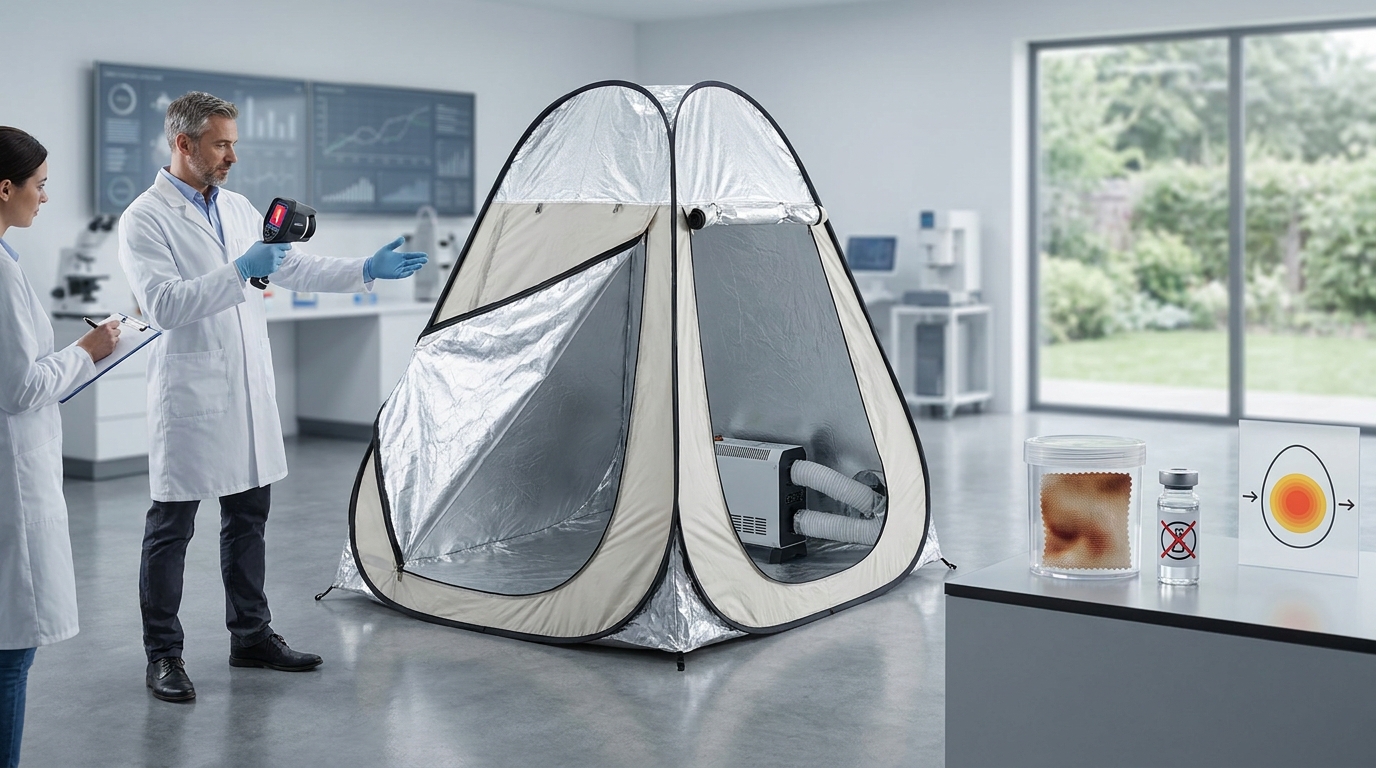
The biology of the bed bug boils down to one simple fact: it cannot tolerate heat above a certain threshold. An adult bed bug dies at temperatures of 45 °C or higher if it remains in that environment long enough. Its eggs, however, are more resilient. Temperatures must reach about 50–55 °C to ensure they are destroyed. And that is exactly what a bed bug heating tent does: it creates an environment where the air reaches and maintains this lethal temperature for bed bugs for several hours.
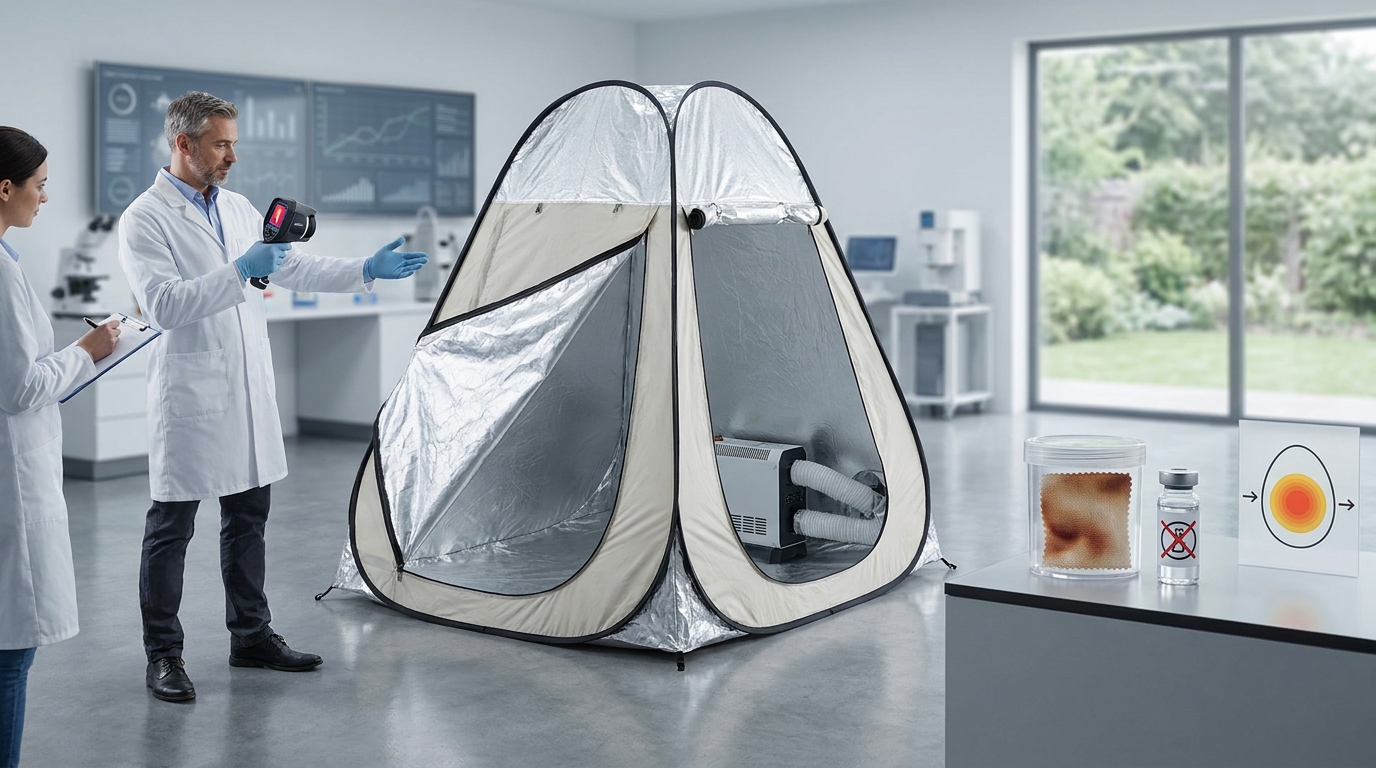
What’s known as thermal shock isn’t just «heating it up a little.» It’s bringing the core of each object—not just its surface—to a lethal temperature and keeping it there. A bed bug hidden in the lining of a suitcase or at the back of a book must be exposed to the same heat as an insect sitting on top. That’s why duration is so important. A successful heat treatment for bed bugs generally takes several hours at the proper temperature—never just a ten-minute burst of heat.
How does the tent do this? Through convective heat. Warm air circulates continuously inside the enclosed space, enveloping the objects and transferring its heat deep into the materials. Dry heat has a major advantage: it penetrates fabrics, leather, and cardboard without soaking them. No moisture, no mold, no water damage. Just hot air doing its job.
And that’s where the tent proves to be a formidable tool for eradicating eggs. Bed bug eggs are invisible to the naked eye—or nearly so—stuck in seams and crevices. No spray can reach them all. Heat, on the other hand, makes short work of their hiding spots. If air at 55 °C circulates throughout the tent, there’s nowhere for an egg to hide. That’s why this method is said to kill bed bug eggs with a reliability that no other home treatment can match.
One thing many people don’t realize: bed bugs haven’t developed any resistance to heat, unlike what happens with insecticides. You can’t «get used» to being cooked. It’s a physical process, not a chemical one. This difference changes everything, and we’ll come back to it in a moment.
Comparison: Thermal Tent vs. Traditional Chemical Treatments
You’re probably wondering why you shouldn’t just buy a good insecticide and spray everywhere. We get asked this question ten times a week. The answer can be summed up in one word: resistance. Over the past twenty years, bed bugs have become highly resistant to pyrethroids, the most common class of insecticides. As a result, you spray, you think you’ve won, and three weeks later they’re back in full force. The debate over insecticides versus heat is almost settled on this point alone.
The primary advantage of heat treatment is its 100 % effectiveness against all life stages. Eggs, larvae, adults—they all die at the same time. Even an effective insecticide often leaves the eggs intact, which means applications must be repeated. With heat treatment, a single, properly conducted cycle is sufficient. There are no survivors hiding out and waiting for the product to evaporate.
Second, and just as important: it’s a chemical-free solution. No toxic residues on your clothes, your sheets, or your children’s belongings. For a child’s bedroom, for people with allergies or asthma, or for households with pets, this makes a huge difference. You get your items back clean, without having to air them out for days or worry about breathing in residues. This natural approach is attracting more and more of our customers in Brussels, and we understand why.
Let’s compare them in practical terms. Chemical treatment often requires multiple applications, is expensive overall, forces you to leave your home for a few hours, and never reaches deep hiding places. The thermal tent, on the other hand, treats the area in a single operation, requires no evacuation, and penetrates everywhere. The only real advantage of chemical treatment is that a professional can treat large surfaces like mattresses or box springs directly. But for anything that can be moved, the thermal tent wins hands down.
We need to be honest about the limitations. A tent is no substitute for a comprehensive treatment of the entire living space if the whole room is infested. It treats personal belongings, not the walls or baseboards. At Punaisesdelitbruxelles, we often combine both approaches: the tent for personal belongings and a targeted treatment for the structure of the home. It’s this combination that yields the best results. But if your problem is limited to a suitcase brought back from a questionable hotel or some suspicious clothing, the tent alone will do the trick without you having to use any chemicals at all.
Selection Criteria and Instructions: How to Use Your Heated Tent at Home Properly
Not everyone needs the same model. A small cube tent is enough for suitcases, bags, and bundles of clothes. For bulkier items—like a sofa or several boxes at once—you’ll need a larger model, such as the ZappBug Room, which offers much more generous processing space. The ZappBug brand remains the industry standard, featuring built-in temperature sensors that confirm the core of the load has indeed reached the lethal threshold. It’s this temperature control that makes the difference between a successful treatment and a false sense of security.
As for tips on how to use it, a few simple rules will help you avoid common mistakes. Never overload the tent. Warm air must circulate freely around each item; otherwise, the center of the pile will never reach the desired temperature. Spread things out, let them breathe, and leave some space. When heating suitcases and clothing, open the suitcases, unpack them, shake them out, and arrange everything so that the heat reaches every nook and cranny. A sweater rolled up into a tight ball is the perfect hiding spot for an egg that will survive.
Stick to the recommended time—it’s non-negotiable. Depending on the load, allow for several hours once the target temperature is reached. Don’t rely on the surface thermometer: wait until the coldest spot in the tent reaches the correct temperature, then maintain it. Also be careful about what you put inside. Candles, cosmetics, fragile electronic devices, vinyl records—anything that melts or warps has no place in a heated tent. Everything else—fabrics, leather, books, toys, shoes—holds up very well.
Should you buy or rent? If you only need it for a one-time use, buying doesn’t always make sense. A high-quality tent is a significant investment, and once the problem is solved, it just gathers dust in a closet. That’s why renting a thermal tent in Brussels is so popular: you take care of the job in a few days, return the equipment, and that’s the end of it. For professionals or in cases of major, recurring infestations, buying makes more sense.
One last practical tip: Treat everything at once. Don’t treat half your clothes today and the other half next week while keeping them in the same room. You’ll just recontaminate everything. Isolate the treated items in sealed plastic bags, and keep them separate until the home is safe. Thoroughness is better than speed here. One forgotten bedbug, and you’re back to square one.
Conclusion
The thermal tent isn’t just a “green” gadget—it’s a physical weapon against an insect that has learned to evade nearly all of our chemical treatments. Heat, on the other hand, cannot be avoided. It kills everything, including eggs, at every stage of development—leaves no residue, and is safe for your family. For treating infested suitcases, clothing, or other items, it’s currently the best non-toxic solution available.
Are you unsure about the extent of your infestation, or do you not know which service to choose? Contact Punaisesdelitbruxelles. We know the ins and outs of the situation; we’ll guide you toward buying or renting based on your specific circumstances, and if necessary, we’ll combine heat treatment with a targeted intervention in your home. The goal remains the same: to get rid of the bed bugs—for good.
Frequently asked questions
Should you buy or rent a thermal tent?
Is a heat tent really effective against bed bugs?
Yes. When used correctly, a heat tent reaches a temperature high enough to eliminate bed bugs at all stages of their life cycle, including eggs. Its effectiveness depends on maintaining a consistent temperature for several hours.
How does a thermal bed bug tent work?
The tent continuously circulates warm air to heat all the items inside. This circulation of heat reaches areas where bed bugs and their eggs may be hiding, such as clothing, suitcases, or books.
Is a thermal tent more effective than an insecticide?
For items that can be placed inside the tent, heat offers a major advantage: it eliminates bed bugs and their eggs without using chemicals and without the risk of developing resistance to insecticides. However, a heat tent does not treat infestations in walls, baseboards, or built-in furniture.
What items can be treated in a heat tent?
A heat-resistant bag is suitable for clothing, shoes, luggage, books, bags, toys, and other items that can withstand high temperatures. However, heat-sensitive items, such as certain electronic devices or products that may melt, should not be placed inside it.
Should you buy or rent a thermal tent?
For occasional use, renting is often the most cost-effective option. Buying may be a good option for regular or professional use, but it represents a larger investment.

 French
  English
  Dutch
Dutch