

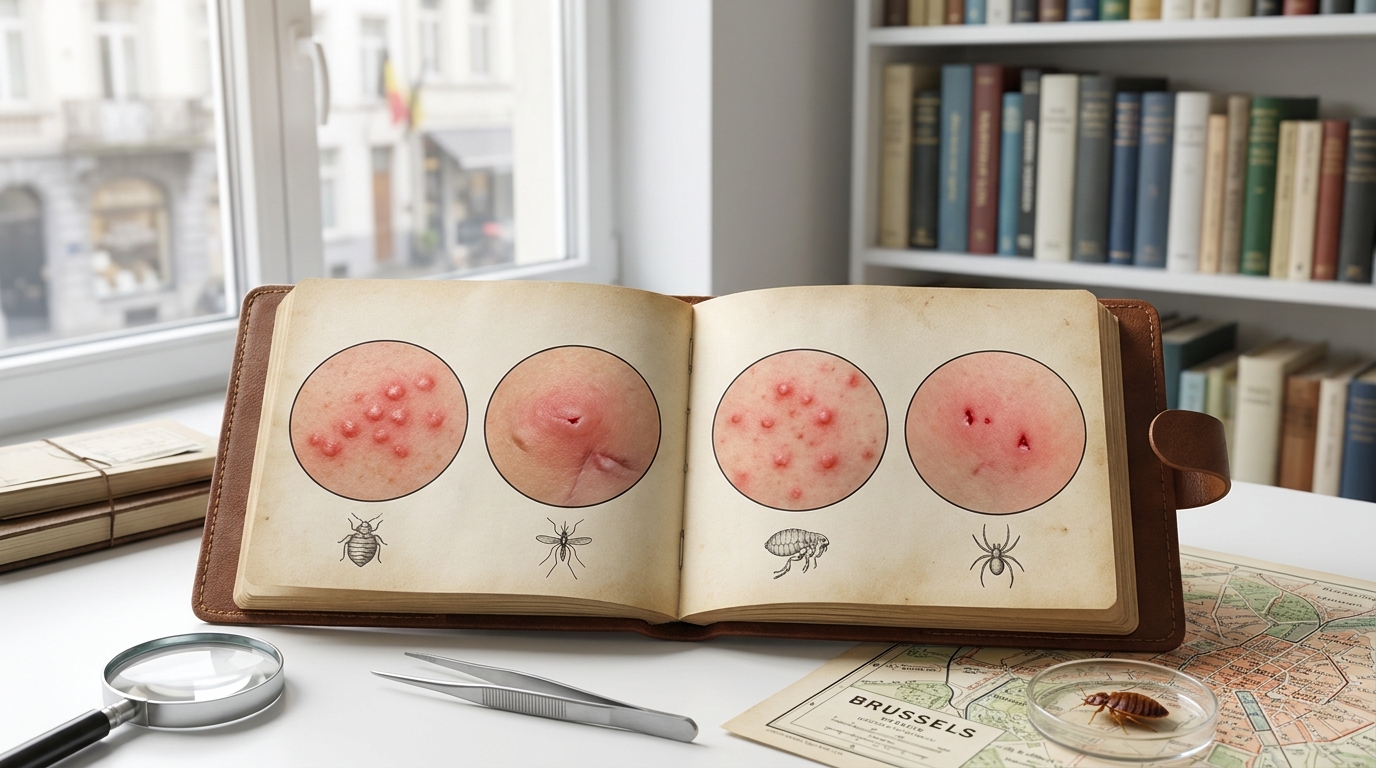
Difference between bedbug bites: the expert's guide to Brussels
Contents
Every week, I receive calls from panicked Brussels residents. They wake up with red pimples, they've been scratching all night, and the first question is always the same: «What are those bites?» Mosquito, cat flea, attic spider, bedbug... everyone has their theory. The problem is, misidentification can set you back weeks. Weeks during which a colony of bedbugs quietly settles in your mattress.
Things to remember
-
This article adopts the eye of the Brussels-based field expert to offer an ultra-precise method of visual and behavioral differentiation.
-
In contrast to generic guides, it explains the subtle nuances between bedbugs and their ‘look-alikes’ (fleas, mosquitoes, spiders), based on real cases encountered in the field.
-
The basics of identifying a bedbug bite
-
Compare bedbugs with mosquitoes, fleas and spiders
At Punaisesdelitbruxelles, we've been working in the field for years. We've seen hundreds of cases, very different skin reactions from one person to another, and above all a lot of confusion. This article is the fruit of those interventions. It's not a copy-paste from Wikipedia: it's a real guide to recognizing a bedbug bite, distinguishing it from other bugs, and knowing what to do next. If you're in Brussels and you're itching to read this, you've come to the right place.
The basics of identifying a bedbug bite
Three red buttons lined up on the forearm. That's how it often starts. The customer shows me his arm, a little embarrassed, and asks if it's serious. The good news: a bedbug bite is not dangerous in itself. The bad news: if you've got them, they're already well established in your home.
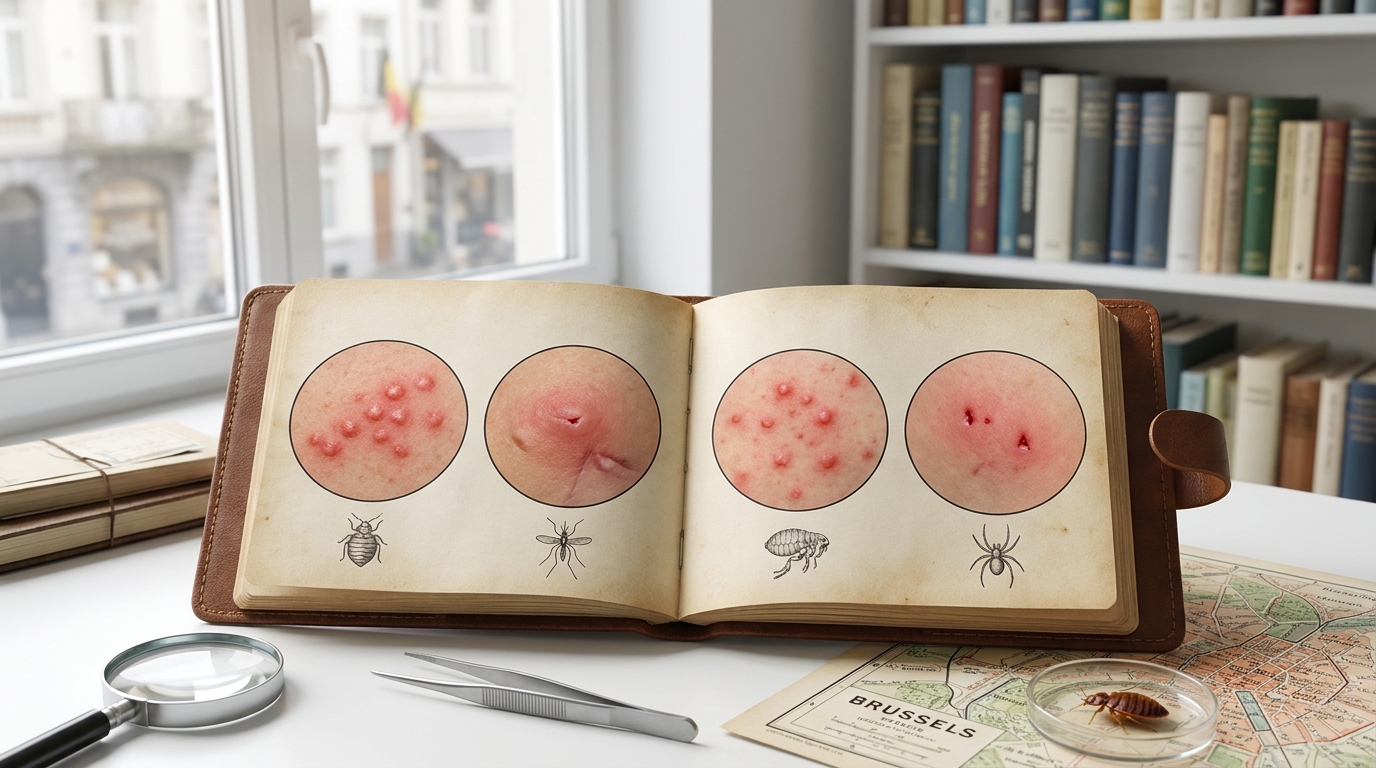
To recognize a bedbug bite, there are some fairly characteristic signs. The first, and best known, is alignment. This is often referred to as onion-row buds, and the expression is apt. The bug feeds by stinging several times along a blood vessel. The result: you end up with three, four, sometimes five spots forming an almost straight line or a small, tight group. A mosquito, on the other hand, bites once and then leaves. A bedbug takes its time.
Visit skin lesions look like red, slightly swollen papules, with a slightly darker central spot. They vary in size from 5 mm to 2 cm, depending on the person's reaction. And here's where it gets complicated: not everyone reacts in the same way. Around 30 % of people develop no visible reaction at all. Zero pimples. They can live with bedbugs for months without knowing it. On the other hand, some people have impressive reactions, with hives-like patches.
The other major clue is the nocturnal itching. Bed bugs are active at night, usually between 3 and 5 am. They are attracted by the CO2 you exhale and by your body heat. You won't feel a thing when they bite you, as they inject an anaesthetic with their saliva. Itching comes later, sometimes several hours later. If you wake up every morning with new pimples and itching, especially at the start of the day, this is a strong signal.
Where do these bites appear? On exposed areas during sleep. Arms, shoulders, neck, face, legs. Rarely under clothing, unlike fleas, which sneak in everywhere. If your pimples are concentrated on parts of your body that stick out from the comforter, that's another clue.
One final point I often notice when I'm out and about: people confuse a bedbug bite with an allergy or eczema. They go to the dermatologist, are prescribed a cream, and the problem returns every night. If a dermatological treatment doesn't work and the pimples only reappear when you wake up, ask yourself the question. Maybe it's time to look for other clues in your bedding.
Compare bedbugs with mosquitoes, fleas and spiders
One out of every three calls we receive at Punaisesdelitbruxelles begins with: «I don't know if it's a mosquito or a bedbug.» This is normal. All bites look alike, especially if you've never had to deal with bedbugs. So let's break down the differences, insect by insect.
Bedbug or mosquito? Visit the difference between a mosquito bite and a bedbug bite is more subtle than you might think. The mosquito spot is usually isolated, round, with a slightly pointed top. It itches immediately after the bite. A bedbug's is flatter, often grouped or aligned, and the itch arrives with a delay. Mosquitoes bite at any time (especially in the evening in summer), while bedbugs bite exclusively at night, in your bed. If you get pimples in the middle of winter in Brussels and your windows have been closed since October, the mosquito is unlikely. Think bedbug.
What about fleas? Visit the difference between a flea bite and a bedbug bite is a classic. Fleas bite mainly the ankles and calves. They jump from the floor, so they attack from below. The bedbug, on the other hand, climbs onto the mattress and bites the areas accessible when lying down. Flea bites are small, very red, with a pinkish halo around them, and they itch intensely and immediately. Another detail: if you have a cat or dog and the animal scratches too, the flea is suspect number one. Bed bugs are not interested in pets, only humans.
I had a case recently in Ixelles. A family with two cats. Pimples all over the children's legs. They were convinced they were bedbugs. In reality, the cats had brought fleas from the garden. The bites were concentrated below the knees, no alignment, no marks on the sheets. We referred her to the vet. Knowing how to difference between flea and bedbug bites avoided unnecessary and costly treatment.
Spider bite, It's a different matter altogether. In Belgium, spiders that bite are rare, and when they do, it's usually just one bite. Not two, not three. One bite. The spider bite is characterized by two small dots close together (the chelicerae), localized swelling and sometimes sharp pain when bitten. Bedbugs, on the other hand, never cause pain on the spot. If you feel a sharp pain followed by isolated swelling, look towards the spider. If you didn't feel a thing and the spots appeared when you woke up online, it's the bedbug.
And Augustats? The the difference between an august bug bite and a bedbug bite also deserves a word. Augustats sting in the folds of the skin: behind the knees, on the belt, under the armpits. The itching is ferocious and lasts a long time. But Augustats are outdoor parasites, active in summer in tall grass. If your pimples appear after a walk in the Forêt de Soignes, it's probably them. If it's in your apartment in the middle of February, no.
To sum up: the alignment of the spots, the time of appearance (on waking), the location (areas exposed during sleep) and the absence of pain at the time of the bite all point to bed bugs. A single criterion is not enough. It's the combination that counts.
Step-by-step guide to confirming an infestation at home
You have suspicious pimples. They're lined up, they appear in the morning, they itch. Before you panic (and before you empty an insecticide can into your bedroom, which is the worst thing you can do), here's how to proceed methodically.
Step 1: Inspect your sheets. It's the first reflex. Visit blood stains on sheets are one of the most reliable clues. When a bedbug bites you, the wound may bleed slightly after it withdraws. You move in your sleep, and the blood leaves small traces, often in the form of dots or reddish streaks. Take a look at your pillowcases, too. These spots aren't huge: we're talking 1 to 3 mm, rust-colored.
Step 2: Look for droppings. Bedbugs leave small black spots, like felt dots, on mattresses, seams, box springs and headboards. This is their excrement, made up of digested blood. If you wipe them with a damp cloth, the stain spreads to a reddish-brown. This is one of indications of bed bugs that speak for themselves. Concentrate your search on the seams of the mattress, the slats of the box spring, and the nooks and crannies of the headboard.
Step 3: Track down molts. Bed bugs moult five times before reaching adulthood. Each molt leaves a translucent envelope, lens-sized for adults, much smaller for youngsters. These are often found wedged in the seams of mattresses or behind headboards. If you find several, the infestation is not recent.
Step 4: Inspect beyond the bed. People often forget this. Bedbugs don't just live in mattresses. They hide in baseboards, behind picture frames, in electrical sockets, nightstand drawers and sofa seams. I've already found entire colonies behind peeling wallpaper in an apartment in Saint-Gilles. If the infestation is advanced, they spread throughout the room.
Step 5: Use a flashlight and double-sided tape. At night, around 3 a.m., turn on the light suddenly and inspect the mattress with a lamp. Adult bedbugs are 4 to 7 mm long, brown, oval and flat (except when they've just fed, in which case they're swollen and reddish). You can also place double-sided tape around the legs of the bed: this can trap bedbugs climbing up from the floor.
Step 6: Call in a professional diagnostician. If you've found one or more of these signs, don't try to treat on your own. Commercial insecticide sprays disperse bedbugs to other rooms without killing them. They make the problem worse. A professional diagnosis allows us to confirm the infestation, assess its extent, and implement a suitable treatment (steam, heat treatment, targeted professional insecticide).
At Punaisesdelitbruxelles, we always start with a thorough inspection before suggesting anything. Sometimes, we arrive and there are no bedbugs. The spots were caused by something else. It happens more often than you think, and that's why a professional eye makes all the difference. There's no need to treat a problem that doesn't exist, and there's no question of letting a real infestation go to waste.
Conclusion
Recognizing a bedbug bite requires a bit of method. The alignment of pimples, the itching in the morning, the stains on the sheets: each clue taken in isolation proves nothing, but put together, the picture becomes clear. And knowing the difference between a mosquito bite, a flea bite or a spider bite saves you from wasting time and money on the wrong diagnosis.
If you're in Brussels and your doubts persist, don't be left alone with your questions. Contact Punaisesdelitbruxelles for an inspection. We'll come over, take a look, tell you exactly what's going on. And if it is bedbugs, we'll take care of them. Quickly and well.
Frequently asked questions
How can you recognize a bedbug bite for sure?
The most characteristic sign is the alignment of pimples (often 3 to 5 pimples in a straight line or grouped together). These red, swollen papules appear mainly upon waking, on areas of the body exposed during the night (arms, neck, legs), and cause severe morning itching.
What's the difference between a mosquito bite and a bedbug bite?
Mosquito bites are usually isolated, round and immediately itchy, often occurring in summer. The bedbug bite is grouped or aligned, the itching comes after a delay, and the infestation persists in the middle of winter in Brussels, even with the windows closed.
How can you tell the difference between flea and bedbug bites?
Fleas mainly attack the lower part of the body (ankles and calves), jumping from the ground or pets, causing small, very red, immediately itchy spots. Bed bugs climb onto mattresses and bite the upper part of the body, never touching dogs or cats.
Does a spider bite look like a bedbug bite?
No, because the spider only bites in self-defense, leaving a single isolated lesion, often characterized by two small dots close together and a sharp pain on the spot. In contrast, bedbugs bite several times without immediate pain, thanks to their anaesthetic saliva.
What clues should I look for in my bed to confirm the presence of bedbugs?
Carefully inspect the seams of your mattress for small black spots (droppings), mini blood trails on your sheets when you wake up, or translucent molts. If you see these signs in Brussels, avoid commercial sprays and contact an expert like Punaisesdelitbruxelles immediately.

 French
  English
  Dutch
Dutch