

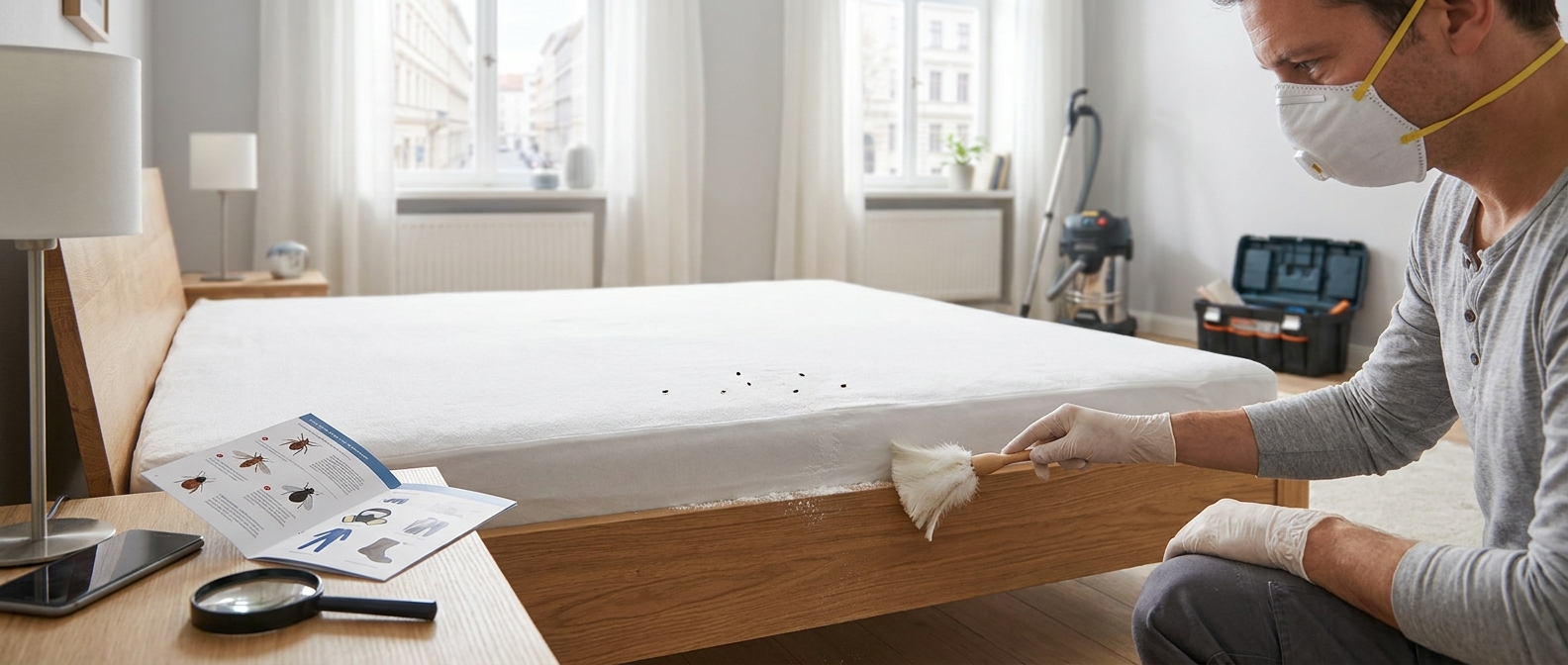
Diatomaceous Earth and Bed Bugs: How to Use It and Its Limitations
Contents
-
How It Works and Potential Hazards: What You Need to Know Before Using Diatomaceous Earth
-
Real-World Effectiveness: When Is Diatomaceous Earth Insufficient Against an Infestation?
Diatomaceous earth is sort of the miracle cure that’s touted everywhere whenever bed bugs come up. Natural, inexpensive, effective: on paper, it has it all. And it’s true that it works. But there’s one side of the story that online tutorials carefully avoid mentioning, and that has to do with your lung health.
Things to remember
-
A transparent guide that demystifies the use of diatomaceous earth by highlighting the often-overlooked respiratory risks and clearly defining the line between what can be treated at home and when professional help is needed in Brussels
-
What You Need to Know Before Using Diatomaceous Earth
-
How to Safely Treat Your Room
-
When is diatomaceous earth not effective against an infestation?
At Punaisesdelitbruxelles, we visit people every week who first tried a natural bed bug treatment using that famous diatomaceous earth. Some have had good results. Others have just wasted three weeks and spread the infestation throughout their entire apartment. What’s the difference? It comes down to two things: knowing how to apply it correctly, and knowing when it’s no longer enough.
This article is an honest guide. We explain how it works, where the real dangers lie, how to treat your room without poisoning yourself, and, most importantly, when you should pick up the phone instead of continuing to spray.
How It Works and Potential Hazards: What You Need to Know Before Using Diatomaceous Earth
Let's start at the beginning. What exactly is diatomaceous earth? It's a powder made up of the fossils of microscopic algae called diatoms. Under a microscope, these particles look like tiny shards of glass. And that's precisely where their power lies.
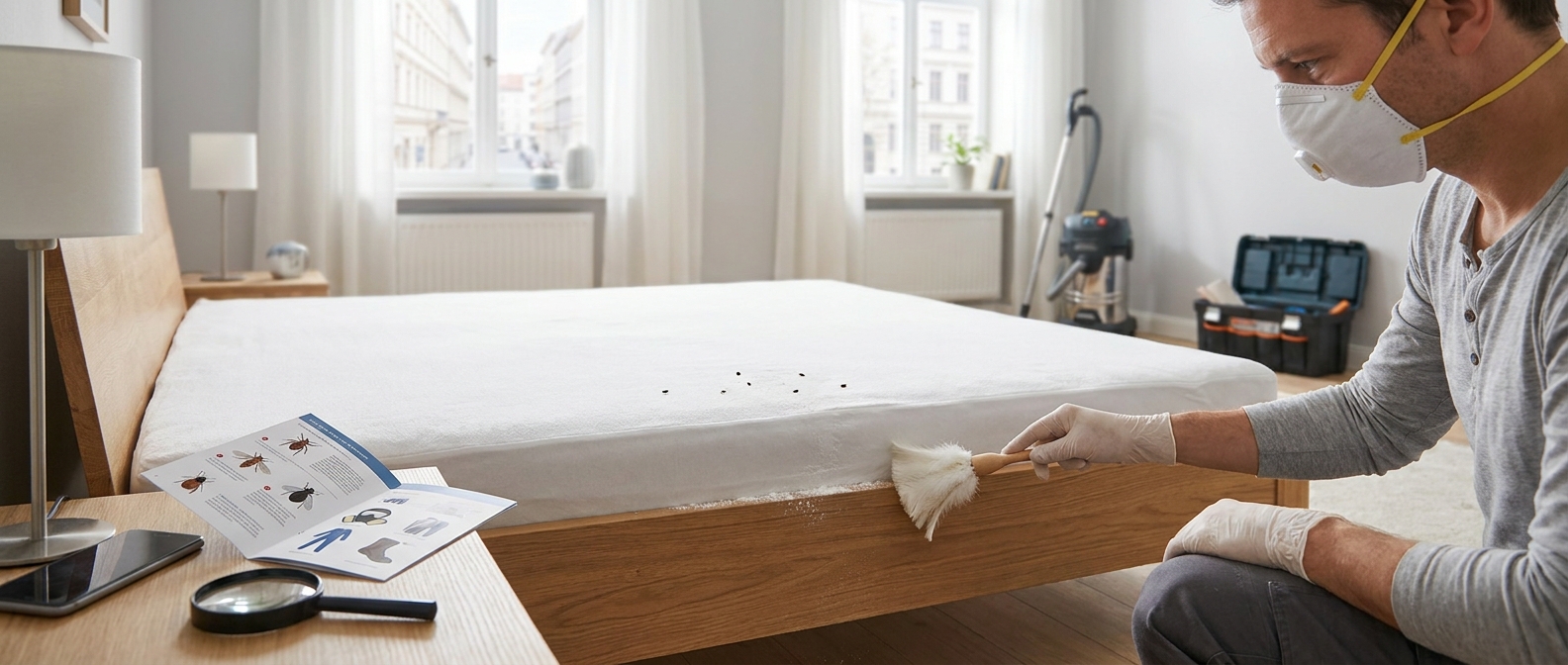
Unlike a chemical insecticide, which poisons the insect, diatomaceous earth works by mechanical action. When a bug walks through the powder, the abrasive particles pierce its waxy exoskeleton and absorb the layer of oil that protects it from dehydration. As a result, the insect loses all its water and dies within a few days. This is a mechanical insecticide, not chemical. This distinction changes everything, because a bedbug cannot develop resistance to a physical mechanism. It can avoid poison, but it cannot avoid dehydration.
Does diatomaceous earth kill bed bugs? Yes, without a doubt. But there’s one condition: the bed bug has to walk on it. If it avoids the treated area, nothing happens. We’ll come back to this later.
Now, the topic we'd rather not talk about. Diatomaceous earth is composed of more than 80 % of silicon dioxide. To be effective as an insecticide, it must be amorphous (uncalcined), and is therefore less hazardous than industrial crystalline silica. But «less hazardous» does not mean harmless. The inhalation hazard is very real, and that's the point that most salespeople brush aside.
When you sprinkle this powder, ultrafine particles become suspended in the air. You breathe them in without even noticing. In the short term, this irritates the throat, nose, and lungs. With repeated exposure, the silica inhalation hazard becomes a real issue for your lung health, especially if you have asthma, young children, or pets that spend most of their time close to the floor.
Our golden rule: Never handle this powder without an FFP2 mask and with the windows open. Never. And we absolutely avoid «decorative» versions or garden center jars where we don’t know the exact composition. To treat bed bugs, we choose food-grade diatomaceous earth or a product specifically sold as bed bug powder—period.
Strategic Application Guide: How to Safely Treat Your Room
A mistake I see all the time: people sprinkle handfuls of powder everywhere, as if they were salting french fries. Bad idea. The thicker the layer, the less effective it is. Why? Because a bug will go around a visible pile of powder, whereas it will walk right through an invisible film without even noticing. The’proper application is based on a single rule: a thin film, almost imperceptible to the eye.
First and foremost, prepare the area. Carefully vacuum the entire room, wash the bedding at a minimum of 60 °C, and steam-clean the mattress if you have a steam cleaner. Diatomaceous earth isn’t a magic wand: it complements a strategy, it doesn’t replace it. For the sprinkling, use a bulb applicator or a brush. This helps you apply an even, thin layer. Focus on the strategic areas, that is, the places where bed bugs move around and hide:
-
A Tour of the mattress, the seams, the piping, and the bed frame
-
Visit baseboards and the gaps between the floor and the wall
-
The bed legs, the frame, and the headboard
-
Behind the electrical outlets and the pictures hanging near the bed
-
Cracks in the hardwood floor or planks that are coming loose
For the’mattress application, many people wonder: Can I sprinkle diatomaceous earth directly on my mattress? Yes, but use it wisely. Lightly sprinkle it along the seams and around the edges—never on the surface where you rest your head. And most importantly, once you’ve applied the powder to the seams, protect the entire mattress with a bed bug-proof cover.
This brings us to THE question: Is it safe to sleep with diatomaceous earth in the room? Can you sleep in your bed after treatment? Technically, yes—as long as the powder is confined to the corners and not on surfaces you come into contact with. Sleeping with diatomaceous earth isn’t dangerous as long as you aren’t breathing it in continuously. But honestly, if you’ve sprinkled it on the mattress that same day, I’d prefer that you sleep somewhere else for a night or two, until the dust settles and you can vacuum it up from the exposed areas.
One last point: patience. Diatomaceous earth works slowly; allow at least two to three weeks before you see any results. Leave it in place; don’t clean it all up after just two days. Reapply it if it clumps together or if moisture has caused it to settle, because damp powder won’t be effective at all.
Real-World Effectiveness: When Is Diatomaceous Earth Insufficient Against an Infestation?
Let's be clear: diatomaceous earth has its limitations, and ignoring them will cost you time, money, and many sleepless nights. All the rave reviews you read online refer to specific cases: infestations detected early, limited to a single room, with only a few insects. In those situations, yes, it works very well.
The problem is that bed bugs are rarely detected early on. By the time you see bites, the infestation has already been going on for several weeks. And by then, the treatment limitations Insects exposed to the powder appear quickly. Diatomaceous earth only kills insects that come into contact with it. It has no effect on the eggs, which are protected by their shells. A female lays up to 5 eggs per day. Do the math: while the powder eliminates a few adults, dozens of nymphs are hatching in hiding spots you haven’t even noticed.
When do we talk about’major infestation ? There are a few telltale signs. You find bed bugs in several rooms. You spot black spots (their droppings) on the wall or the mattress. You smell a sickeningly sweet odor. You’re getting bitten every night despite the treatment. If you check off two of these boxes, diatomaceous earth alone won’t do the trick. Ever.
A quick clarification on a persistent myth: people often confuse diatomaceous earth with Sommières earth. Sommières earth is useless against bed bugs—it’s a stain remover for fabrics. Don’t waste your time with it.
And the famous resistance ? Good news: bed bugs do not develop resistance to the mechanical action of the powder. However, they have become largely resistant to conventional chemical insecticides, which explains why supermarket sprays almost always fail. That’s also why a true professional never relies on just one product: they combine heat treatment, steam, and sometimes mechanical insecticides, depending on the area.
In Brussels, as soon as an infestation goes beyond the early stages, call a professional exterminator It’s not a luxury—it’s what keeps you from having to start all over again in six months. At Punaisesdelitbruxelles, we assess the true extent of the infestation before making any recommendations. Sometimes we confirm that a natural treatment is sufficient. Often, we find that the infestation has already spread into the walls and that heat treatment is necessary. Transparency comes first, even when it doesn’t help close the sale.
Conclusion
Diatomaceous earth is a good tool—when used properly and within its limits. For an early-stage infestation, when applied properly in a thin layer to strategic areas—with a mask and a little patience—it can help you get rid of bed bugs without using chemicals. It’s a truly natural treatment for bed bugs, provided you follow safety precautions, especially regarding inhalation.
But don’t rely on the powder if signs of a major infestation are piling up. Every week that goes by means dozens of eggs hatching. If you live in Brussels and are unsure about the extent of the problem, contact Punaisesdelitbruxelles for a clear diagnosis. They’ll tell you straight up whether you can handle it on your own or if you need to step up your game. No sales pitch—just an honest assessment of your situation.
Frequently asked questions
Does diatomaceous earth really kill bed bugs?
Yes, diatomaceous earth is an excellent mechanical insecticide. Made up of fossilized microscopic algae, it acts like tiny shards of glass that pierce the exoskeletons of bed bugs when they walk on it, causing them to dehydrate and die within a few days. Unlike chemical products, bed bugs cannot develop any resistance to this physical action.
What are the health risks associated with diatomaceous earth?
Although it is natural, diatomaceous earth poses a real risk if inhaled. Its ultrafine particles remain suspended in the air and can severely irritate the respiratory tract, lungs, and throat. Its use is particularly discouraged in the presence of people with asthma, young children, or pets. Always wear an FFP2 mask when applying it.
Can you sleep in your bed after applying diatomaceous earth?
It is safe to sleep in the room as long as the powder has been applied strategically and confined (to baseboards, cracks, and mattress seams) and never on surfaces that come into direct contact with your skin or near your head. To be on the safe side, if you’ve just treated your mattress, we recommend sleeping elsewhere for 24 to 48 hours, until the dust settles, and covering the mattress with a waterproof bed bug-proof cover.
What is the difference between diatomaceous earth and Sommières earth?
These two natural powders are often confused, but Sommières clay is completely ineffective against bed bugs. It is a highly absorbent clay used exclusively as a stain remover for fabrics and carpets. To combat these pests, only diatomaceous earth (amorphous/food-grade) possesses the necessary abrasive properties.
When does diatomaceous earth become ineffective against an infestation?
Diatomaceous earth reaches its limits as soon as the infestation becomes severe. It has no effect on eggs and kills only the insects that come into direct contact with it. If you’re getting bitten every night, if you see spots of feces on the walls, or if bed bugs are present in multiple rooms, the powder won’t be enough.
What should you do if the natural diatomaceous earth treatment fails in Brussels?
If the infestation persists after two to three weeks, it is essential to change your strategy to prevent the bed bugs from spreading throughout your home. In Brussels, the experts at Punaisesdelitbruxelles offer an honest and transparent assessment to permanently eradicate the problem, primarily through thermal treatments (using heat or steam) combined with appropriate professional methods.

 French
  English
  Dutch
Dutch