


Moving checklist: anti-bedbug guide
Contents
-
Administrative checklist vs. health prevention: choosing the right priorities
-
Criteria for choosing cardboard boxes: the advantages of new cardboard against bedbugs
-
Pre-departure recommendations: check every area to make sure you haven't forgotten anything
You've found your new home in Brussels, signed the lease and reserved the truck. On the administrative side, you're square. But have you thought about what might slip into your boxes uninvited? Bed bugs travel. They love to travel. And a move, for them, is a first-class ticket to a new territory.
Things to remember
-
Supplement the traditional logistics checklist with a strict sanitary protocol to avoid transferring bed bugs
-
The article guides the user from packing to inspecting the new home, offering reassuring and protective local expertise.
-
Choosing your priorities
-
The benefits of new bedbug-proofing
At Punaisesdelitbruxelles, we see families every year who discover an infestation a few weeks after moving in. The scenario is almost always the same: uninspected furniture, boxes picked up somewhere, a mattress transported without protection. The problem is that most of the moving checklists available online focus on administrative procedures and logistics. The health aspect? Absent. This article fills the gap.
We're going to take you step-by-step through the preparation of your move, from the creation of your moving list to the inspection of your new home, integrating into each phase a concrete protocol for moving without bedbugs. No panic, no unnecessary jargon: just what you need to know to ensure your move goes smoothly.
Administrative checklist vs. health prevention: choosing the right priorities
If you type «moving checklist» into Google, you'll come across dozens of guides on changing addresses, terminating contracts and transferring mail. It's useful, of course. Nobody wants to receive their bills at their previous tenant's place for six months. But these lists miss an issue that can ruin your move: pests.
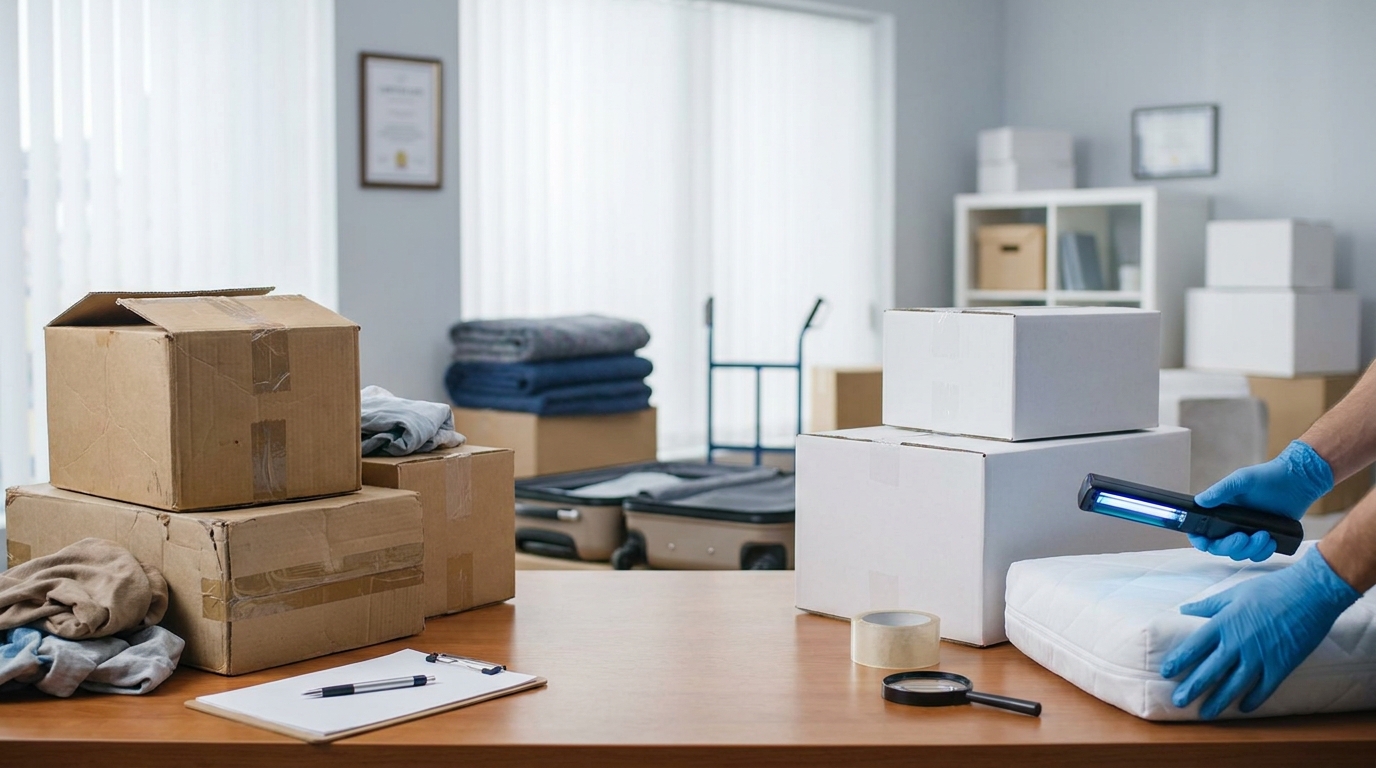
Let's take a concrete example. You've ticked all the boxes for your administrative formalities: you've notified your mutual insurance company, your employer has been informed, the Brussels commune has been notified of your new address, and you've contacted your energy supplier. Perfect. Three weeks later, you wake up with bites lining your arms. Bedbugs. They were in the box spring you moved without checking, or in the second-hand boxes you picked up on the sidewalk. All your administrative organization didn't protect you from them.
The real problem is prioritizing. We spend hours comparing movers« quotes, planning the change of address (change of address checklist included) and sorting our belongings. What about sanitary arrangements? We forget about it because we don't think about it. Or because we tell ourselves that »it only happens to other people". In Brussels, reports of bedbugs have climbed steadily in recent years. It doesn't just happen to other people.
Here's what I recommend: include prevention directly in your moving to-do list. Not as an appendix, not as an option. On the same level as «cancel internet» or «notify the crèche». In concrete terms, this means adding three categories to your list:
-
Inspection of former home Check mattresses, box springs, baseboards and electrical outlets before packing anything.
-
Packaging selection and preparation For example, use new cardboard boxes and pack linen in airtight bags.
-
New home inspection The most important thing you can do is: go through each room with a fine-tooth comb before moving in.
These three points don't take days. A few hours are enough. But they change everything. We're talking about a ridiculous investment of time compared to the cost of a professional bedbug treatment (easily 400 to 600 euros for a Brussels apartment, sometimes more depending on surface area).
Organizing a move isn't just about ticking administrative boxes. It's also about protecting your future home. And to do that, you have to accept that the classic moving checklist is incomplete. Add the health aspect, and you're off to a good start.
One last point on administrative procedures: when you change your address, take the opportunity to ask the previous tenant or landlord if the property has ever had a pest problem. The question may come as a surprise, but it's a legitimate one. And if the answer is vague, it's a signal. We'll come back to this in the last section.
Criteria for choosing cardboard boxes: the advantages of new cardboard against bedbugs
A box is a box. Is it? Not when it comes to bedbugs. Choosing your moving boxes is probably the simplest and most underestimated act of prevention.
The temptation to pick up free boxes is strong. Supermarkets, neighbors, classified ads: it's easy to find second-hand boxes in Brussels. Moving budgets are often tight, and saving 50 or 80 euros on packing counts. That's understandable. But these boxes have a history. They've been in cellars, attics, warehouses, apartments you know nothing about. An adult bedbug can survive for several months without feeding. A single fertilized female in a fold of cardboard, and that's the start of an infestation in your home.
New cardboard eliminates this risk. They come straight from the factory, and have never been in contact with a domestic environment. The extra cost? Between 2 and 4 euros per box from supermarkets or specialist suppliers. For a standard move (30 to 50 boxes), we're talking about 60 to 200 euros. Put that against the cost of professional disinfestation, and you've got a quick calculation.
In addition to the cardboard itself, the packaging method is also very important:
-
Textiles and household linen Wash at 60°C minimum before packing. Bedbugs and their eggs cannot withstand this temperature. Then place the clean linen in thick, hermetically sealed garbage bags, then in the cardboard box. Double barrier.
-
Recently worn clothes Same protocol. Do not dispose of them loose in an open bag.
-
Books and storage items Inspect bindings and gaps. Bedbugs love to hide in narrow, dark spaces. A book on an infested bedside table may be harboring eggs.
-
Mattresses and pillows Invest in certified anti-flea covers. They start at 25 euros for a double mattress. They encapsulate the mattress completely, preventing insects from entering or leaving.
A reflex that few people have: taping up boxes immediately after filling them. Not «I'll close that tomorrow». Immediately. An open box in a corridor at night is an invitation. Bedbugs are nocturnal and move easily over a few meters.
Budget question: does all this add to the bill? Yes, a little. We add around 100 to 250 euros to the total (new boxes, covers, airtight bags). But think in terms of overall cost. A bedbug treatment means money, stress, rotten nights and sometimes the need to throw out furniture. Not to mention wasted time. Preventive packing is the cheapest insurance you'll ever take out.
And if your moving budget is really limited? As a minimum, opt for new boxes for the bedroom: bedding, clothes, nightwear. This is the critical area. Bedbugs live close to their food source, which is you, while you sleep. Protecting this area as a priority goes a long way.
Pre-departure recommendations: check every area to make sure you haven't forgotten anything
72 hours before the big day. Your boxes are packed, your list of things to bring is almost complete. There's still one step that most people skip: the systematic inspection of both the old and the new home.
Let's start with the old. Even if you've never had a visible problem, a thorough inspection of the furniture is essential. Bed bugs can go undetected for weeks or even months, especially in the case of light infestations. Here's how to proceed, room by room:
-
Bedroom Remove the sheets. Examine the mattress seams, especially the four corners. Look under the box spring, in the slats, screws and fasteners. Look for small black dots (droppings) or brownish spots. Inspect the headboard, front and back.
-
Salon sofa, armchairs, cushions. Lift up the seats, look in the folds of fabric, the seams, the zippers. If you have a sofa bed, unfold it completely.
-
Storage and baseboards Empty nightstands and dressers close to the bed. Run a flashlight along baseboards, around electrical outlets, behind picture frames hanging on the wall.
-
Luggage and suitcases If you're using suitcases for moving, inspect them. Inside seams, pockets, wheels. Traveling suitcases are a classic vector.
Find something suspicious? Don't pack anything more. Contact a professional for a diagnosis. At Punaisesdelitbruxelles, we can intervene quickly to confirm or deny an infestation before your moving date. It's better to delay a few days than to contaminate a new home.
Let's move on to the new home. Ideally, you should get there before you bring your things. Even half a day is enough. Do the same type of inspection: baseboards, sockets, cupboards, bathroom (yes, bedbugs can hide there too, contrary to popular belief). If the dwelling is empty, it's easier. If there are still elements of the previous occupant (curtains, carpets, recessed light fittings), be doubly careful.
Cleaning your home before moving in has a double meaning. It's not just a question of cleanliness: it's a safety measure. Vacuum every nook and cranny, paying particular attention to wall/floor junctions. Empty the vacuum bag into a closed garbage bag outside. Steam-wash floors if you can (heat kills bedbugs at all stages).
A point often overlooked in the list of things to remember when moving: document your inspection. Take photos of the areas checked, and note the date. If a problem arises after you've moved in, this evidence will come in handy, whether you need to lodge a complaint with the landlord or refer the matter to a professional.
For a worry-free move, a thorough inspection is just as important as the quality of your movers. You can have the best truck in the world: if you're transporting bedbugs with your furniture, everything else doesn't matter. Inspection is your last line of defense. Take it seriously.
Conclusion
A complete moving checklist in 2026 is no longer just a matter of paperwork and neatly stacked boxes. It's also a sanitary protocol. Three essential gestures: inspect before packing, choose new, airtight packaging, check the new home before placing any furniture in it.
It doesn't complicate your move. It makes it safer. And if you have the slightest doubt, before or after your move to Brussels, the Punaisesdelitbruxelles team is there to help you. One call, one diagnosis, one solution. Move with peace of mind.
Frequently asked questions
Is it risky to use recycled cardboard boxes for a move?
Yes, collecting second-hand boxes (from the street, supermarkets, neighbors) is a major vector of infestation. Bed bugs can survive for several months without eating in the folds of cardboard; choosing new cardboard is the most profitable investment to protect your future home.
How do you prepare your clothes and linen for a stress-free move?
The ideal protocol is to wash all your textiles at 60°C minimum, then immediately enclose them in airtight plastic bags before packing them in cardboard boxes. This double thermal and physical barrier ensures that no insects or eggs survive the transfer to your new address.
What are the priority areas to inspect in a new home?
Before unpacking, use a flashlight to check baseboards, electrical outlets and closet junctions in every room, especially bedrooms. If the previous tenant left curtains or light fittings behind, inspect the seams and fastenings, as these are ideal hiding places for bedbugs.
Why is a pre-departure inspection crucial?
Even without visible bites, a light infestation can go undetected in the nooks and crannies of a box spring or headboard. Detecting their presence before loading the truck allows you to treat your furniture and avoid contaminating your new home and the movers' vehicle.
Is a bedbug-proof mattress cover really effective during transport?
Yes, a certified cover acts like a shield, encapsulating the mattress completely and preventing bedbugs from getting in or out. It's an essential accessory for securing your most critical piece of furniture throughout the moving and storage process.

 French
  English
  Dutch
Dutch