

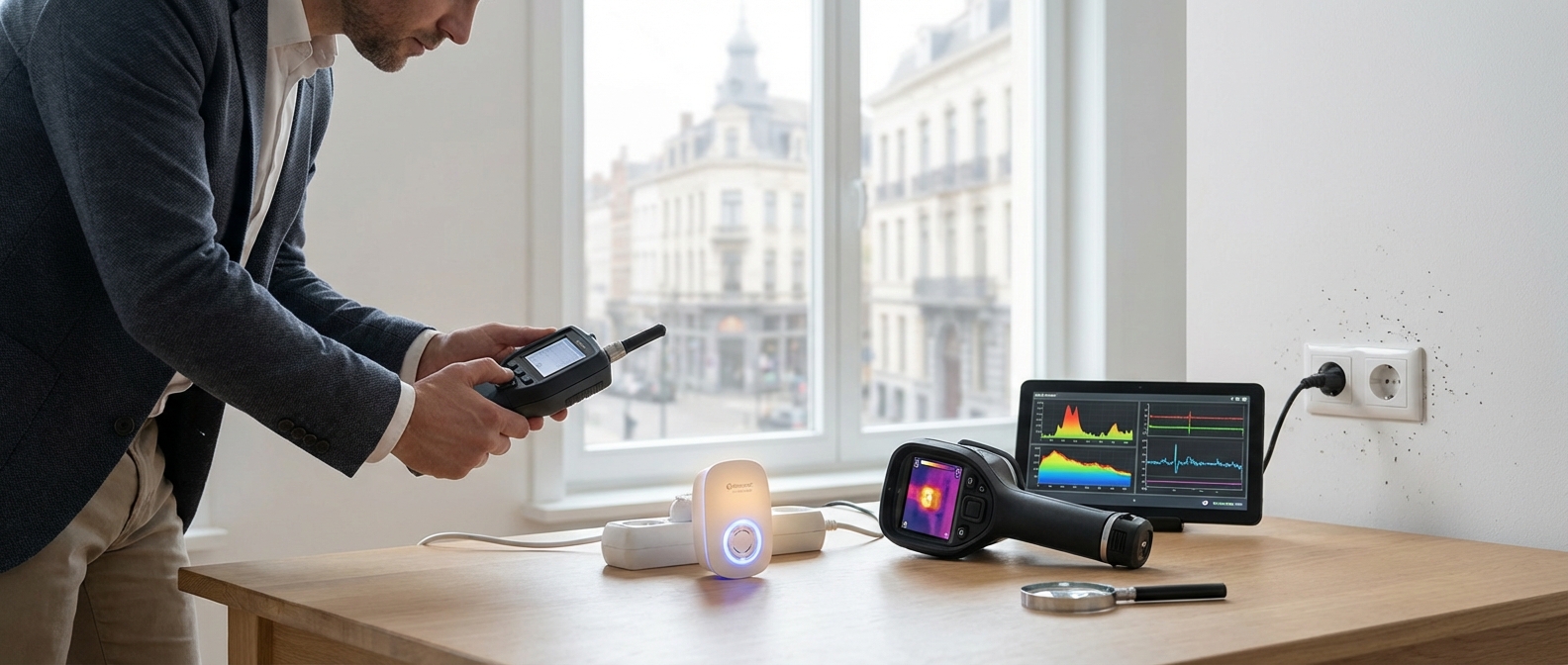
Bed bugs behind a socket: detection, risks and solutions
Contents
-
Bed bugs behind electrical sockets: analysis of an ideal hiding place
-
Ultrasonic anti-flea plugs vs. active detectors: the match of efficiency
-
Selection criteria and recommendations before buying a device for your holds
You turned your mattress over, inspected the seams, ran a flashlight along the headboard. Nothing. And yet, the bites continue every night. There's one place 90% people forget to check: electrical outlets. Yes, those little boxes embedded in your walls, just a few centimetres from the floor, are perfect havens for bed bugs.
Things to remember
-
This article explains why sockets are strategic hiding places and propagation vectors.
-
We compare the actual effectiveness of market gadgets (ultrasound) against professional detectors, while providing a safe inspection protocol adapted to the urban context of Brussels.
-
Analysis of an ideal hiding place
-
Compare the different options before deciding.
In Brussels, we regularly intervene in apartments where the infestation seemed «impossible to locate». The owner had cleaned up and sometimes even thrown away his bed. When we unscrewed the plug plate, we found the colony: adults, nymphs, eggs, droppings. Everything was there, well hidden, protected from light and surface treatments.
This article will explain why bedbugs hide behind plugs, how to inspect without risk, and above all what the gadgets sold online are really worth (spoiler: ultrasonic plugs are a load of rubbish). We're talking real, in the field.
Bed bugs behind electrical sockets: analysis of an ideal hiding place
Three conditions make a bedbug happy when it's looking for a place to nest: darkness, warmth and proximity to its food source (you, while you sleep). An electrical outlet ticks all three boxes. The recessed box creates a dark cavity between the wall and the cover plate. The cables running behind it give off a slight heat. And the bedroom socket is often less than a metre from the bed.
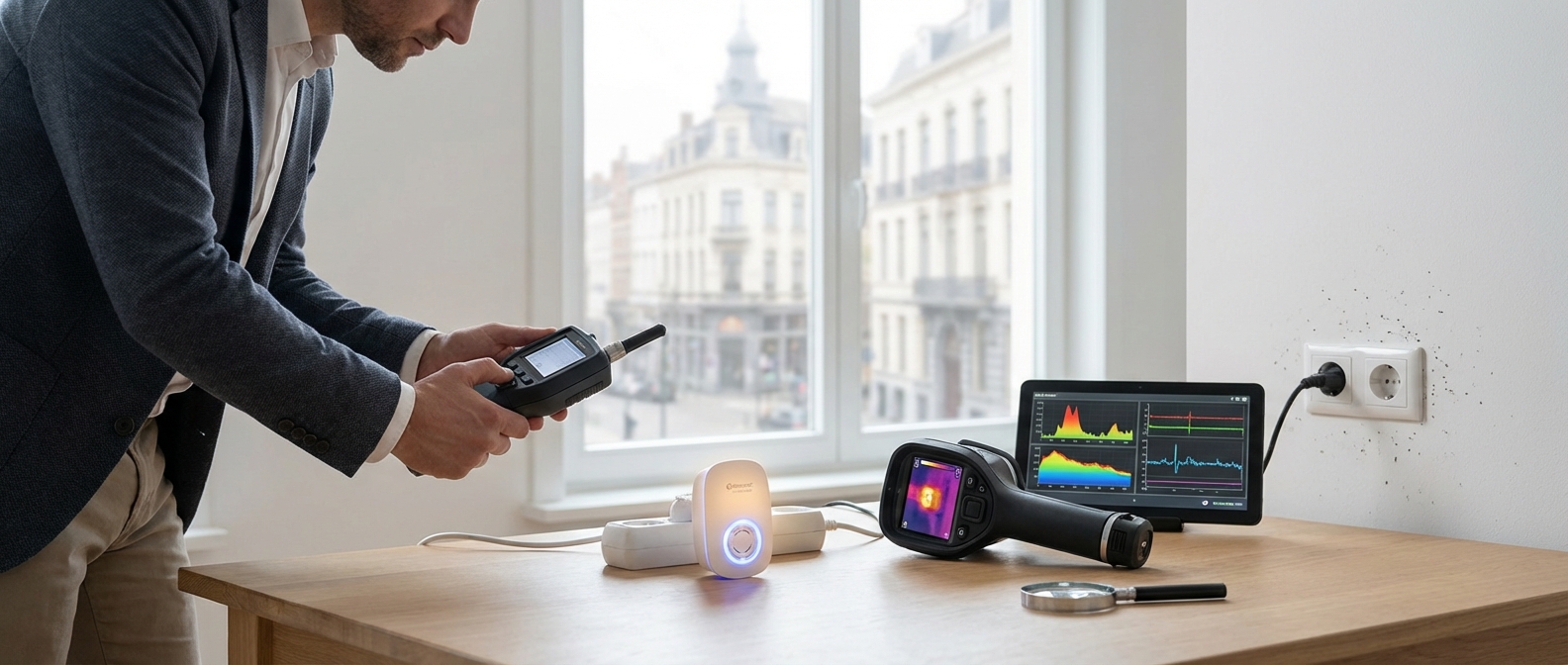
What makes this hiding place so formidable is that it's invisible. You can vacuum every day, wash your sheets at 60°C, encapsulate your mattress: if the colony is installed in the socket, it remains intact. Bedbugs come out at night, feed, then return to their hiding place before daybreak.
One thing many people don't know: bedbugs can actually lay their eggs in electrical outlets. The eggs are tiny, around 1 mm in size, pearly white and stuck in clusters to the inside walls of the socket. A female lays between 5 and 15 eggs a day. Within two weeks, a single socket can harbor dozens of bedbug eggs, ready to hatch.
Nesting in electrical installations poses another major problem: propagation between dwellings. In buildings in Brussels, electrical conduits run through common walls. Bedbugs use these passages like freeways. We've seen cases where a treated apartment reinfected itself within three weeks, because the insects were passing through the sockets from the neighboring dwelling. This is a classic scenario in dense neighborhoods like Ixelles, Saint-Gilles or Schaerbeek.
How to check? First of all, turn off the room's circuit breaker. This is non-negotiable. Next, unscrew the socket plate with a suitable screwdriver. Use a flashlight and look inside the casing. What you're looking for: small black spots (droppings), rusty-brown traces (digested blood), translucent molts, and of course the insects themselves. Adults are about 5 mm long, flat, oval and reddish-brown. Nymphs are smaller and lighter.
If you find signs in one outlet, check all the other outlets in the room, and the switches too. And consider that the infestation is probably more extensive than what you see. A bedbug behind an outlet is rarely an isolated bug.
Ultrasonic anti-flea plugs vs. active detectors: the match of efficiency
Type «anti-bedbug plug» into Google and you'll come across dozens of ultrasonic boxes selling for between 15 and 40 euros. The principle: you plug the device into an electrical socket, and it emits high-frequency sound waves designed to repel pests. Bedbugs, cockroaches, mice, you name it. The packaging is reassuring, and reviews seem positive. The problem is, it doesn't work.
Several scientific studies have tested ultrasonic devices against bedbugs. The results are clear: no measurable effect on insect behavior. No repulsion, no disruption of reproduction, no mortality. In fact, the Federal Trade Commission in the United States has penalized manufacturers for false advertising. Bedbugs are simply not sensitive to ultrasound in the frequency ranges emitted by these devices.
When a customer tells me «I bought an ultrasonic bedbug plug on Amazon», I already know that the infestation has had time to progress during the weeks he thought he was protected. That's the real danger of these gadgets: they give a false sense of security. Meanwhile, the colony grows.
Active detectors, on the other hand, deserve a closer look. There are several types. Passive traps (footboard interceptors) do not directly concern sockets, but they are still useful for confirming infestation. For specific detection in sockets and nooks, CO2 or heat detectors are more relevant: they simulate the presence of a host to lure bedbugs out of their hiding place.
A quick comparison. On the one hand, an ultrasonic device that does nothing. On the other, detection tools that confirm or deny the presence of bedbugs. Not the same products, not the same objective, not the same effectiveness. A plug-in bedbug detector doesn't really exist as a reliable product for the general public. What do exist are inspection protocols, whether manual or assisted by a professional.
The most reliable method is still dog detection. A trained dog detects live bedbugs and eggs with a reliability rate of over 95%. In Brussels, several exterminators offer this service. In 20 minutes, the dog has scanned the entire apartment, including sockets. No electronic gadget can match that.
Selection criteria and recommendations before buying a device for your holds
Before pulling out your bank card, ask yourself a simple question: what do I want to achieve? Detect bedbugs? Prevent them from entering my sockets? Eliminate them? The answer completely changes the type of product or service you need.
For detection, forget consumer electronics. What works: methodical visual inspection (with the electrical precautions I described above), interceptor traps at the foot of the bed, and professional canine detection. If you suspect an infestation in your electrical outlets, call in an exterminator in Brussels who will be able to inspect them properly without the risk of short-circuiting or dispersing the insects.
When it comes to prevention, there are practical measures that work. Installing airtight socket covers on unused outlets is basic but effective: it eliminates a point of entry. Applying diatomaceous earth around baseboards and electrical boxes creates a mechanical barrier. Bedbugs that pass through this powder dehydrate and die within 24 to 48 hours. This is a real preventive solution against infestation, not a marketing gimmick.
If you live in a condominium, prevention also means coordinating with your neighbors. Treating a single apartment when bedbugs are circulating through the electrical ducts is like draining the water from a boat without plugging the hole. Talk to your building manager. In Brussels, the Region offers resources and sometimes support for affected buildings.
When it comes to buying bedbug repellent online, here are my concrete tips:
-
Avoid any product that promises to «repel» bedbugs with ultrasound, electromagnetic waves or UV light. Zero proof of effectiveness.
-
Insecticide sprays in sockets: no. Risk of fire, risk of poisoning, and bedbugs develop resistance to common pyrethroids.
-
Anti-fly covers for mattresses and box springs are still a good investment (between 30 and 80 euros). They don't solve the problem of plugs, but they do remove the main hiding place.
-
Food-grade diatomaceous earth costs less than 15 euros per kilo. Unbeatable value for money for a complementary treatment.
One piece of expert advice I always give my customers: don't look for a miracle product. They don't exist. A bedbug in an electrical socket is the sign of an established infestation that requires professional treatment, either thermal or chemical, by someone who knows the insect's biology and the configuration of Brussels' housing. Investing 30 euros in a useless gadget means 30 euros less on the budget for a real treatment.
What attracts bed bugs in the first place? Your body heat and the CO2 you exhale. Not dirt, not mess. A spotless apartment can be infested. And how does the first bedbug arrive? Through luggage, second-hand furniture, clothing or visitors. A single fertilized female is enough to launch a colony. That's why vigilance and regular inspection of outlets (especially in bedrooms) are among the reflexes you need to adopt, especially if you live in the city.
Conclusion
Electrical outlets are perfect hiding places for bed bugs, and most people never think to check them. If you have unexplained bites and your bedding looks clean, unscrew your socket plates (circuit breaker off). You may be in for an unpleasant surprise.
Ultrasonic devices are worthless against these insects. Save your money for a professional diagnosis. In Brussels, don't hesitate to contact us for a complete inspection of your home, including sockets. The earlier we intervene, the simpler, faster and less costly the treatment. Every week you wait means another generation of bedbugs.
Frequently asked questions
Is it possible for bedbugs to hide in electrical outlets?
Yes, sockets are ideal hiding places, offering darkness, cable warmth and proximity to the bed. They also serve as 'highways» to get from one apartment to another via the technical ducts, especially in Brussels buildings.
How to inspect an electrical socket without risking electrocution?
It is imperative to turn off the main circuit breaker before handling. Then unscrew the cover plate and use a flashlight to look for black droppings, 1 mm white eggs or translucent moults.
Are ultrasonic bedbug repellents really effective?
No, scientific studies prove that ultrasound has no repulsive or lethal effect on bedbugs. These gadgets give a false sense of security, allowing the infestation to spread freely for several weeks.
How can I prevent bedbugs from getting into my neighbors' outlets?
Applying diatomaceous earth to the inside of enclosures (excluding electrical contacts) creates a deadly physical barrier for the insect. Installing airtight socket covers can also limit direct entry points into your bedroom.

 French
  English
  Dutch
Dutch