

All you need to know about liquid nitrogen treatment for bedbugs
Contents
Minus 196 degrees Celsius. That's the temperature at which liquid nitrogen instantly freezes all living organisms. When we talk about cold treatment for bedbugs, we're not talking about opening windows in January or putting your sheets in the freezer. We're talking about a cryogenic process capable of destroying adults, larvae and eggs in a matter of seconds. Not in days, not in several passes: in seconds.
Things to remember
-
Explaining the science of cryonics at -196°C while humanizing the procedure
-
We show how liquid nitrogen outperforms CO2 and chemicals for total and immediate eradication in Brussels
-
The technical operation of liquid nitrogen treatment
-
Why choose liquid nitrogen over insecticides?
In Brussels, more and more homeowners and tenants are discovering this method. And with good reason: it leaves no chemical residue, can be used on all surfaces (mattresses, parquet flooring, baseboards, electrical sockets) and gives immediate results. If you're looking to find out how it works, why it's more effective than conventional insecticides and what a real intervention looks like, you've come to the right place.
We'll break down the science behind the process, make an honest comparison between liquid nitrogen and other solutions on the market, and show you what happens when our team comes to your home.
The technical operation of liquid nitrogen treatment
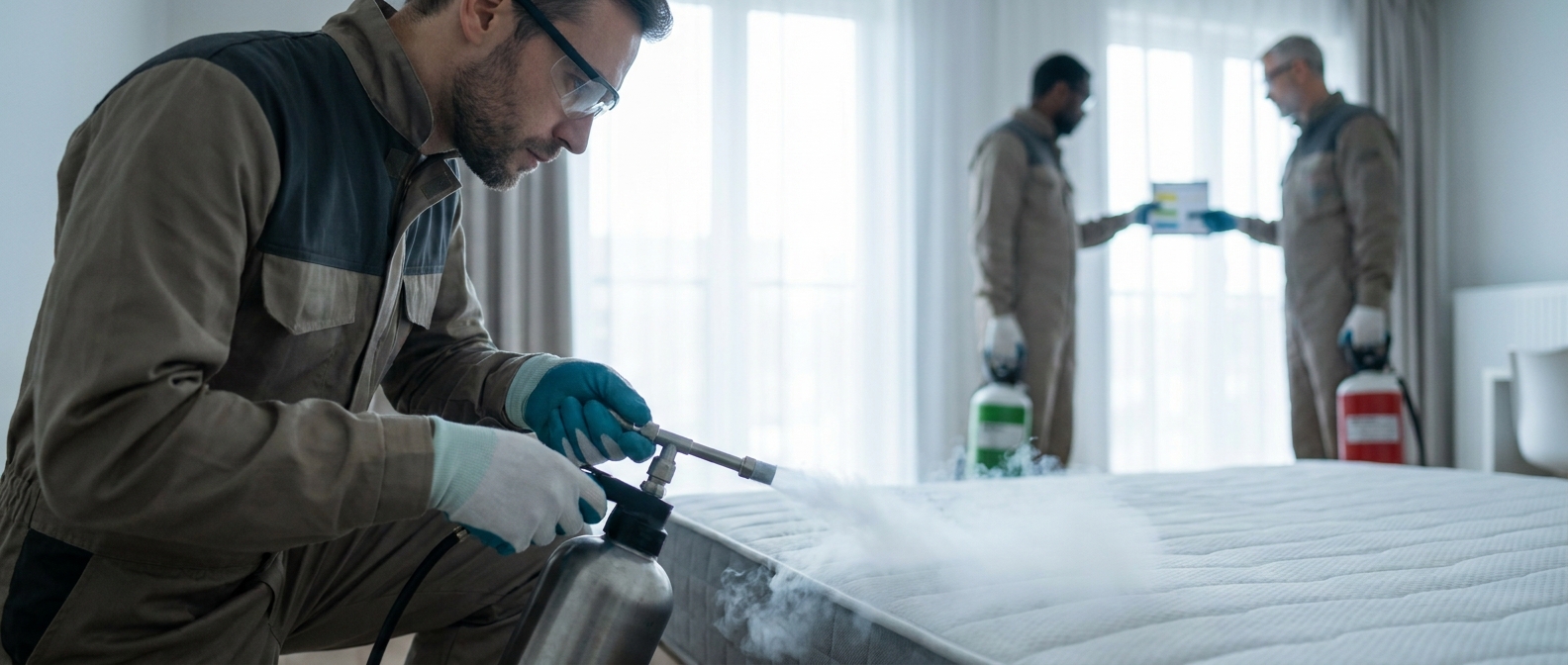
To understand why cryonics is so radical, we need to go back to a fairly simple principle of physics. Liquid nitrogen, stored at -196°C, is sprayed directly onto infested areas using a precision nozzle. On contact with the surface, it provokes an extremely violent thermal shock. The cells of bedbugs, their larvae and eggs literally burst. The water in their tissues crystallizes in a fraction of a second, and the cell membrane ruptures. Instant death, with no possibility of survival.
This extreme cold has nothing to do with a domestic freezer. A freezer goes down to -18°C, sometimes -24°C for the best models. At this temperature, an adult bedbug can survive for several hours, or even days if it has time to acclimatize. Eggs, on the other hand, are even more resistant: their protective envelope partially insulates them from the progressive cold. With liquid nitrogen at -196°C, acclimatization is not possible. The temperature differential is so brutal that thermal shock leaves no chance, whatever the insect's stage of development.
An important technical point: nitrogen is an inert gas. It makes up 78% of the air we breathe. When it evaporates after spraying, it simply reverts to atmospheric gas. No residue, no toxicity, no odor. It's a detail that makes all the difference when you're working in a bedroom or nursery.
Spraying is carried out using specialized equipment that controls the flow rate and direction. The professional exterminator can target mattress seams, box spring grooves, wood floor gaps, electrical outlets, bed frames - in short, all the nooks and crannies where bedbugs love to hide. And they're good at hiding: they can sometimes be found behind peeling wallpaper, in furniture hinges or inside electrical boxes.
Cryonics also acts on biofilms and traces of excrement. The extreme cold sanitizes surfaces in depth, which is a considerable bonus for people allergic to bedbug droppings (a more common problem than you might think).
Some people confuse liquid nitrogen with dry ice (solid CO2). There's a major difference. Dry ice reaches around -78°C. That's cold, yes, but not cold enough to guarantee the systematic destruction of eggs. Entomological studies show that at -78°C, some eggs may survive if exposure is too brief or if the layer of dry ice is not thick enough. At -196°C, the debate is over. Liquid nitrogen leaves no margin for error, and that's exactly what you want when treating a bedbug infestation.
Why choose liquid nitrogen over insecticides?
What's the most effective product against bedbugs? That's the question we're asked most often. The answer may surprise you: it's not a product. Insecticides, even the most powerful ones, come up against a major problem. Bedbugs develop genetic resistance to chemical molecules. Pyrethroids, which were the benchmark ten years ago, have become virtually ineffective on certain strains encountered in Brussels. We spray, we wait, we come back three weeks later: they're still there. Sometimes even more numerous.
With liquid nitrogen treatment, the question of resistance simply doesn't arise. No living organism can withstand -196°C. No genetic mutation can withstand the instant crystallization of body fluids. This is physics, not chemistry. And it's physics that bedbugs can't adapt to.
The other decisive advantage is egg eradication. Bedbug eggs are every exterminator's nightmare. They're one millimetre long, translucent, stuck to surfaces with a kind of biological cement, and most insecticides won't penetrate them. That's why chemical treatments generally recommend two or even three passes: you have to wait for the eggs to hatch before you can kill the new larvae. With cryonics, a single pass is all that's needed. The cold penetrates the egg shell and destroys the embryo inside.
When it comes to health, the difference is clear. Conventional chemical treatment involves spraying biocides into your home. You are asked to leave the premises for several hours, sometimes a whole day. You have to ventilate for a long time, and not let children or pets touch the treated surfaces for some time. With an ecological treatment using liquid nitrogen: none of this. The nitrogen evaporates, reverts to harmless gas, and you can return to your home immediately after the treatment. No chemicals on your mattress, no residues on your sheets, no risk to your pets.
We sometimes hear that heat treatment (dry steam at 180°C) is an equivalent alternative. It's true that heat works well, but it has its limits. Steam rapidly loses temperature as soon as it penetrates a deep interstice or thick material. Liquid nitrogen, on the other hand, maintains its destructive capacity even in the most inaccessible nooks and crannies, because the cold spreads by conduction through the surrounding materials.
When it comes to eco-friendly insect control, liquid nitrogen ticks all the boxes: zero chemicals, zero toxic waste, zero impact on the indoor environment. For people with asthma, allergies or chemical sensitivities, it's often the only option. And even without a particular health problem, who wants to sleep on an insecticide-soaked mattress?
The procedure for a cryonics operation in Brussels
So how do professionals treat bedbugs using cryonics? Here's what happens when you call on Punaisesdelitbruxelles.
It all starts with a call or message. We ask you a few questions to assess the situation: how long you've noticed the bites, in which rooms, whether you've already tried any treatment. This initial exchange enables us to calibrate the intervention. An infestation detected early (a few weeks) does not require the same work as one that has been established for six months in several rooms.
Before we come, we send you a list of things to do to prepare your home. This is a step we can't neglect. You'll need to clear the area around the bed, remove furniture from the walls, and remove bedding (sheets, comforter, pillows) for washing at 60°C minimum. Clothes in nearby closets should be bagged and washed or tumble-dried. Preparing your home in this way is not just a matter of comfort: it directly conditions the effectiveness of the treatment. If the professional exterminator can't get into the nooks and crannies, he can't treat them. Simple.
On the day, our technician arrives with his equipment: a liquid nitrogen tank, a spray device with adjustable nozzle, and a detector to spot areas of activity. The inspection is meticulous. Every mattress seam, every box spring slat, every skirting board crack is checked. Bedbugs leave recognizable traces: small black spots (droppings), translucent molt skins, and sometimes dried blood trails on sheets.
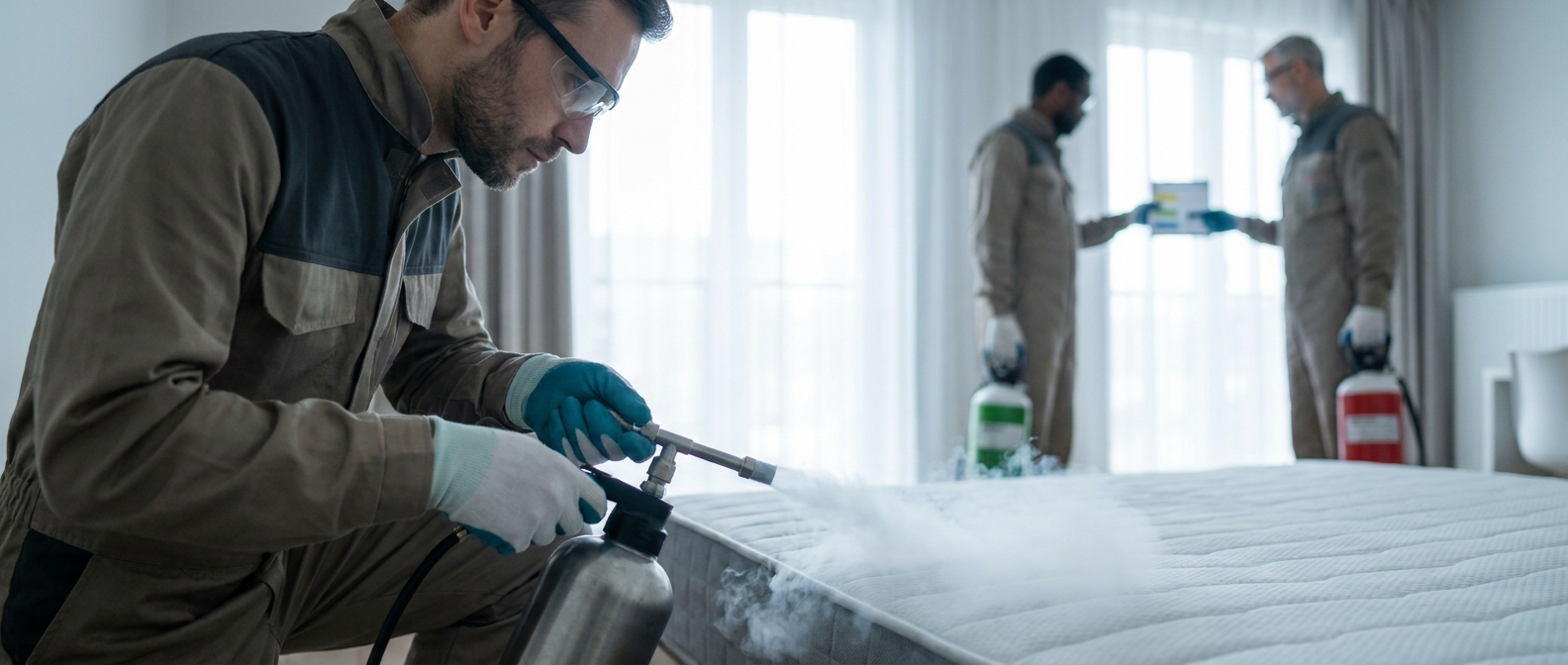
Once the focal points have been identified, spraying begins. The liquid nitrogen emerges in a controlled jet. On contact with surfaces, it transforms into a characteristic white mist. Surface temperature drops instantly. Each area is treated methodically, starting with the bed (the usual epicenter of infestation), then extending to adjacent furniture, baseboards, sockets and wall-mounted picture frames.
On average, the procedure takes between one and three hours, depending on the surface and degree of infestation. For a studio apartment or a single room, allow around an hour. For a two-bedroom apartment with extensive infestation, this can rise to two and a half or three hours.
The result was immediate. All bedbugs, larvae and eggs exposed to the cold treatment died instantly. There's no waiting period, no «leave it to work». As soon as the technician has finished, you can put your clean bedding back on and sleep in it that same night. It's a life-changing point when you haven't slept a wink in weeks because of the stings.
At Punaisesdelitbruxelles, we systematically offer a follow-up check two to three weeks after the procedure. Not because we doubt the effectiveness, but because it's professional. If a bedbug was stashed away in a really inaccessible place (inside an electronic device, for example), the follow-up makes it possible to detect it and intervene before it restarts a reproductive cycle.
In terms of cost, a cryogenic treatment is in the same ballpark as a professional heat treatment. It's more expensive than a supermarket spray, yes. But a supermarket spray doesn't work. If you add up the cost of ineffective products, the sleepless nights, the stress, and finally the call to a professional that should have been made in the first place, the equation is quickly done.
Conclusion
Liquid nitrogen treatment of bed bugs is no fad. It's the most radical, cleanest and fastest method available today. Minus 196°C is unforgiving, and that's exactly what's needed when dealing with such a tough insect.
If you're in Brussels and suspect an infestation, don't wait. Every day that passes, bedbugs lay their eggs. Contact Punaisesdelitbruxelles for a rapid diagnosis and chemical-free intervention. Your sleep is non-negotiable.
Frequently asked questions
Is putting sheets in the freezer enough to kill bedbugs?
No, a domestic freezer is totally ineffective in eradicating an infestation. At best, these freezers go down to -24°C, a temperature at which adult bedbugs can survive for several days, and which has no impact on their protective eggs. Only the instant thermal shock of liquid nitrogen at -196°C guarantees the bursting of insect cells at all stages of development.
What's the difference between CO2 and liquid nitrogen treatment?
Dry ice (solid CO2) reaches a temperature of around -78°C, which is still insufficient to systematically destroy bedbug eggs during brief exposure. Liquid nitrogen, on the other hand, peaks at -196°C, leaving absolutely no margin for error or survival. It's the most radical and reliable physical solution on the market.
Why is liquid nitrogen more effective than chemical insecticides?
Bed bugs have developed strong genetic resistances to conventional insecticides, making chemical treatments time-consuming and often ineffective. Liquid nitrogen circumvents this problem through a purely physical action: the instantaneous crystallization of body fluids does not allow for any biological adaptation. What's more, a single pass is all that's needed, as the extreme cold destroys the eggs directly, where chemistry fails.
Can I sleep in my room immediately after a cryogenic treatment?
Yes, and that's one of the greatest advantages of this environmentally-friendly method. Liquid nitrogen is an inert gas that evaporates instantly into the atmosphere, leaving no toxic, chemical or odorous residue. Unlike fumigation, which requires you to vacate the premises, you can safely return to your home and sleep in your own bed that evening.
What happens during a cryonics procedure in Brussels?
Our technician begins with a meticulous endoscopic inspection to locate all outbreaks and traces of droppings. He then methodically sprays liquid nitrogen at -196°C using a precision nozzle into every nook and cranny (mattresses, baseboards, electrical sockets). The procedure takes between 1 and 3 hours, and a follow-up check is scheduled two weeks later to guarantee total eradication.

 French
  English
  Dutch
Dutch