

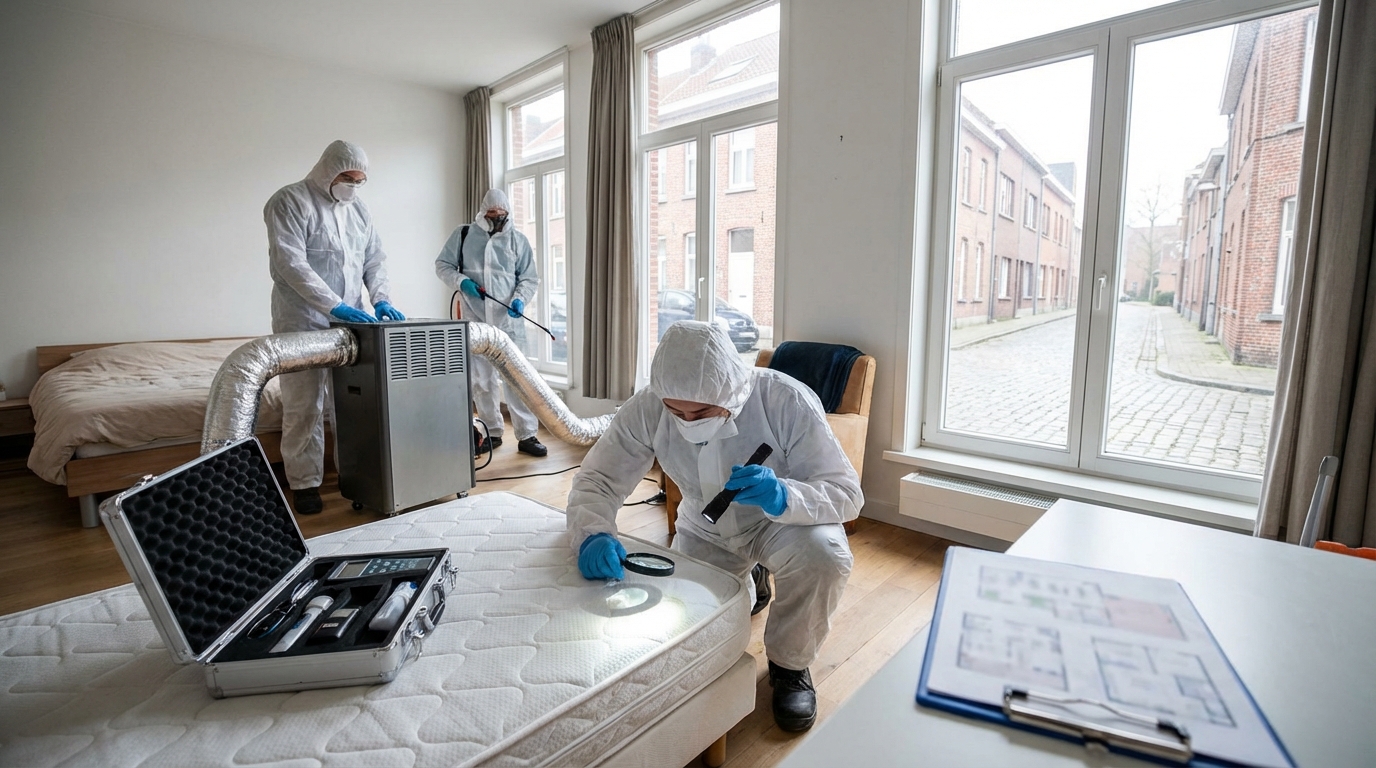
Bedbug treatment in Neder-Over-Heembeek: Protocol 1120
Contents
Three o'clock in the morning, you wake up with itchy arms. You turn on the light, inspect the sheets, and there they are: little brown spots lined up along the seam of the mattress. Welcome to the nightmare experienced by more and more Neder-Over-Heembeek residents. As we see every week in the field, the bedbug problem in Neder-Over-Heembeek has accelerated over the last two years, driven by the density of buildings and proximity to the center of Brussels.
Things to remember
-
We differentiate ourselves with an ultra-local approach to 1120, detailing step-by-step our combined technical protocol to reassure Neder-Over-Heembeek residents via the transparency of a neighborhood expert.
-
Careful diagnosis and detection in the Heembeek district
-
How our thermal and chemical eradication protocol works
-
Post-intervention follow-up and prevention for 1120 households
We're a local disinfection company, based in the 1120 district, so we know the streets, the types of housing and the recurring problems in the area. And above all, we've developed a precise protocol, combining thermal and chemical treatments, which we apply step by step with total transparency. No unnecessary jargon, no vague estimates: you'll know exactly what we're doing to your home and why.
This article details our complete method, from initial diagnosis to post-intervention follow-up. If you're looking for an exterminator in Neder-Over-Heembeek who really explains his work, you've come to the right place.
Careful diagnosis and detection in the Heembeek district
90% people who call us have already had an infestation for several weeks. Why is this? Because the first signs of a bedbug infestation go unnoticed. You scratch, you think it's an allergy, you change your laundry. By the time you make the connection, the insects have colonized the bedding, the box spring, sometimes even the baseboards and electrical outlets.
What are these famous signs? The most reliable: small bites in groups of three or four, often on the arms, neck or shoulders. Black marks on sheets or mattresses, which are in fact droppings. And sometimes, small bloodstains, left when you crush a bedbug while tossing and turning in your sleep. If you spot any of these, don't dawdle.
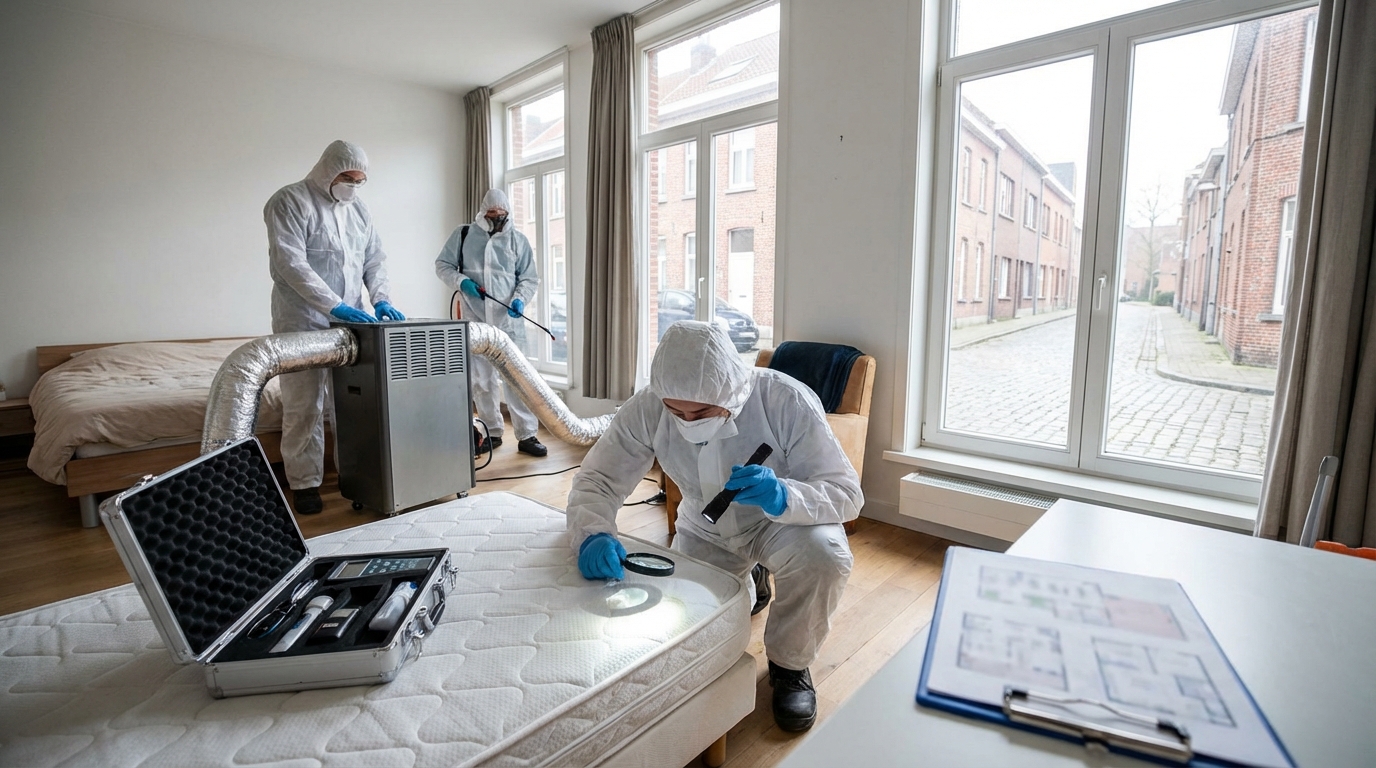
Our first step is always a thorough inspection of the bedding and its immediate surroundings. We don't just lift the comforter. We dismantle the slats of the box spring, inspect the mattress seams with a flashlight, check the headboard, bedside tables and picture frames hanging on the nearby wall. Where do bedbugs nest? Often less than two meters from the sleeper, in dark, narrow nooks and crannies. The mattress seams are the number-one spot, followed by the cracks in the box spring and the back of baseboards.
In Neder-Over-Heembeek, we're working on a lot of 60-70s apartments with strip parquet floors and wooden skirting boards. Unfortunately, these homes are ideal breeding grounds for 1120 pests: the gaps between the floorboards provide perfect hiding places. We know this because we've been working in this neighborhood for years, and it changes the way we inspect. A technician who is unfamiliar with the local built environment can miss critical areas.
Diagnosis takes between 30 and 45 minutes for a standard apartment. We also use passive detection traps that we leave in place for 48 hours in doubtful cases, when the infestation is very recent and visual traces are still scarce. At the end of this phase, you receive a clear report: estimated level of infestation, areas affected, proposed action plan. No surprises.
How our thermal and chemical eradication protocol works
A customer once told me, «I bought a steamer on the internet, treated it myself, and three weeks later they were back.» Not surprising. Steam alone, without method, without controlled temperature, without residual treatment, isn't enough. It's like sweeping a flooded floor: the gesture is good, but the result is insufficient.
Our bedbug treatment protocol in 1120 is based on a precise combination. First, the dry steam treatment at high temperatures. We use a professional generator which produces steam at 180°C at the nozzle outlet. On contact with surfaces, the temperature remains above 60°C, which is the lethal threshold for bedbugs at all stages: adults, nymphs and eggs. Eggs are the real problem. They're resistant to a lot of things, but not to heat.
High-temperature steam is passed over every centimetre of the bedding, the bed base, the headboard and the skirting boards identified during the diagnosis. It's a slow, methodical process. A studio takes about two hours for this phase alone. We never botch things up, because a forgotten area means guaranteed recolonization in the weeks that follow.
Next comes the application of a professional insecticide with residual effect. This product, reserved for professional insect killers in Brussels, continues to work for several weeks after the treatment. Any bedbugs not directly affected by the steam will sooner or later pass through the treated areas and be eliminated. It's this combination of heat and chemicals that makes the difference with «home-made» solutions or single-method treatments.
We use products approved by the SPF Santé publique, with safety data sheets available on request. You can return to your home a few hours after the treatment, following the instructions we give you in writing. Dosages are also adapted to the configuration of the dwelling: an apartment with carpeting is not treated in the same way as a studio with tiled floors. Pest eradication is tailor-made, not copy-and-paste.
How do you get rid of bedbugs fast? Let's be honest, not in two days with a miracle method. A serious intervention requires at least one main pass and one control pass. Beware of promises of instant elimination: they systematically overlook the question of eggs, which hatch in 7 to 10 days.
Post-intervention follow-up and prevention for 1120 households
The day we leave your apartment after treatment, our job isn't finished. Far from it. We always schedule a follow-up visit between 10 and 14 days after the first treatment. Why this precise timeframe? Because that's how long it takes for any eggs that may have survived to hatch. If we detect the slightest residual activity, we come back. This is included in our performance guarantee.
This warranty is very important to us. It covers a period of 60 days after the initial intervention. If the bedbugs reappear during this period, we come back at no extra charge. It's a commitment we can afford, because we do the job right the first time. Our success rate in a single main intervention plus a control is around 95% on infestations detected at a moderate stage.
For the remaining 5%, these are almost always mass infestations or situations where the infestation comes from a neighbouring dwelling. In such cases, we work with property managers and owners to coordinate treatment of the entire building. In Neder-Over-Heembeek, we know of several buildings where we have intervened floor by floor. In Brussels, pest control in apartment buildings is often a collective effort.
You will also receive prevention tips adapted to your home. Not a generic sheet printed off the Internet. Precise recommendations: install certified anti-flea covers on mattresses and pillows, vacuum regularly along baseboards (and dispose of the bag immediately afterwards), inspect any second-hand furniture before bringing it home. This last point is crucial. A significant proportion of infestations in Neder-Over-Heembeek start with a salvaged sofa or mattress.
We also recommend keeping a detection trap under each foot of the bed for three months after the operation. It's a simple device, a small dish with a rim that bedbugs can't climb over. If a bedbug tries to climb to your bed, it remains trapped and you can spot it immediately. Prevention is surveillance.
And last but not least: you can always reach us. Do you have a doubt, a suspicious sting, a question three weeks after our visit? You call, we answer. We're a local disinfection company, not a call center. When you contact us, you get someone who knows your case and your neighborhood. That's what being an exterminator in Neder-Over-Heembeek is all about: not just intervening, but accompanying.
Conclusion
Bedbug treatment in Neder-Over-Heembeek isn't about miracle products or online recipes. It's all about rigorous protocol, local knowledge and serious follow-up. Our approach, combining dry steam and professional insecticide, applied by technicians who know the 1120 building, delivers reliable, long-lasting results.
If you suspect an infestation in your home, don't wait. Every week of delay means a colony doubling in size. Contact us for a rapid diagnosis: we'll intervene anywhere in Neder-Over-Heembeek, usually within 48 hours. We take care of your peace of mind.
Frequently asked questions
How did I get rid of my bedbugs in two days?
The main signs are grouped bites (3 or 4 per bite) on waking, small bloodstains on your sheets and black spots (droppings) on mattress seams. In typical 1120 buildings, they also frequently hide behind wooden skirting boards and in floor cracks.
Why does your protocol combine heat and chemical treatment?
Dry steam at 180°C instantly eradicates all stages of bedbugs, including insecticide-resistant eggs. We then apply a professional chemical with a long-lasting effect to eliminate any remaining specimens that try to circulate after our visit.
How long does the procedure last and when can I return to my home?
Methodical diagnosis and treatment of a standard dwelling usually takes between 2 and 3 hours. Thanks to our secure protocol, approved by the Federal Public Health Service, you can return to your home in complete safety just a few hours after the disinsectisation has been completed.
Do you offer a guaranteed result for Neder-Over-Heembeek households?
Yes, our protocol systematically includes a control visit between 10 and 14 days after the first visit to block the reproductive cycle. What's more, we offer a 60-day results guarantee: if residual activity is detected, we intervene again at no extra cost.
What should I do if the infestation is coming from a neighboring apartment in Heembeek?
In 1120 apartment buildings, bedbugs can migrate via sockets or floors. If the diagnosis reveals an external origin, we work directly with owners, trustees and neighbors to coordinate a comprehensive, collective treatment of the building.

 French
  English
  Dutch
Dutch