


Bed Bug Fumigators: How Effective Are Over-the-Counter Products?
Contents
-
The Benefits and Limitations of Commercially Available Bed Bug Fumigators
-
Comparison and Selection Criteria: How to Optimize Your Home Treatment
Every week, I get calls from people in Brussels who’ve already tried «that thing they bought at Brico» or «the fumigant they ordered online.» The result: the bed bugs are still there, sometimes even in rooms that weren’t affected before. A bed bug fumigator is the first thing that comes to mind when you wake up to find bites. That’s normal. It’s easy to get—it costs between 8 and 25 euros—and the packaging promises total eradication. Except that the reality is a bit more complicated than that.
Things to remember
-
An honest analysis by a local expert in Brussels: Beyond the marketing hype, we examine why store-bought smoke bombs are often only a temporary solution and how to prevent them from making the infestation worse by driving bed bugs deeper into the walls
-
The Benefits and Limitations of Commercially Available Bed Bug Fumigators
-
The Hidden Dangers
-
How to Optimize Your Home Treatment
I’m not going to tell you that all smoke bombs are useless. Some are actually effective against adult bed bugs exposed to the product. The problem is everything they don’t tell you on the packaging: the resistance of the eggs, the insects’ tendency to flee, and above all, the very specific conditions that must be met for the treatment to have even the slightest chance of working. That’s exactly what we’re going to break down here.
I’ve worked in hundreds of apartments in Brussels and throughout Belgium. What I’m going to share is what I’ve observed firsthand, not what the product descriptions say. You deserve an honest answer before you spend your money.
The Benefits and Limitations of Commercially Available Bed Bug Fumigators
A bed bug fumigant is, essentially, a small metal canister that releases a cloud of insecticide into a closed room. The active ingredient varies by brand: permethrin, cypermethrin, or other pyrethroids. You light the wick or trigger the reaction (for hydro-reactive models), leave the room, close the door, and wait two to four hours. It seems simple enough.
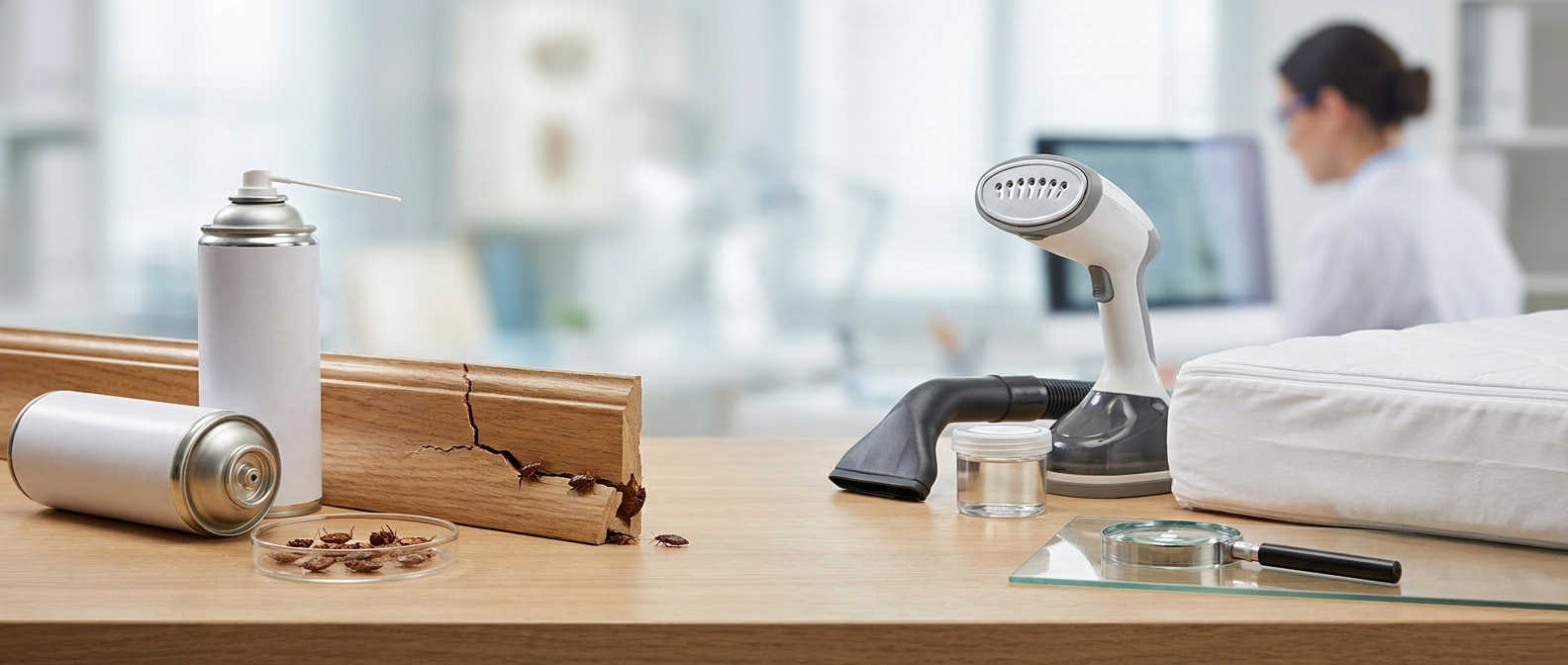
The first advantage is accessibility. You can find them at any home improvement store or pharmacy in Brussels—no appointment needed, no waiting. A fogger costs around 10 to 20 euros for a room measuring 20 to 30 m². When you compare that to the cost of a professional bed bug treatment (expect to pay at least 200 to 500 euros for an apartment), it’s easy to see why it’s so tempting.
Another advantage is the spread of the product. The insecticide mist disperses into the air and settles on exposed surfaces: mattresses, box springs, floors, and furniture. Adult bed bugs that are out in the open at the time of treatment will indeed come into contact with the product. In this regard, the insecticide treatment works. I’ve had customers show me dead bed bugs after using a fumigant. It happens.
Now, the limitations. And they're serious.
First, penetration. A smoke bomb produces an aerosol that settles on surfaces. It does not penetrate the seams of the mattress, the cracks in the hardwood floor, behind the baseboards, or into electrical outlets. Yet that is precisely where bed bugs hide during the day. A bed bug spends 90% of its time tucked away in crevices just a few millimeters wide. The cloud drifts right over them without reaching them.
Next, there’s the issue of dosage. Fumigants sold to the general public contain much lower concentrations of insecticide than those used by professionals. This makes sense: regulations are designed to protect consumers. But it means that even bed bugs exposed to the product don’t always receive a lethal dose. They are «stunned,» sometimes temporarily paralyzed, and then resume their activity a few hours later.
Another point that’s often overlooked: a smoke bomb treats only one room at a time. If the infestation affects both the bedroom and the living room (which is common in Brussels apartments where rooms are connected), you’ll need to use multiple canisters. And you must treat them simultaneously; otherwise, the bed bugs will migrate from one room to another.
So yes, as a supplementary curative measure, a smoke bomb can temporarily reduce the visible population. But the word «temporarily» is key. Without additional action, the survivors will reproduce within a few weeks. And you’ll be back to square one—or even worse.
Why Using a Fumigator Alone Often Fails: The Hidden Dangers
85% of the clients I see on emergency calls in Brussels first tried a fumigator. This figure isn’t an official statistic; it’s from my appointment book over the last three years. And in almost every case, the infestation got worse between the time they used the fumigant and the time they called me.
Why? The first problem is bed bug eggs. A female lays between 5 and 15 eggs a day, and these eggs are protected by a shell that’s resistant to surface-acting insecticides. No over-the-counter fumigant kills the eggs. None. Even the most honest manufacturers admit this in the fine print of the instructions. This means that after using your fumigant, even if you’ve killed all the adults (which is already unlikely), a new generation will hatch within 7 to 14 days. And the cycle starts all over again.
The second problem is even more insidious: the risk of dispersal. This is a danger that nobody mentions enough. Bed bugs can detect chemicals. When the fumigant is triggered, the insects that do not receive an immediate lethal dose will flee. They scatter into walls, electrical conduits, and pipes. I’ve seen cases where an infestation limited to a mattress spread to three rooms after a fumigation. In an apartment building, bed bugs can even migrate to neighbors’ units through the walls.
This dispersion is the real danger of using smoke bombs on their own. You turn a localized problem into a widespread one. Instead of treating just one room, you end up having to treat the entire apartment. The cost of professional treatment skyrockets.
The effectiveness of fumigators also raises questions on another front: resistance. Bed bug populations in Belgium, as throughout Europe, have been developing resistance to pyrethroids for years. These are precisely the chemicals found in most fumigants available to the general public. Entomological studies show that certain strains are resistant to doses 100 times higher than those that killed their ancestors twenty years ago. Your €15 fumigant doesn’t stand a chance against these populations.
And then there are the health risks. A smoke bomb releases chemical particles that settle everywhere: on your sheets, your clothes, your dishes, and your children’s toys. The instructions recommend ventilating the area thoroughly and cleaning all surfaces after treatment. How many people actually do that? Poisonings from household insecticides are a problem that Belgian poison control centers are all too familiar with. Headaches, respiratory irritation, nausea—reports of these symptoms are on the rise every year.
How long should you leave a smoke bomb to work? Most manufacturers recommend 2 to 4 hours, with the room closed and no people or animals inside. But some users think that «the longer, the better» and leave it on all night. This is dangerous and does not improve effectiveness. The active ingredient settles within 30 to 60 minutes. After that, you’re just accumulating unnecessary chemical residues.
Comparison and Selection Criteria: How to Optimize Your Home Treatment
So you’ve decided to give it a try anyway? I can understand that. Before you get started, here’s what I recommend to my clients when they want to try it on their own first (yes, I do sometimes suggest this for infestations that are just starting).
On the market in 2026, smoke bombs fall into two categories: traditional wick-type smoke bombs, where you light a small device that produces smoke, and hydro-reactive smoke bombs, which activate upon contact with water. Hydro-reactive smoke bombs offer an advantage: the reaction is more controlled, the smoke spreads more evenly, and there is no risk of fire. For household use, this is clearly the better choice of the two.
What is the best insecticide in 2026? Based on tests and real-world feedback, products containing transfluthrin or clothianidin (a neonicotinoid) perform better than older permethrin-based formulas. The reason is simple: bed bugs are less resistant to them at this time. Check the active ingredient on the packaging before buying. That’s more important than the brand.
The cost of a bed bug treatment using a fumigant ranges from 8 to 30 euros per can. You’ll need one can per room of 15 to 25 m², depending on the product. For a two-room apartment, the cost will be 30–60 euros if you treat it properly. Add bed bug-proof covers for the mattress and box spring (20–40 euros each), diatomaceous earth for hard-to-reach spots (10 euros per kilo), and you’re already approaching 100–150 euros. Not so cheap after all.
Here are the steps to maximize your chances:
-
Prepare the room. Vacuum everything: mattresses, box springs, baseboards, and behind furniture. Dispose of the vacuum bag in a sealed trash bag immediately afterward.
-
Wash all the laundry at a minimum of 60°C. Bed bugs and their eggs die at this temperature. If you can't wash an item, put it in the dryer for 30 minutes on a high heat setting.
-
Fill in the cracks Before setting off the smoke bomb: baseboards, electrical outlets, door frames. This limits escape routes and thus reduces the risk of the smoke spreading.
-
Place the fumigator in the center of the room, on a protected surface (aluminum plate). Close the windows and doors. Block the bottom of the door with a damp towel.
-
Go over it a second time 10 to 14 days later. This is non-negotiable. The eggs hatch in 7 to 14 days, and the first fumigant didn't kill them. Without this second treatment, you're wasting your time.
An over-the-counter insecticide alone is not enough. Combine the smoke bomb with diatomaceous earth in the nooks and crannies (it works mechanically, not chemically, so resistance is not possible) and interceptor traps under the legs of the bed. This combined approach yields satisfactory results for infestations less than three weeks old, in a single room, provided the occupant is thorough.
If, after two treatment cycles, you still see live bed bugs or new bites, stop wasting money. Every week you waste means dozens more eggs. At this point, a professional in Brussels who combines heat treatment with a targeted insecticide will resolve the problem in one or two visits. The money spent on fumigants won’t have been a total waste if you’ve also done a thorough cleaning, but it’s important to recognize the limits of DIY.
Are fumigant bombs effective against bed bugs? Yes, to some extent, on exposed adults, under ideal conditions. No, they are not a reliable method for eradicating bed bugs from a home. There’s a huge difference between «killing a few bed bugs» and «eliminating an infestation.» That’s the crucial distinction that product labels never make.
Conclusion
A bed bug fumigator is still just a tool, not a miracle solution. It can be part of a broader strategy, especially at the very beginning of an infestation, when the bed bugs are still few in number and concentrated in a single area. But used on its own—without proper preparation, a second treatment, or follow-up measures—it’s likely to waste your time and spread the problem.
My advice: If you have even the slightest doubt about the extent of the infestation, have your home inspected before buying anything. In Brussels, a professional inspection will tell you exactly what you’re dealing with. This prevents you from spending 100 euros on over-the-counter products only to end up paying 500 euros for professional treatment three months later—by which time the infestation will have had time to spread everywhere.
Do you have questions about your situation? Contact us. We’d rather be honest with you and say, «Try this at home first,» when it’s feasible, rather than sell you an unnecessary service. And when the problem is too advanced, we’ll tell you that, too. That’s how we work.
Frequently asked questions
What is the best smoke bomb for bed bugs?
Hydro-reactive foggers (which are activated with water) are more effective and safer than wick-type models. To maximize effectiveness, choose products containing transfluthrin or clothianidin, as bed bugs have developed less resistance to these ingredients.
Why do commercially available bed bug smoke bombs often fail?
Conventional fumigators only treat surfaces and do not kill any eggs. Furthermore, the insecticide mist does not penetrate deep hiding places (baseboards, mattresses, cracks) and may even cause the bed bugs to flee and spread to other rooms in your home.
How long should a fumigator be left to work?
It is generally recommended to let the product sit for 2 to 4 hours with windows and doors tightly closed. Extending the treatment time (such as overnight) does not improve the insecticide’s effectiveness and unnecessarily increases the buildup of toxic chemical residues in your home.
How can you maximize the effectiveness of a homemade bed bug treatment?
It is essential that you combine the smoke bomb with thorough vacuuming, washing the laundry at 60°C, and applying diatomaceous earth to all nooks and crannies. Above all, be sure to apply a second treatment 10 to 14 days later to eliminate any new infestations.
When should you stop DIY treatments and call a pest control professional in Brussels?
If you notice new bites or live insects after two full cycles of home treatment, stop wasting your money. The infestation is likely too advanced and requires the help of a Brussels-based expert who uses a combination of heat treatments and targeted professional insecticides.

 French
  English
  Dutch
Dutch