


Everything you need to know about bedbug feeding and survival
Contents
When it comes to bedbugs, most people immediately think of bedbugs. That's normal: it's often after a night of itching that we start looking for answers. But the word «bedbug» actually covers hundreds of species, with radically different diets. Some eat plants, others devour harmful insects, and a handful feed exclusively on your blood.
Things to remember
-
Beyond biological identification, this article deciphers the extreme survival strategy of bed bugs
-
We explain why their dependence on human blood dictates their behaviour and answer the crucial question: how long can they really withstand starvation?
-
Understanding the different diets of bedbug species
-
Why human blood is vital
What makes the bedbug so fearsome is not just its appetite for human blood. It's its ability to survive for months without a single meal. Months. This extraordinary resistance explains why so many people in Brussels think they've got rid of them, only to see them reappear a few weeks later. In this article, we'll take a look at the diet of bedbugs in the broadest sense, then zoom in on the one that's keeping you awake at night, and above all answer the question on everyone's mind: how long can they really go without eating?
Understanding the different diets of bedbug species
There are over 40,000 species of hemiptera in the world, the order of insects to which all bedbugs belong. And contrary to what you might think, the vast majority of them have absolutely no interest in you. Their diet depends on their species, their environment and their role in the ecosystem.
Let's start with the largest group: the phytophagous bugs. They are herbivores. They feed on sap, fruit and leaves. The green bug, often found on tomatoes and beans, is a typical example. Green bugs feed on plant sap, which they pierce with their rostrum, a sort of rigid proboscis. They are a pest of crops, but totally harmless to humans. Wood bugs, sometimes seen in houses in autumn as they seek shelter for the winter, fall into this category. They don't bite, nor do they reproduce in your home. If you find one on a curtain, you can put it back outside without stress.
Another category, much less well known to the general public: the predatory bugs. These are carnivorous. They hunt other insects, aphids, caterpillars and mites. The assassin bug (yes, that's its real name) is a formidable predator, impaling its prey and sucking out its contents. In organic farming, certain predatory species are even used as biological control agents. So, what's eating the stink bugs? Often, other bugs.
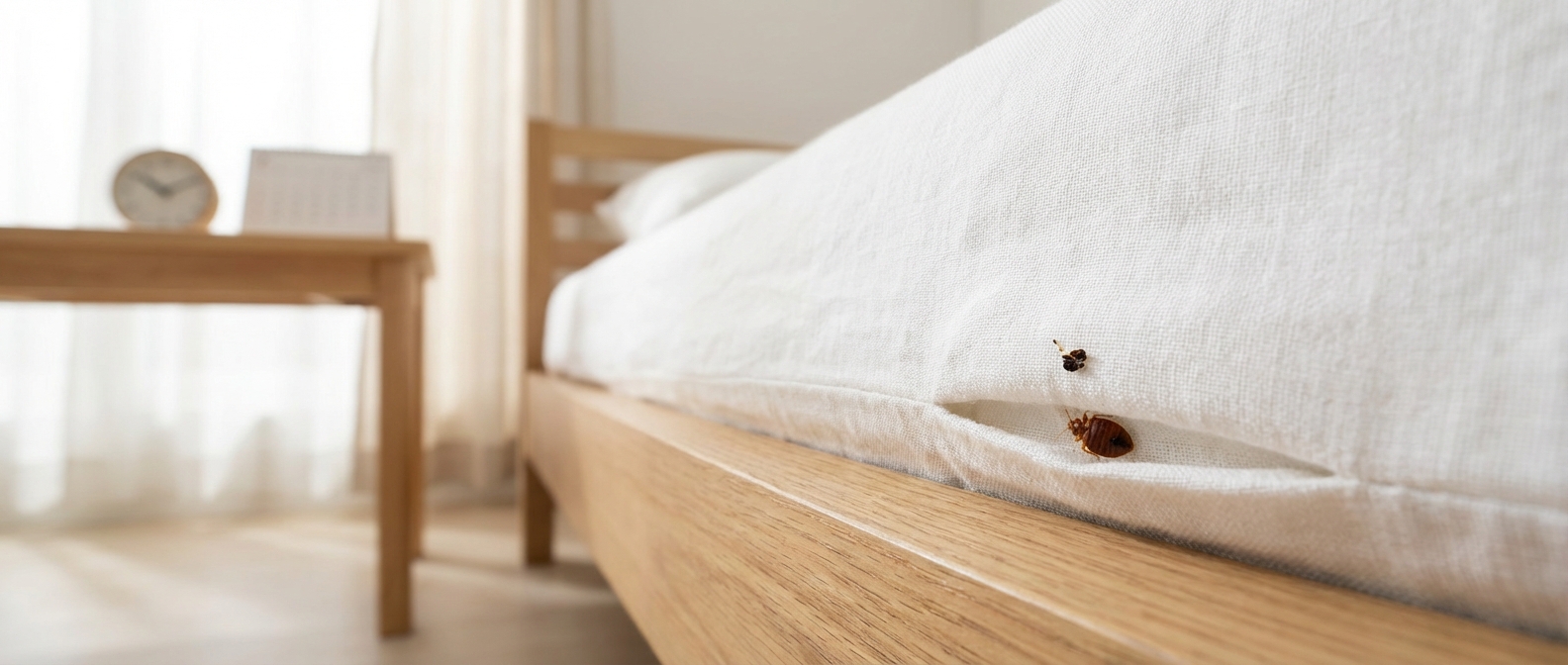
And then there's the third group, the one that concerns us directly: hematophagous bugs. They feed on blood. The bedbug (Cimex lectularius) is the best known, but it's not the only one. Some tropical species, such as the reduva, even transmit Chagas disease. The bedbug, for its part, transmits no known disease to date, but its impact on quality of life is considerable.
Why is it important to distinguish between the two? Because we regularly receive calls from customers in Brussels who are panicking after finding a bedbug in their apartment. In 30% of cases, it's a stray wood or green bug. No need to treat, no need to panic. Correct identification is the first step. The feeding habits of bedbugs tell you all about the real risk they represent: a phytophagous one will never bite you, a predatory one will do you a favor, and a hematophagous one requires rapid intervention.
A final point often forgotten: do you have to kill every bedbug you come across? No. Many species play a useful role in regulating insect pest populations. To systematically crush them, especially the predatory ones, is to deprive yourself of natural allies. The only exception is the bedbug. There's no reason to spare them.
The bedbug diet: why human blood is vital
What do bedbugs eat? Blood. Exclusively blood. No breadcrumbs, no food scraps, no wood, no cloth. Blood, and preferably human blood. It's a hematophagous insect strict, which means that each stage of its development depends on a blood meal.
The bedbug life cycle comprises five larval stages before adulthood. At each stage, the nymph must gorge itself on blood to moult and move on to the next stage. Without this meal, no growth, no reproduction. An adult female needs blood to produce her eggs: around 5 to 7 eggs a day after a full meal, i.e. up to 500 eggs in her lifetime. The link between feeding and reproduction is direct. Cut off access to blood, and you put the brakes on the colony.
The blood meal lasts between 5 and 10 minutes. The bedbug pierces the skin with its rostrum, injects an anesthetic (that's why you can't feel it at the time) and an anticoagulant that prevents the blood from congealing while it sucks. She can ingest up to six times her own weight in blood. Afterwards, she retires to her hiding place to digest, which takes several days. It's this discretion that makes infestation so difficult to detect at first.
A question we're often asked: can bed bugs feed on animals? Technically, yes. In the total absence of a human host, they can bite a dog, cat or bird. But this is plan B, not their preference. Human blood remains their optimal source of nutrition, and it's around our beds that they make their home, not in our pets' baskets.
What's striking is the extent to which their entire behavior is dictated by this food addiction. They're nocturnal, because that's when you're immobile in bed. They hide in mattress seams, box spring slats and baseboards, always a few meters from their food source. They detect the CO2 you exhale and your body heat. Everything in their biology is optimized for a single objective: to access your blood undetected.
In Brussels, we find that many tenants try to «starve them out» by sleeping elsewhere for a few nights. The idea seems logical, but it's counter-productive. Bedbugs don't die in a few days without eating (we'll come back to this in the next section), and in your absence, they can migrate to other rooms, or even other apartments, in search of a new host. You don't solve anything, you just spread the problem.
Another common misconception: feed a bedbug to trap it better. This makes no sense in a domestic context. You don't «feed» a bedbug, you eliminate it. The CO2 traps used by professionals simulate human presence to attract bedbugs, but this is a detection tool, not a bedbug extermination method. Only a professional treatment, whether thermal or chemical, will get rid of an established infestation.
Resistance and famine: how long do they go without eating?
Here's the number that surprises everyone: an adult bedbug can survive without eating for up to three days. 6 to 12 months under favorable conditions. Some laboratory studies have even observed specimens lasting up to 18 months at low temperatures. A far cry from the fragile insect many people imagine.
How is this possible? Bedbug resistance is based on several biological mechanisms. First, its metabolism. In the absence of food, it enters a state of near-dormancy. Its activity slows drastically, and its energy consumption plummets. It hardly moves at all, no longer reproduces, and waits. Patiently. Temperature plays a key role: the cooler it is (around 10-15°C), the more it saves its reserves. In an apartment heated to 20°C, survival time without food is around 4 to 6 months. This is already enormous.
Nymphs, on the other hand, are less resistant. A young larval stage can starve to death in 2 to 3 months, sometimes less. But adults, especially fertilized females, are true survival machines. They store enough lipid reserves to last an entire season without meals.
What does this mean in practical terms for you? It means that going on vacation for two weeks, or even two months, won't be enough to eliminate an infestation. The bedbug won't starve to death because you've left the apartment. It will simply wait for you to return. People who move out thinking they've left the problem behind make the same mistake: bedbugs survive in furniture, suitcases and clothes, and they follow you.
We also see landlords in Brussels leaving an empty apartment between two tenants, hoping that the problem will resolve itself. Three months' vacancy? Not good enough. Six months? Maybe for the nymphs, but the adults hold out. And as soon as a new tenant moves in, the colony literally wakes up, attracted by the CO2 and body heat of the new occupant.
The only reliable way to break this cycle is active extermination. A heat treatment (raising the temperature above 55°C throughout the room) kills all stages, including eggs, in a single intervention. Chemical treatments also work, but often require two passes spaced 15 days apart to reach the eggs that hatch in the meantime. In both cases, a professional specialized in bedbugs in Brussels will be able to adapt the protocol to your situation.
One final point on bedbug resistance that's worth highlighting: over the decades, these insects have developed increasing resistance to conventional insecticides, particularly pyrethroids. Today's populations in Belgium are genetically more resistant than those of 20 years ago. This is an additional factor that makes professional intervention essential. Commercial insecticide sprays? They disperse bedbugs without killing them, and often aggravate the problem by pushing them into other rooms.
Conclusion
The diet of bedbugs varies considerably from one species to another: sap for the phytophagous, insects for the predatory, blood for the hematophagous. The bedbug, on the other hand, eats only human blood, and this dependence dictates all its behavior, from its nocturnal schedules to its hiding places near the bed. Its ability to survive for months without eating makes avoidance strategies totally ineffective.
If you suspect an infestation in your home in Brussels, don't wait and hope they'll go away. They won't. Contact us for a rapid diagnosis and appropriate treatment. The earlier we intervene, the simpler and less costly it is.
Frequently asked questions
What do bedbugs eat, and can they eat anything other than blood?
Bed bugs are strict hematophagous: they feed exclusively on blood, with a marked preference for human blood. They do not eat crumbs, fabrics or wood, and only bite pets as an absolute last resort.
How long can a bedbug survive without eating?
An adult bedbug is extremely hardy, and can survive between 6 and 12 months without a meal under favorable conditions. In the absence of a host, it enters a state of dormancy, making strategies to «starve» the insect totally ineffective.
Do all bedbugs bite humans?
No, the vast majority of bedbug species are either phytophagous (they eat sap, like green bugs) or predatory (they eat other insects). Only the bedbug family and a few tropical species actively seek out human blood.
Why do bedbugs only come out at night to feed?
Their behavior is dictated by survival: they take advantage of host immobility and darkness to feed undetected. They are attracted by body heat and the CO2 we exhale as we sleep.
Does leaving your home for a few weeks kill bedbugs?
Absolutely not. Going on vacation or leaving an empty apartment won't solve the infestation, as bedbugs will simply wait for you to return. Worse still, the absence of a host may prompt them to migrate to neighboring apartments through partitions to find a new source of food.

 French
  English
  Dutch
Dutch