


Disinfection protocol for industrial laundries
Contents
-
Domestic laundry vs. industrial laundry: the disinfection match-up
-
Thermal or chemical disinfection: which protocol should you choose for your linen?
-
Criteria for choosing a laundry: recommendations before making a commitment
A hotel sheet that smells clean is reassuring. But «clean» doesn't mean «disinfected». There's a gulf between linen that looks spotless and linen that's truly free of bacteria, viruses and parasites. A gulf that only a rigorous industrial laundry protocol can bridge.
Things to remember
-
This article explains the complex RABC standards for the general public.
-
It emphasizes the importance of industrial disinfection in the face of sanitary and parasitic risks (bedbugs), by positioning the local expert as the guarantor of healthy linen thanks to rigorous protocols.
-
The disinfection match
-
Which protocol should you choose for your laundry?
If you run a hotel, B&B or nursing home in Brussels, you know that textile hygiene is no small matter. It's a health issue, a legal issue, and frankly, a reputational issue. No one wants to see their establishment associated with a bedbug infestation or bacterial contamination. Professional linen disinfection is based on precise standards, tried and tested methods, and above all on professionals who apply them without compromise.
This article looks at what really goes on in a proper industrial laundry: protocols, temperatures, controls, and what you should check before entrusting your textiles to anyone.
Domestic laundry vs. industrial laundry: the disinfection match-up
Your washing machine at home, it does a good job for everyday use. But let's be honest: a domestic cycle at 40°C with scented detergent doesn't disinfect anything. It washes. It's not the same thing.
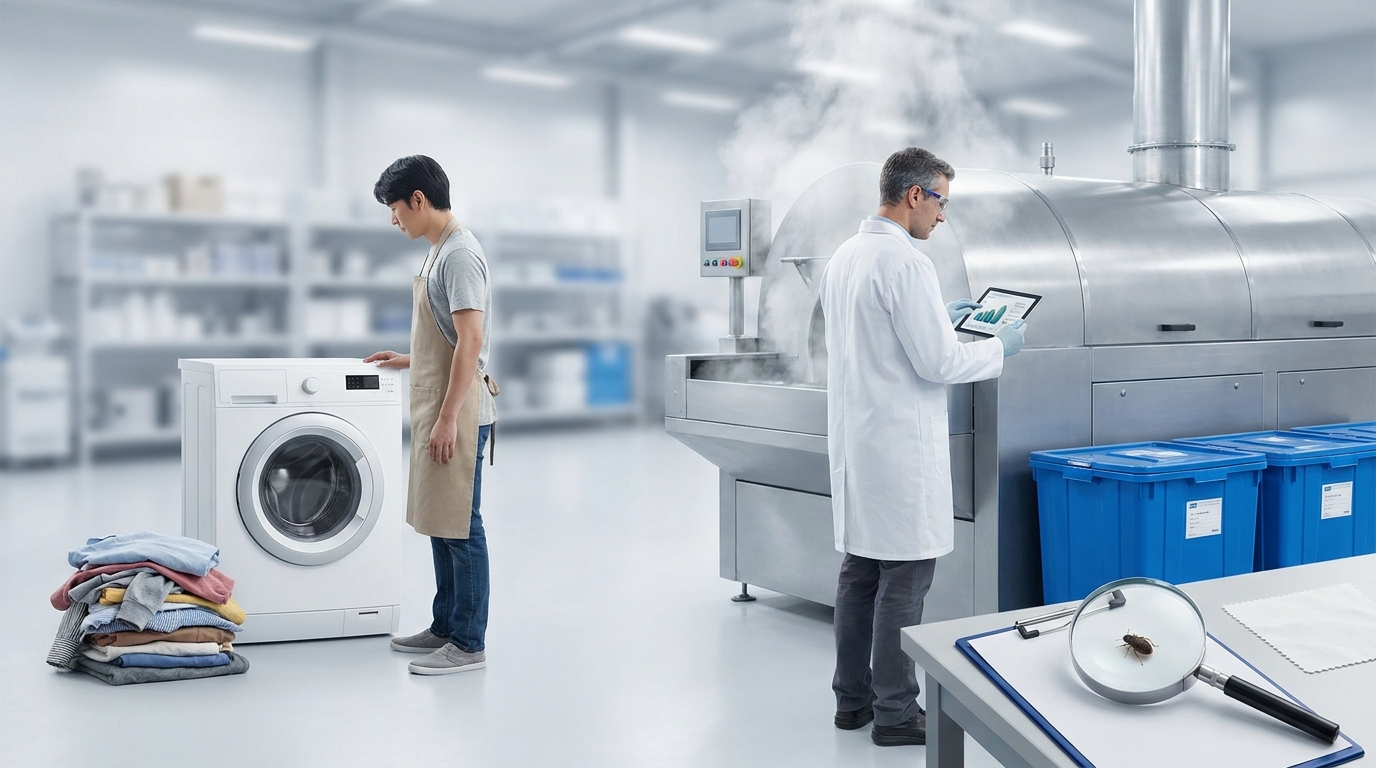
The really effective disinfection temperature starts at 60°C, and even then needs to be maintained for a sufficiently long time. To eliminate the majority of pathogenic micro-organisms (staphylococci, E. coli, Candida), a minimum of 71°C for 3 minutes, or 65°C for 10 minutes, is more appropriate. These are the recognized thresholds for reliable microbiological efficacy. In industrial laundries, machines are calibrated to guarantee these parameters for each industrial wash cycle. At home, the machine's thermostat displays 60°C, but no one checks whether the water actually reaches this temperature at the heart of the laundry.
Another fundamental difference is the load. A domestic machine processes 7 to 10 kg. An industrial washer handles 30, 60, sometimes 120 kg per cycle. The volume changes everything, because professional machines are designed to agitate the laundry so that each fiber is exposed to the right temperature for the right amount of time. The mechanical, thermal and chemical ratio is optimized, known as the Sinner Circle. At home, you have a «cotton 60°C» program and your fingers are crossed.
What about parasites? Let's talk about them. Bedbugs die at 56°C if exposure lasts at least 20 minutes. A «rapid» domestic cycle at 60°C often lasts only 15 minutes at maximum temperature. The risk of survival is real. In industrial laundries, the protocol for eliminating pests from linen is thought out right from the collection stage: water-soluble bags, separate sorting, extended thermal cycles. Nothing is left to chance.
Professional laundry procedures follow a precise sequence: reception and sorting of soiled linen, pre-washing if necessary, temperature-controlled washing-disinfection, rinsing, high-temperature drying, ironing-calendering, then packaging of clean linen. Each step is documented and verifiable. For you, the process is: put the laundry in the machine, press start, forget about it for three hours, then find it damp in the drum the next morning.
I'm not saying this to criticize home washing. For your personal t-shirts and towels, it's fine. But for laundry that passes from person to person, in a context where the health risk is real, the difference between washing and disinfecting professional laundry is the difference between hoping and knowing.
Thermal or chemical disinfection: which protocol should you choose for your linen?
90°C for 10 minutes and you're all set? If only it were that simple. Some textiles can't stand high temperatures. Polyester shrinks, elastics snap, colors fade. So what do you do - accept a clean but damaged linen, or an intact but not disinfected one?
That's exactly why the RABC method exists. RABC stands for Risk Analysis and Biocontamination Control Risk analysis and biocontamination control. This is the methodological framework described in standard NF EN 14065, the European reference for textile hygiene in laundries. This standard does not prescribe a single method. It requires a management system that identifies risks at every stage and implements appropriate controls.
In practical terms, there are two main approaches to disinfection:
-
Thermal disinfection : the temperature is raised. This is the most reliable method, and the easiest to control. Above 70°C for several minutes, virtually all bacteria, enveloped viruses and parasites are eliminated. This is the default choice for bed linen, towels and flat cotton linen. No additional chemicals, no residue. Efficiency is based solely on the time-temperature pair.
-
Chemical (or thermo-chemical) disinfection: we use disinfectants, often based on peracids or chlorine compounds, which work at lower temperatures (40-60°C). This is essential for fragile textiles, synthetic workwear or items that cannot tolerate high temperatures. Dosage must be precise, contact time respected, and products approved.
The RABC method, as defined by NF EN 14065, doesn't say «choose one or the other». It says: analyze your linen, identify the level of risk, and apply the appropriate protocol. A nursing home treating linen soiled by patients carrying multi-resistant bacteria does not have the same requirements as a hotel washing standard room linen. The industrial laundry protocol must be calibrated according to the actual risk.
The 7 principles of the RABC method follow a logic similar to that of HACCP in the food industry: identify hazards, determine critical points, set limits, monitor, correct, verify and document. Each certified laundry must be able to prove, by means of microbiological sampling, that its linen leaving the process complies with the defined biocontamination thresholds. We're talking about less than 12 CFU (colony-forming units) per 25 cm² of textile for standard linen. This is not a vague objective: it's a figure, measured and traced.
For facilities in Brussels faced with bedbug problems, the question of protocol becomes even more acute. Thermal disinfection remains the benchmark method for eliminating bedbug pests from linen: bedbug eggs are more resistant than adults, and require prolonged exposure to high temperatures. A laundry that rigorously applies the NF EN 14065 standard offers this guarantee. A laundry that «hot washes», without control or traceability, does not.
Criteria for choosing a laundry: recommendations before making a commitment
Not all laundries are created equal. I know, when you put it like that, it sounds obvious. However, many establishments choose their service provider based on price per kilo and delivery time, period. It's a costly mistake.
The first criterion to check is the principle of forward motion. This technical term refers to the physical organization of the premises so that dirty and clean linen never cross paths. Ever. Laundry enters on one side of the building, progresses from zone to zone (sorting, washing, drying, finishing, packaging) and exits on the other side, ready for delivery. If clean linen passes through the soiled linen reception area again, you run the risk of cross-contamination. And cross-contamination is exactly what cancels out all the disinfection work done during washing.
Ask for a tour of the premises. Serious laundries always accept. Observe the physical separation between zones, the general cleanliness, and the wearing of protective equipment by staff. Look to see if clean and dirty laundry carts are differentiated (color, markings). These details speak volumes about the rigor of the protocol.
Second point: traceability. A laundry that applies the RABC method records the parameters of each cycle: temperature reached, duration, products used, dosages. It also takes regular microbiological samples of the linen leaving the plant, and keeps a record of the results. If your service provider can't provide you with this data, ask yourself some questions.
The third criterion, often overlooked, is the management of contaminated linen or linen at risk from parasites. If you're a hotel or B&B in Brussels and you're faced with an episode of bedbugs, your laundry must have a specific protocol. Suspect linen must be collected in closed bags (ideally water-soluble), transported separately, and treated as a priority with a cycle that guarantees elimination of the pests in the linen. This is not an optional service, it's a basic one.
Fourth point: industrial laundry standards are not decorative. Certification to NF EN 14065 is a verifiable commitment. It implies audits, external controls and up-to-date documentation. Not all laundries are certified, and some do very good work without formal certification. But certification remains the simplest way for a non-specialist to ensure that industrial laundry protocol is respected.
Finally, let's talk about human relations. At Punaises de Lit Bruxelles, we regularly work with establishments that discover an infestation and are understandably panicking over the issue of linen. The right thing to do is to work with a local laundry that knows your constraints, can react quickly, and understands that behind every bag of sheets lies the peace of mind of your customers or residents. Price per kilo is one criterion. But your service provider's ability to guarantee truly healthy linen is the key criterion.
Conclusion
Professional linen disinfection is not a luxury reserved for hospitals. It's a necessity for any establishment that welcomes the public and takes the health of its occupants seriously. Protocols exist, standards are clear and methods are tried and tested. What makes the difference is the seriousness of those who apply them.
If you run a hotel, B&B or nursing home in Brussels and have the slightest doubt about the quality of your linen treatment, or if you're facing a bedbug problem, contact us. We'll point you in the right direction, with the right partners, so that your linen is clean, disinfected and safe. Really safe.
Frequently asked questions
What's the difference between domestic washing and industrial disinfection?
Domestic washing is often limited to low-temperature surface cleaning with no time control. Industrial laundries guarantee microbiological disinfection by maintaining precise temperatures (such as 71°C for 3 minutes) and respecting the Sinner circle to eliminate viruses and bacteria.
What is the RABC standard (NF EN 14065) for laundries?
The RABC standard is a risk management method for controlling the biocontamination of linen throughout the treatment process. It is based on a rigorous analysis of critical points, from collection to delivery, to guarantee perfectly healthy textiles for sensitive sectors.l. The standard describes methods that standardize industrial washing and its effects on workwear.
How does a laundry eliminate bedbugs?
To eradicate parasites, laundries use prolonged thermal cycles (minimum 60°C for more than 20 minutes) and strict containment protocols, such as water-soluble bags. This approach guarantees the destruction of adults and eggs, which a rapid domestic cycle cannot ensure.quality control before being returned.
Should I choose thermal or chemical disinfection?
The choice depends on the fragility of your textiles: thermal disinfection is ideal for resistant cotton, as it is both ecological and radical. Thermo-chemical disinfection is preferred for fragile synthetic fibers, using approved disinfecting agents effective at lower temperatures (40-60°C).
What are the criteria for choosing a professional laundry in Brussels?
Prioritize a service provider who respects the principle of forward processing (physical separation of dirty and clean linen) and is able to provide full traceability of its cycles. Make sure they have specific protocols for contaminated linen or parasitic risks.

 French
  English
  Dutch
Dutch