

Bedbug traps: The complete guide to professional and DIY bedbug traps
Contents
-
Comparison of interceptors on the market: OmniGuard, Fleen vs Classic models
-
Making your own traps vs. buying certified models: Advantages and disadvantages
-
Selection criteria and installation: Our recommendations from experts in Brussels
You're in doubt. Little marks on the sheets, itching when you wake up in the morning, and the question on your mind: do I have bed bugs? Before you dismantle everything or call an exterminator in a panic, there's a simple and formidably effective step: install bedbug traps under the legs of your bed. Bedbug interceptors are just that. Cups that trap the insects as they try to climb towards you at night. No chemicals, no noise, just pure mechanics.
Things to remember
-
We merge DIY tips with professional expertise
-
The article guides the user through the making of home-made traps for immediate detection, while scientifically comparing models on the market (Fleen, OmniGuard) to offer long-lasting bedding insulation, all with the proximity of a Brussels expert.
-
OmniGuard, Fleen vs Classic Models
-
Advantages and disadvantages
The thing is, not all interceptors are created equal. Between a 5-euro model on the market and a lab-designed device, the difference in capture can be as much as threefold. And then there's the homemade option: make your own trap with talcum powder and plastic cups. It works, but to what extent? We're going to untangle all this, with a view from the field, from a professional who works every week in Brussels on real cases of infestation.
The aim here is twofold: to help you quickly detect the presence of bedbugs, and above all to isolate your bedding to cut off their access to their food source (you). Whether you opt for professional equipment or smart DIY, you'll leave with a clear plan of action.
Comparison of interceptors on the market: OmniGuard, Fleen vs Classic models
When looking for the best bedbug trap in 2025, three names keep coming up: Nidoan's OmniGuard interceptor, the Fleen Bug Safe, and classic models such as ClimbUp or Sentinelle. I tested all three categories in real-life conditions, at customers' premises in Brussels. Here are my conclusions.
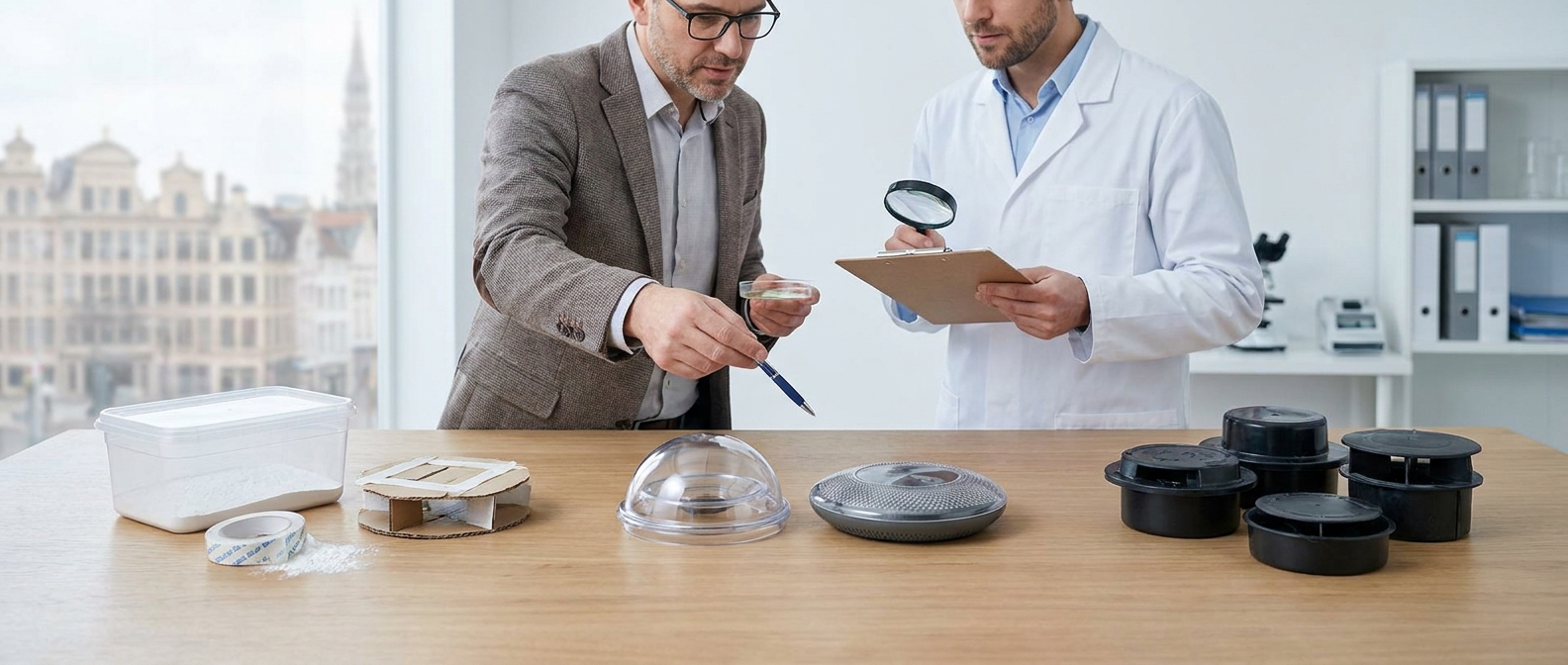
L’OmniGuard is probably the best-known in professional circles. Its double-walled design creates two capture zones: one for bedbugs descending from the bed, the other for those attempting to climb in. The inner surface is micro-textured so that the insect can get in, but the smooth coating on the bottom prevents it from getting out. Well thought-out. The plastic is sturdy, the profile low (it fits under most box springs), and the load capacity reaches around 200 kg per cup. For a double bed, that's no problem.
Visit Fleen Bug Safe takes a different approach. Fleen has developed a system in which the cup is integrated into a larger bedding isolation system. The idea is that the trap is not just for capturing: it's part of a complete protocol. The trapping texture is different, with a patented non-stick treatment. In the field, the capture rate is comparable to OmniGuard, sometimes slightly higher on nymphs (young, smaller, lighter bugs). The price is higher, around 30 to 40 % more than OmniGuard, but the kit often includes covers and installation guides.
Visit classic models, ClimbUp Interceptor or Sentinelle traps remain the historical benchmark. These are the interceptor bedbug traps that have been the focus of most scientific studies published since 2010. Their advantage: an unbeatable price (often less than 3 euros a piece in batches) and effectiveness proven by dozens of publications. Their limitations: the plastic is sometimes thin, the trapping surface quickly gets dirty (dust, hair), and they need to be cleaned regularly to maintain the slippery effect.
In this bedbug trap comparison, the real question is not «which one catches the most», but «which one are you going to maintain properly». An OmniGuard that has been clogged with dust for three months no longer traps anything. A ClimbUp cleaned every week remains formidable. Regular maintenance counts as much as the quality of the product.
A technical point that makes all the difference: the height of the outer wall. Bed bugs climb easily over rough surfaces, but are unable to climb over a smooth surface of more than 15 mm. OmniGuard and Fleen Bug Safe respect this margin. Some inexpensive models do not. Always check the height of the smooth area before buying.
My verdict on bedbug detection in doubtful situations? The ClimbUp or Sentinelle, in packs of 8, installed under each foot. If you want a durable system on a budget, the OmniGuard interceptor is still a safe bet. The Fleen Bug Safe is excellent if you're looking for an all-in-one kit for complete bedding insulation.
Making your own traps vs. buying certified models: Advantages and disadvantages
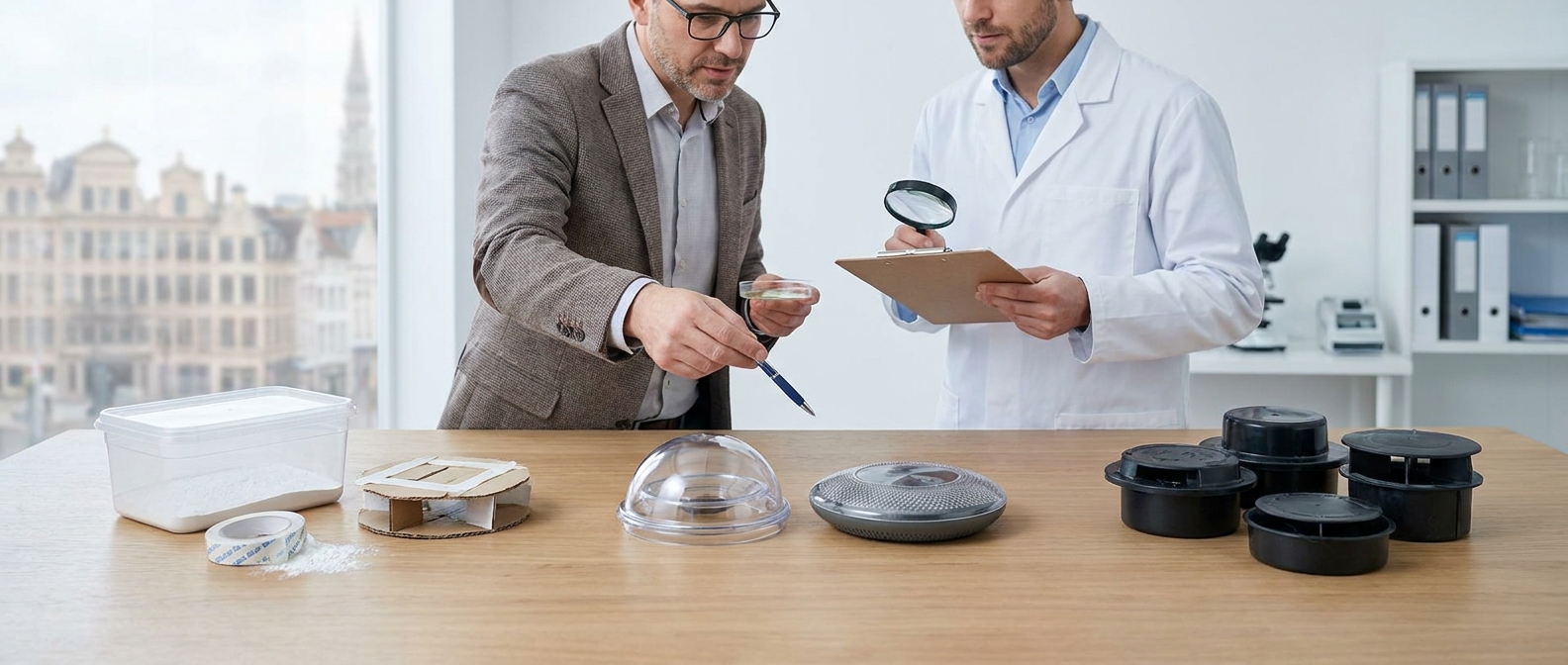
A customer showed me his installation last week: four plastic cups nested together, talcum powder sprinkled inside, all taped under the legs of the bed. The result? Two bedbugs trapped in one night. Proof that making a bedbug trap works. The question is: how long does it work, and under what conditions?.
The principle behind the DIY mechanical trap is simple. You create an area where the bug can enter but not leave. Two nested containers (one large, one small), a slightly rough outer surface (adhesive cloth, fine sandpaper), and an ultra-smooth inner surface (talcum powder, kerosene oil, smooth adhesive tape). The bug climbs onto the outer container, falls into the bowl and can't climb back up. It's exactly the same principle as commercial interceptors.
The advantages of homemade are obvious. Virtually zero cost: cups, talcum powder, scotch tape. Immediate availability: no need to wait for delivery. And best of all, it's a quick detection solution when you're in doubt at 11pm and want to know if there's something waiting for you in the mattress.
But the limits are quickly reached. Talc loses its effectiveness within a few days. Ambient humidity (and in Brussels, we know what that is) agglomerates the powder and creates micro-grips for the bedbugs' legs. Thin plastic cups deform under the weight of the bed. I've seen mounts crushed overnight, releasing the trapped insects. Not ideal.
The effectiveness of a certified interceptor depends on details that can't easily be reproduced at home. The calibrated roughness of the outer wall (enough for the bug to climb, not enough for it to get too much of a grip). The sliding coefficient of the inner wall, lab-tested. Mechanical resistance under load. These are industrial parameters.
So, should you make or buy? My answer is nuanced, but clear. For initial emergency detection Make your own. You'll know within 48 hours whether bedbugs are circulating on the floor. For long-term monitoring or bedding insulation as part of treatment Buy certified models. The difference in reliability over several weeks is too great to risk.
A homemade mechanical trap is a diagnostic tool. A pro interceptor is a treatment tool. Both have their place, but not the same role. To mix the two is to run the risk of believing you're protected when you're not, since the talcum powder absorbed the moisture from the bathroom next door.
One last point: if you make your own trap, remember to check it every morning. Take a photo of what you find. Nymphal bedbugs are translucent and tiny, easy to mistake for a speck of dust. A flashlight and a white background in the dish make all the difference to detection.
Selection criteria and installation: Our recommendations from experts in Brussels
Four criteria. That's all you need to evaluate to choose the right interceptor and install it correctly. Not fifteen, not twenty. Four. I use them every time I work with our customers in Brussels, and they've never failed.
First criterion: compatibility with your bed. It sounds silly, but it's the number one source of failure. Bed legs vary enormously: round, square, wide, thin, with castors, without castors. Measure the diameter or width of the foot before ordering. The OmniGuard accepts legs up to 7 cm in diameter. The Fleen Bug Safe goes up to 8.5 cm. Classic models vary. If your bed has wide runners or a frame that rests directly on the floor, you'll need to adapt (risers, wedges). An interceptor that doesn't fit under the foot of the bed is strictly useless.
Second criterion: the room's environment. To insulate your bed effectively, the trap is not enough. The bed must be an island. There must be no contact between the bedding and the wall, curtains, bedside table or a piece of clothing lying around. If the comforter touches the floor, the bedbugs bypass the interceptor. In Brussels, many older apartments have beds pushed up against the wall with fabric headboards. This is a direct bridge for bedbugs. Move the bed at least 5 cm apart, and tuck in sheets and comforter so they don't hang down.
Third criterion: inspection frequency. Monitoring an infestation of bedbugs doesn't mean putting up cups and forgetting about them. Inspect at least once a week. Look for live bugs, exuviae (moults), black spots (droppings). Clean the interceptors with soapy water, dry them thoroughly and put them back in place. A dirty trap is a dead trap. I insist: regular inspection is what separates successful detection from an infestation that worsens in silence.
Fourth criterion: the number of traps. One per foot is the minimum. Four for a standard bed. If you have a sofa bed, a mezzanine bed with a ladder, or a box spring on a metal frame with six support points, adapt. Some of our customers in Brussels also install interceptors under the legs of the sofa in the living room, especially in studios where the sofa is used as an extra bed. Clever.
For the actual installation, here's the sequence I recommend. Vacuum the entire room, paying particular attention to the baseboards and around the bed. Place the interceptors under each foot. Check that the bed is stable and won't tip over (adjust with wedges if necessary). Install a bedbug cover over the mattress and box spring. Move bed away from wall. Tuck in bedding. It's a 30-minute protocol that turns your bed into a safe zone.
The best bedbug trap, after all, is the one you actually maintain and inspect. A 50-euro model forgotten under the bed for six months is worth less than a plastic cup checked every morning. That said, if you want a long-term, reliable solution, investing in a real interceptor is well worth it. Our recommendations from Brussels: the OmniGuard for value for money, the Fleen Bug Safe for a complete bedding isolation protocol, and the classic ClimbUp if budget is tight but motivation is high.
A final field tip: never rely on traps alone. Interceptors are a detection and isolation tool, not a treatment. If you catch bedbugs, it's confirmation that action is needed, not the solution itself. Contact a professional for a complete diagnosis and a treatment plan tailored to your situation.
Conclusion
Interceptor-type bedbug traps are the most underrated tool in the fight against these insects. Simple, chemical-free and remarkably effective when used properly. Whether you choose to build a homemade trap for quick detection, or invest in a certified model like the OmniGuard or Fleen Bug Safe for long-lasting protection, the essentials remain the same: set them, inspect them, maintain them.
If you're in Brussels and suspect an infestation, don't be left alone with the problem. Put down your interceptors tonight, and if you find something tomorrow morning, give us a call. We know every neighborhood, every type of dwelling, and we'll be able to guide you towards the right strategy. Early detection is the difference between a manageable problem and a full-blown infestation.
Frequently asked questions
How does a bedbug interceptor work?
The interceptor is a double-walled cup placed under the foot of the bed. It uses a rough outer surface to allow bedbugs to climb, and an ultra-smooth inner wall that traps them by simple sliding, preventing them from reaching your mattress.
Are homemade bedbug traps effective?
DIY traps (cups and talcum powder) are excellent for immediate emergency detection. However, for long-lasting protection, they are less reliable than certified models, as the talc clumps with moisture and the cups can crush under the weight of the bed.
What's the best trap between OmniGuard, Fleen and ClimbUp?
The OmniGuard is the pro reference for value for money, while the Fleen Bug Safe offers premium insulation with a patented non-stick treatment. ClimbUp remains the most economical and scientifically proven choice for mass detection.
Why is it crucial to keep the bed away from the wall during installation?
Interceptors only work if the bed is an «island». If your comforter touches the floor or the headboard brushes against the wall, bedbugs will bypass the traps, using these direct bridges to gain access to you.
How often should you inspect your bedbug traps?
We recommend inspecting the cups at least once a week. Take the opportunity to wipe off any dust with a dry cloth, as a dirty surface allows insects to regain their grip and escape.

 French
  English
  Dutch
Dutch