

Sports halls and changing rooms: The danger of bedbugs
Contents
-
Choosing locker room equipment and furniture to facilitate detection
-
Maintenance guide and local solutions for pest-free changing rooms
There's a lot of talk about hygiene in gyms. Cleaning of machines, disinfection of mats, hydro-alcoholic gel at the entrance. All well and good. But there's a blind spot that nobody looks at: the changing rooms. Specifically, what lurks in the seams of benches, the gaps of lockers and the nooks and crannies of baseboards. Bedbugs.
Things to remember
-
In the face of classic design guides, we reveal a growing health risk: sports locker rooms as vectors of bedbug infestation.
-
This article deals with structural hygiene and furniture choices to protect clubs and their members.
-
Why are gym locker rooms hotbeds of infestation?
-
Choosing locker room equipment and furniture to facilitate detection
It's not a glamorous subject, and that's precisely why it's neglected. And yet, gym changing rooms have everything it takes to become silent hotbeds of infestation. Constantly passing people, bags on the floor, clothes piled up in confined spaces, heat, darkness. The perfect cocktail. And when a member brings home bedbugs after his or her crossfit session, no one makes the connection with the gym.
This article is aimed at club managers, architects who design these spaces, and users who want to understand the risk. We're going to talk about layout, choice of furniture and maintenance, but from an angle you won't find in the catalogs for community sports equipment: that of pest prevention.
Why are gym locker rooms hotbeds of infestation?
An adult bedbug measures 5 to 7 mm. They are flat, nocturnal and can survive for several months without feeding. They do not fly or jump. They travel. In a sports bag, in the lining of a jacket, in the folds of a towel. And that's exactly what happens in a locker room.
Imagine the flow: an average gym in Brussels welcomes between 200 and 500 people a day. Each person deposits his or her belongings in a locker or on a bench, changes, sweats, returns, gets dressed again. In the meantime, the bags are placed next to each other, sometimes in stacks. If just one person is carrying a bedbug (or worse, eggs stuck to fabric), the transfer can take place in a matter of minutes. The bug leaves the bag, crawls into a crack in the bench and waits. It has found a new territory.
Gym hygiene, as usually understood, doesn't cover this risk. Mopping, disinfecting surfaces, airing showers: these are all necessary, but they don't affect bedbugs. They don't live on clean floors or smooth surfaces. They seek out dark nooks and crannies, joints, screws and hinges. The smallest gap in a chipboard locker or a bench with slats becomes a refuge.
Three factors make changing rooms high-risk areas:
-
Passage density. The more people there are, the higher the probability of introduction. A room open 7 days a week, from 6 a.m. to 10 p.m., means a continuous flow.
-
Promiscuity of personal belongings. Sports bags touch, clothes hang side by side. Passive transfer is almost inevitable if an infestation is present.
-
Lack of inspection. Who checks inside the lockers? Who looks under the benches? In 90% clubs, no one. Maintenance is limited to the visible.
And here's the catch: a bedbug infestation in a changing room can remain invisible for weeks, even months. Bedbugs don't bite on the spot (they prefer to bite at night, in a bed). So users don't make the connection. They scratch at home, think it's mosquitoes, change their laundry. Meanwhile, the colony grows in the changing room and contaminates other bags, other clothes, other homes.
One thing many people don't know: bedbugs leave traces. Little black spots (their droppings), translucent molts, sometimes a sweet smell when the colony is large. But in a poorly-lit locker room, with dark furnishings and inaccessible corners, these signs go completely unnoticed. The hygiene of sports changing rooms can no longer be limited to surface cleanliness. Pest control must be integrated into the protocol.
Choosing locker room equipment and furniture to facilitate detection
When architects or managers choose locker room furniture, they think in terms of aesthetics, durability and budget. Rarely do they consider ease of sanitary inspection. This is a costly mistake.
Take the classic gym locker. The chipboard model with visible hinges and rubber seals. Visually correct, economical to buy. But it's a bedbug's paradise. The porous wood provides micro-cracks where they lay their eggs. The hinges create shadowy areas that are impossible to clean without dismantling. Joints age, peel and form pockets where an entire colony can settle.
Checkroom furniture designed for prevention is just the opposite:
-
Non-porous materials. HPL (high-pressure laminate), stainless steel or compact PVC. No micro-cracks, no porosity, no refuge. A bedbug on a smooth, non-porous surface is a visible bedbug.
-
Raised feet. Racks and benches placed directly on the floor create dead zones that are impossible to inspect. With 15 to 20 cm feet, you can vacuum underneath, shine a light and check. Simple, but formidably effective.
-
No nooks and crannies. Visible screws, 90° corners with joints, hollow tubular structures: all hiding places. Choose welded joints, continuous surfaces and rounded corners.
-
Light colors inside the lockers. Bedbug droppings are black. On a white or light-gray background, they're obvious. On a charcoal or black background, they're invisible. This choice of color is not cosmetic; it's a detection tool.
Benches deserve special attention. Many changing rooms still use wooden slatted benches, sometimes with built-in suspension hooks. Every slat, every screw, every gap between the planks is a potential hiding place. A one-piece, gap-free HPL bench can be cleaned in 30 seconds and inspected at a glance.
When it comes to fitting out a sports club, the question of professional furniture goes beyond the catalog. You have to think of the changing room as a sanitary space in its own right. Showers have anti-mould standards, floors have anti-slip standards. Why shouldn't lockers have anti-mildew standards?
A point often overlooked: electrical outlets and baseboards. Bedbugs love to crawl behind socket plates, in the spaces between baseboard and wall. When designing or renovating, seal these areas. Use grooved baseboards (with no gap to the floor) and watertight socket covers. Every millimeter counts.
If you manage a public sports facility (municipal gymnasium, aquatic center, multi-sports complex), the volume of traffic is even greater. The choice of furniture is not a detail: it's your first line of defense. A well-designed locker for a sports hall doesn't necessarily cost more than a conventional model. But it will save you a four-figure disinfestation bill and, above all, a reputational crisis.
Maintenance guide and local solutions for pest-free changing rooms
Having the right furniture is basic. But without the right maintenance protocol, even the best equipment ends up causing problems. Here's what really works, tested in the field.
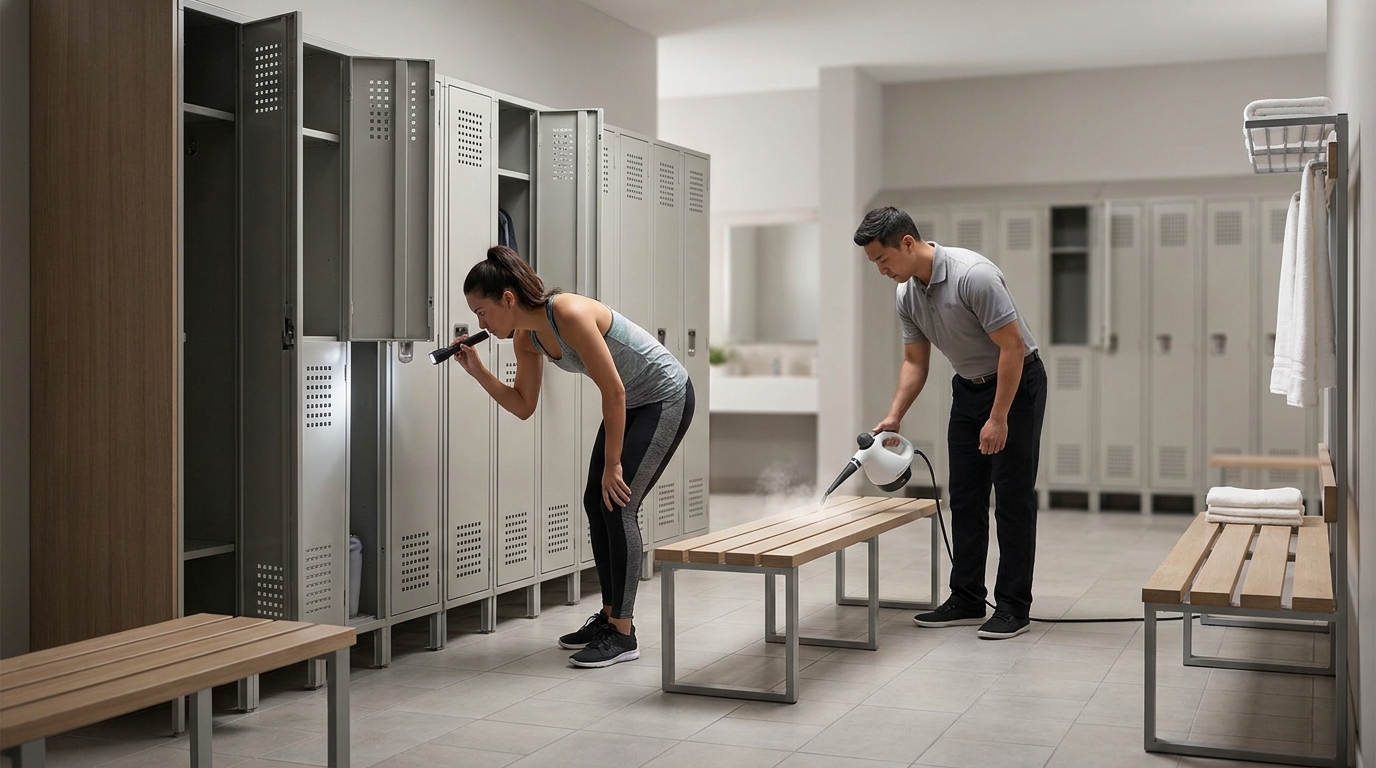
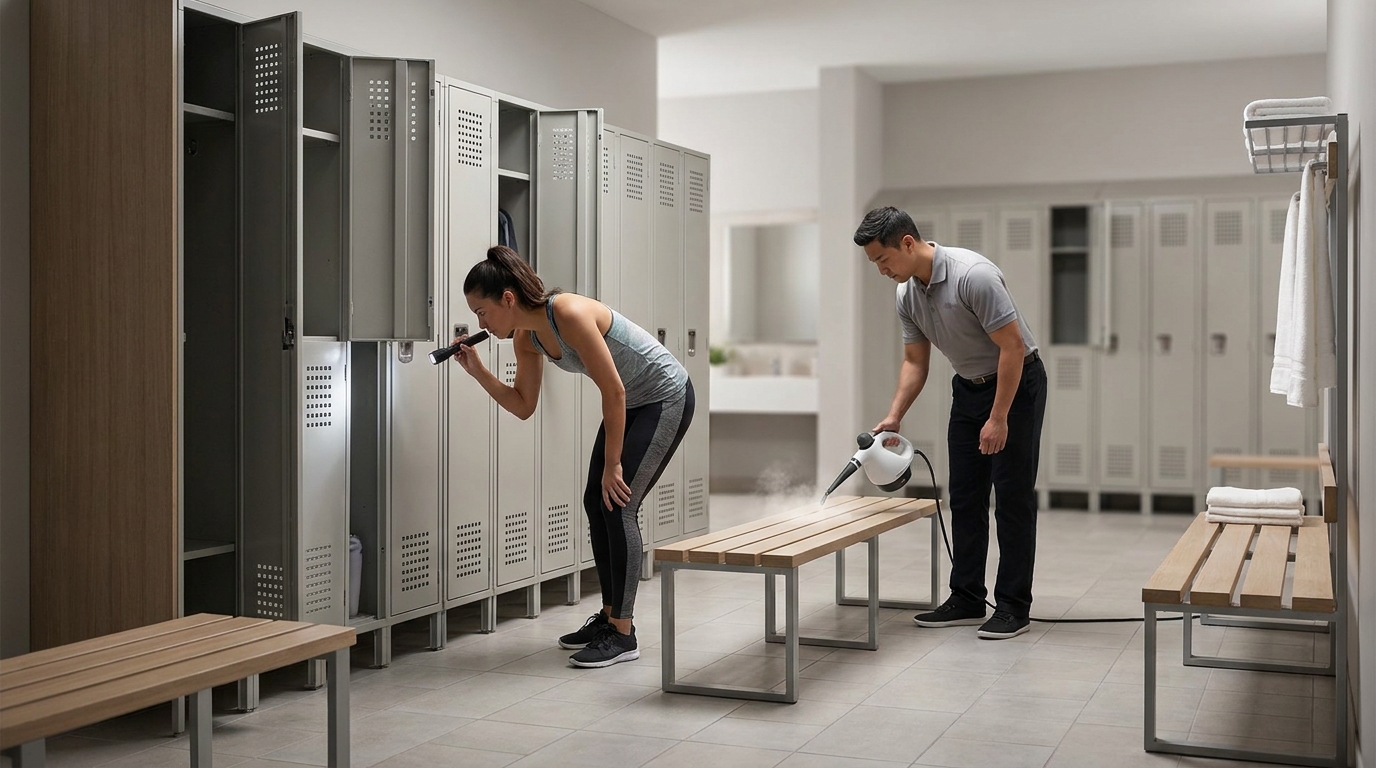
Weekly visual inspection. It takes 20 minutes for a medium-sized locker room. A flashlight, a keen eye, and we check: the inside of lockers (top corners especially), the underside of benches, hinges, skirting boards, sockets. Look for black spots, molts, eggs (tiny, pearly-white eggs stuck to surfaces). Train your maintenance staff. Show them photos. Early detection is the difference between a €300 localized treatment and a €3,000 generalized infestation.
Vacuuming, not just sweeping. A broom pushes dust away. A vacuum cleaner captures insects, eggs and debris. For sports locker room maintenance, a fine-tip vacuum cleaner should be used in every nook and cranny, at least once a week. Empty the bag outside the building, into a closed garbage bag. This is a vital detail: if you empty the vacuum into the locker room garbage can, you're putting any insects back into circulation.
Dry steam. It's the most effective weapon for preventing infestation. A steam cleaner at 120°C kills bedbugs at all stages (eggs, nymphs, adults) on contact. A monthly pass over high-risk areas (joints, foot of lockers, under benches) creates a formidable barrier. No need for chemicals, no residues, no risk to users. Some clubs are already incorporating this protocol into their routine. The others should get on with it.
A few additional measures that make all the difference:
-
Install raised bag holders. Bags on the floor are the number one vector. Wall hooks or shelves 50 cm from the floor drastically reduce the risk of transfer.
-
Communicate with your members. A discreet sign in the checkroom («Have you noticed any unusual bites? Report it to reception») can speed up detection. No need to create panic, just vigilance.
-
Keep an inspection log. Date, area checked, observations. In the event of a problem, this document proves your diligence and helps the pest control professional target his intervention.
For club managers in Brussels and Belgium, there are professionals specialized in the detection and treatment of bedbugs in collective environments. At Punaises de Lit Bruxelles, we regularly work in gyms, swimming pools and fitness centers. We're well aware of the specific features of these spaces: the flow of people, the time constraints (it's impossible to close for three days), the need for treatments without toxic residues for athletes.
A final word on pest prevention in general. Bedbugs in the gym are not inevitable. It's a manageable risk, provided you take it seriously before it becomes a problem. Clubs that integrate this dimension into their overall hygiene, in their choice of furniture and in the training of their staff, are the ones that will never have to manage a crisis.
And for club-goers: if you go to a club and notice bites in a line on your skin (typically three bites in a row, the bug's famous «breakfast, lunch, dinner»), ask yourself. Inspect your sports bag. If in doubt, wash your gear at 60°C after each session. Individual vigilance complements collective prevention.
Conclusion
Sports halls and changing rooms are wellness areas. They should never become infestation vectors. Yet, without appropriate furniture, inspection protocols and awareness-raising, this is exactly what happens, more often than you might think.
If you're a manager, architect or person in charge of a sports facility, get to grips with the subject now. Audit your changing rooms, rethink your furniture if necessary, train your teams. And if you have the slightest doubt about the presence of bedbugs, don't leave it to chance. Contact a professional for an inspection. At Punaises de Lit Bruxelles, we always prefer to intervene early, when the problem is still small, rather than deal with an established infestation. Your reputation and the health of your members depend on it.
Frequently asked questions
How do bedbugs get into a gym?
Bedbugs aren't born in clubs; they travel by «hitchhiking». They are passively transported by members in sports bags, coats or towels, before spreading through the interstices of lockers and benches.
Why are changing rooms high-risk areas for infestation?
The high turnover of users and the close proximity of personal belongings create an ideal environment. Bags lying on the floor or piled up clothing facilitate the transfer of insects from one piece of equipment to another in spaces that are often dark and confined.
What are the signs of bedbugs in a locker?
Inspect corners and hinges for small black spots (droppings), fine translucent molts or pearly-white eggs. On dark furniture, these clues are difficult to see, which is why it's important to use a flashlight and prefer light-colored crates.
What type of furniture should I choose to avoid bedbugs in the gym?
Choose non-porous materials such as metal or high-pressure laminate (HPL), and furniture with legs for easy cleaning. Avoid chipboard and slatted structures, as their micro-cracks provide impenetrable hiding places for pests.
How do you get rid of bedbugs in a professional changing room?
Dry steam treatment (120°C) is the most effective solution, as it kills eggs and adults without toxic chemicals. In addition, rigorous weekly vacuuming of all nooks and crannies and sealing of baseboards drastically reduce potential outbreaks.

 French
  English
  Dutch
Dutch