


Can you smell a bedbug bite? Analysis and advice
Contents
You woke up this morning with little red spots on your arm, and one question keeps coming up: did a bedbug bite me last night? And more importantly, why didn't I feel anything? This is the question 9 out of 10 customers ask me when I visit them in Brussels. Nobody understands how an insect can feed on your blood for ten minutes without you flinching.
Things to remember
-
The biological mechanism of anesthetic saliva unlocks the mystery of sting indolence
-
The article deconstructs the confusion between ‘bite’ and ‘sting’, while offering local Brussels expertise in identifying late skin reactions and signs of infestation that are often invisible at first glance.
-
Why can't I feel a bedbug bite?
-
Types of pimples and onset times
So let's get one thing clear from the outset: the term «bedbug bite» is often used, but it's a misnomer. Bedbugs don't bite, they bite. It pushes a rostrum into your skin, like a needle. The difference isn't just semantic: it explains why a bedbug bite goes completely unnoticed at the time. And why reactions only appear hours, sometimes days, later.
This article gives you the keys to understanding this mechanism, recognizing the real symptoms, and knowing what to do if you live in or around Brussels. Don't panic, but don't be naive either: an infestation never resolves itself.
The biological mechanism: why can't you feel a bedbug bite?
Bedbugs, Cimex lectularius, has developed a formidable biological arsenal for feeding undetected. This is the result of millions of years of co-evolution with humans. And frankly, when you take a close look at the process, it's almost fascinating (if you forget the disgust for a second).
When a bedbug bites you, it immediately injects its saliva into the micro-plaque. This anesthetic saliva contains a cocktail of substances, each with a specific role to play. Firstly, a natural anesthetic that literally puts the bitten area to sleep. Your skin no longer transmits a pain signal to the brain. You sleep, you feel nothing. Zero.
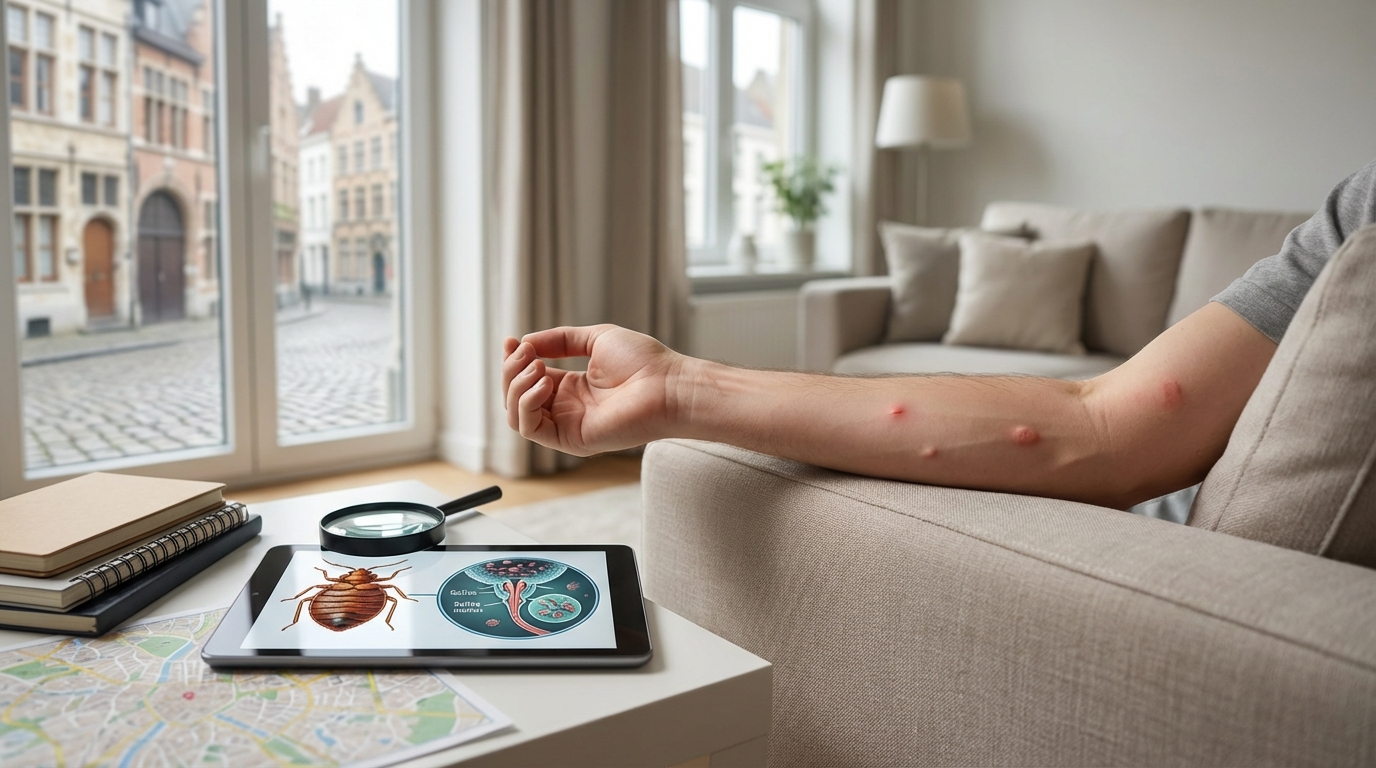
Saliva also contains a powerful anticoagulant. Why is that? Because without it, your blood would clot around the bug's rostrum and block the blood pump. The anticoagulant maintains the flow, and the bug can feed quietly for 5 to 15 minutes. Sometimes longer. It swells, takes on a dark red hue, then withdraws and goes back into hiding.
This biological mechanism is the reason why the bite is totally painless. Unlike a mosquito (whose bite often causes a little immediate tingling), the bedbug has perfected its approach to the point where you can't feel a bedbug bite, even if you're a light sleeper. I've had clients with insomnia, people who wake up at the slightest noise: none of them ever felt the bite at the time.
An often overlooked detail: bedbugs don't bite just once. It usually makes several successive bites, either because it's looking for an optimal blood capillary, or because it's been slightly disturbed and has moved a few millimeters. This explains the famous lined-up pimples we'll talk about next.
Another thing that surprises my customers is that the bedbug is attracted by the CO2 you exhale and by your body heat. They don't «choose» you, they follow a chemical gradient. That's why they mainly bite at night, when you're still and breathing regularly. The mechanism is well-honed. The bug detects, approaches, bites, anesthetizes, pumps, withdraws. All without triggering the slightest alarm in your nervous system.
Result: can you smell a bedbug bite? No. Categorically no, not when it happens. What you feel are the consequences, and they come long afterwards.
Identifying reactions: types of pimples and onset times
Three days. That's the average time it takes for a skin reaction to appear after a bedbug bite. For some people, it's just a few hours. For others, up to 14 days. And in around 30% of the population, there's simply no visible reaction. Not a thing. Not a pimple.
That's what makes diagnosis so complicated. Someone can be stung every night for weeks without ever seeing the slightest sign on their skin. His partner, in the same bed, may be covered in pimples from the very first night. Skin reaction depends entirely on your immune system and your individual sensitivity to the proteins contained in the bedbug's saliva.
When pimples appear, what do they look like? The most characteristic sign is their alignment. Dermatologists speak of onion-row pimples: three, four or five small lesions arranged in a straight line or in a small, tight group. This arrangement reflects the path of the bedbug, which bites, moves forward a few millimeters, then bites again. You won't find this with mosquito bites, which are scattered randomly over the body.
In dermatology, these lesions are classified as maculopapules: little red bumps, slightly raised, sometimes with a darker central spot. They resemble mosquito bites, yes, but with the linear arrangement that makes the difference. The areas most affected are the arms, shoulders, neck, legs: anything that sticks out from the sheets at night.
Night-time itching is another warning sign. Not because the bedbug bites you at that time (although, if the infestation is active, it may), but because the itching associated with existing bites often intensifies at night, when the body warms up under the comforter. Many of my Brussels customers tell me, «I scratch mostly in bed.» This makes sense.
Allergic reactions vary enormously from one person to another. Some develop a simple rash that disappears in two days. Others develop blisters, severe swelling and unbearable itching that lasts for more than a week. In the most severe cases (rare, but real), a generalized allergic reaction can occur. If you notice facial swelling or breathing difficulties, it's the emergency room, not the exterminator.
One point I'd like to emphasize: there is such a thing as a stinging sensation without a pimple. Some people feel a tingling sensation, a slight burning sensation on the skin, without any visible marks. This is frustrating, because it makes diagnosis almost impossible on the basis of skin symptoms alone. In such cases, you have to look for other clues. And that's exactly what we're going to see.
How long does a bedbug bite (or rather, the reaction to the bite) last? Allow between 3 and 10 days for classic cases. With appropriate local treatment (antihistamine cream, mild corticosteroid on prescription), it calms down more quickly. Without treatment, itching may persist, and scratching may lead to superinfection.
Diagnosis and action: confirm the infestation and take action in Brussels
Pimples lined up on waking are not enough to make a diagnosis. I know, it's infuriating. But I've seen too many people treat their apartment for bedbugs when it was really mites, fleas, or even an allergy to the new detergent. Before you go into panic mode, you need to confirm.
The most reliable signs of infestation are not on your skin, they're in your bed. Lift the mattress. Look at the seams, the folds, the nooks and crannies of the box spring. What you're looking for: small black or dark-brown spots (droppings), traces of dried blood on the sheets (when a gorged bedbug gets crushed while you're sleeping), and possibly molts, those little translucent skins that bedbugs leave behind as they grow.
Signs of their presence can also be found in cracks in the bed frame, behind the headboard, in nearby baseboards, sometimes even behind electrical outlets. Bed bugs are photophobic: they shun light and hide in the narrowest possible spaces. A space the thickness of a credit card is enough.
If you find these signs, or even if you have a serious doubt, the next step depends on where you live. In Brussels, you're in luck (so to speak): the city has a network of specialized professionals, and the subject is no longer taboo. Infestations have exploded throughout Belgium in recent years, and Brussels has not been spared. Not even Ixelles, Uccle or Saint-Gilles. No commune is immune.
At Brussels bedbugs, We always start with a thorough inspection before proposing anything. If a pest control expert in Brussels sells you a treatment without having inspected your home, run away. Visual diagnosis, supplemented if necessary by canine detection, is the basis. You can't treat blindly.
Once infestation has been confirmed, the protocol is clear. Heat treatment, targeted chemical treatment, or a combination of both, depending on the situation. Every case is different: a studio in Saint-Josse is not treated in the same way as a house in Woluwe. The surface area, the level of infestation, the type of furniture - everything comes into play.
For parallel treatment of bites, consult your doctor or pharmacist. Hydrocortisone-based creams relieve itching. Oral antihistamines also help, especially at night. The main thing is not to scratch: easier said than done, I know, but bacterial superinfections linked to scratching are a real problem.
My advice to all my customers in Brussels: don't wait. A female bedbug lays between 2 and 5 eggs a day. Within a month, a moderate infestation can become massive. People who wait «to see if it goes away» systematically end up with a much more costly problem to solve. Time is against you, not for you.
And no, commercial products don't solve the problem. Insecticide sprays disperse bedbugs to other rooms without killing them. You're turning a localized infestation into a generalized one. A bedbug expert in Brussels will tell you: professional treatment is the only thing that works in the long term.
Conclusion
No, you can't feel a bedbug bite as it happens. The insect's anesthetic saliva is too effective for that. What you can spot are the consequences: onion-like pimples that appear in the following hours or days, itching that intensifies at night, and above all, the physical traces left by bedbugs in your bedding.
If you're in Brussels and these symptoms speak to you, don't remain in doubt. Contact Brussels bedbugs for professional inspection. The earlier the diagnosis, the simpler, faster and more affordable the treatment. We operate in all the communes of Brussels, and always start by listening to your situation before proposing a solution.
Frequently asked questions
Can you feel a bedbug biting you at night?
No, it's impossible to feel the bite at the precise moment it occurs. The bedbug injects an anesthetic saliva that numbs the area, allowing it to feed on your blood without waking you.
Why doesn't a bedbug bite hurt right away?
Pain is absent because the insect uses a sophisticated biological cocktail of a natural anesthetic and an anticoagulant. This mechanism prevents your brain from receiving a pain signal and keeps the blood flowing during the meal.
How long does it take for bedbug spots to appear?
The cutaneous reaction is never immediate: it generally appears between a few hours and 3 days after the sting. In some people, the delay can extend to 14 days, while 30 % of the population develop no visible reaction.
How to recognize a bedbug bite on the skin?
The most reliable sign is the alignment of spots, often referred to as «onion rows». Unlike mosquitoes, bedbugs bite several times in a linear trajectory along exposed areas such as the arms, shoulders or legs.
What should I do if I suspect a bedbug infestation in Brussels?
Don't treat yourself with commercial products that may disperse the insects. Contact an expert like Punaisesdelitbruxelles quickly for a thorough inspection and professional diagnosis, so you can act before the infestation spreads.

 French
  English
  Dutch
Dutch