


Bedbug size: can you really see them with the naked eye?
Contents
-
The real visibility of bed bugs: myths and physical realities
-
A practical guide to visually identifying signs of presence in Brussels
I'm asked this question at least three times a week. A Brussels customer calls, a little panicked: «I found something tiny on my mattress, but it's so small... could it be a bed bug?» The short answer: yes, you can see them. The long answer is worth thinking about, because the size of a bed bug varies enormously according to its stage of development, and that's exactly where the confusion arises.
Things to remember
-
We shatter the myth of invisibility by explaining exactly what the human eye can perceive at each stage, from egg to adult.
-
By using everyday points of comparison, we transform an abstract anxiety into a concrete visual diagnosis, while asserting Punaisesdelitbruxelles' local expertise.
-
Understanding the size of bed bugs from egg to adult
-
Physical myths and realities
Many people think that these bugs are microscopic, invisible without a magnifying glass. But they're not. An adult Cimex lectularius is the size of an apple seed. You don't need a microscope for that. The real challenge is to spot the youngest ones, the nymphs, the ones that have just hatched and measure barely a millimetre. Here, you need to know where to look and what to look for. That's exactly what we're going to detail here.
At Punaisesdelitbruxelles, we intervene on a daily basis in homes where residents have been in doubt for weeks. They saw «something», but weren't sure. This article is designed to give you the concrete visual cues you need to turn doubt into certainty, without waiting for the infestation to grow.
Understanding the size of bed bugs from egg to adult
A bedbug egg is a grain of rice cut into four. We're talking about 1 millimetre long, pearly white and slightly translucent. At this stage, you really need to look closely. Placed on a white sheet, it goes unnoticed. On a dark mattress seam, on the other hand, it's easy to spot if you know it's there. Females lay between 5 and 15 eggs a day, often in clusters stuck in nooks and crannies. When you come across a cluster of eggs, there's no doubt about it.
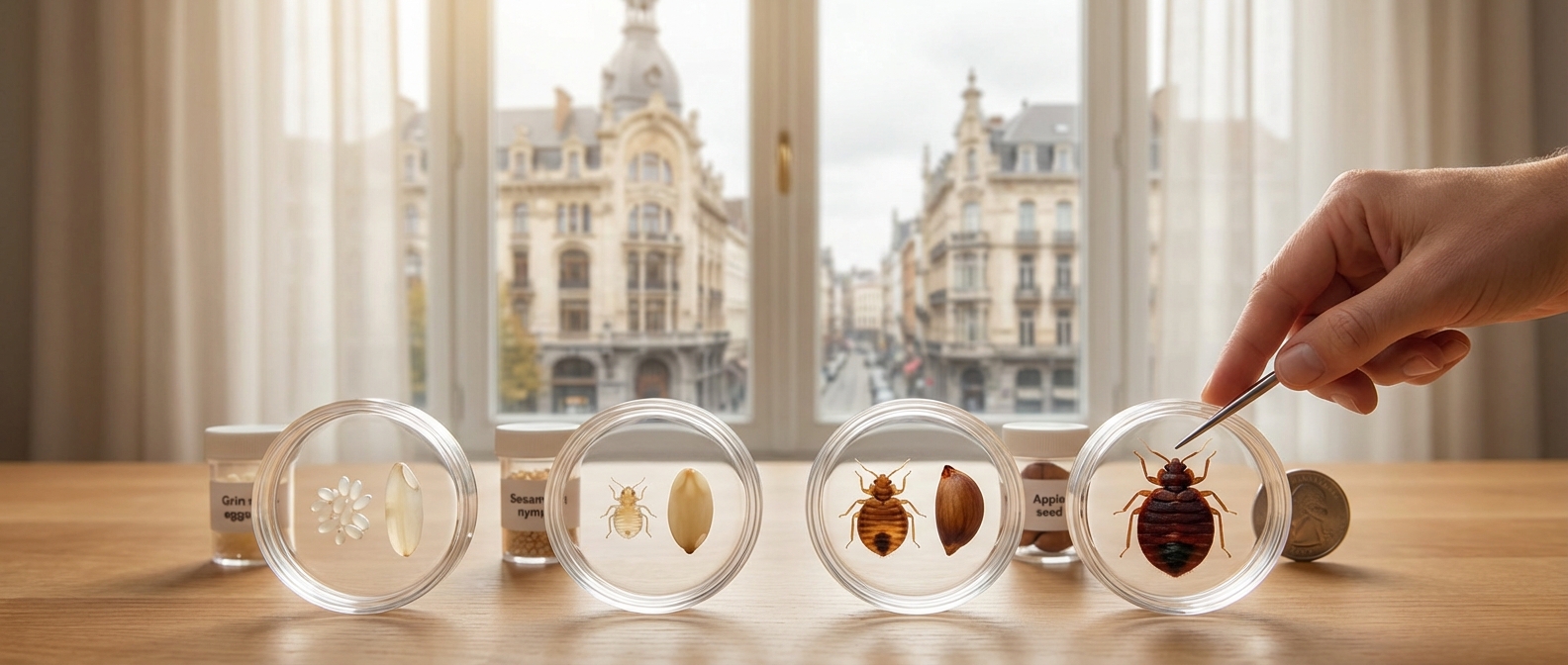
The bedbug life cycle comprises five nymphal stages before adulthood. Each stage requires a blood meal to move on to the next. An important detail: an uneaten bedbug nymph is almost transparent. They measure between 1 and 2.5 millimeters in the early stages. This makes them difficult to spot on light-colored fabric. Once they've eaten, they turn bright red, gorged with blood, and then they're quite obvious.
Exactly how long is an adult bedbug? Between 5 and 7 millimeters. The size of a mature bedbug can easily be compared to an apple seed, in shape and size. Flat when hungry, swollen and elongated after a meal. Its color ranges from light brown to dark reddish-brown. At this stage, the size of a bedbug leaves no room for doubt: you see it, period.
To give you some concrete pointers, here's what it looks like in everyday comparisons:
-
Egg (1 mm) : a grain of salt, perhaps a hair longer
-
Pupa stage 1 (1.5 mm) : a pinhead
-
Pupa stage 3 (3 mm) : a sesame seed
-
Adult (5-7 mm) : an apple seed, a small brown lentil
So the size of an adult bedbug is far from negligible. What fools people is that they never see adults in broad daylight. These insects are nocturnal and hide in tight places. When you turn over a mattress and discover a colony, the most frequent reaction is: «But how long have they been there?» Often, weeks. Sometimes months.
The actual size of a bedbug is almost always surprising. People expect a tiny, invisible insect. In reality, it's their behavior that makes them discreet, not their size. They avoid light, slip into slits only a few millimeters thick, and only come out at night to feed. It's this ability to hide, far more than their size, that explains why an infestation can go undetected for so long.
The real visibility of bed bugs: myths and physical realities
«They're too small to see with the naked eye.» I hear it all the time. And it's the number one myth to deconstruct. You can see a bedbug with the naked eye as early as nymph stage 2 or 3, and it's even easy for an adult. The problem is never size. The problem is not knowing where to look, or when.
The confusion probably comes from dust mites. Dust mites, on the other hand, are truly microscopic (0.2 to 0.3 mm). Impossible to see without optical aids. Bedbugs are a different matter. They are visible crawling insects, with a segmented body, six legs and a recognizable oval shape. Even a stage 1 nymph, at 1.5 mm, remains theoretically visible if you have good light and a contrasting background. Is it easy? No. But it can be done.
The translucent color of young nymphs complicates matters, it's true. On a white sheet, a nymph that hasn't eaten yet is almost invisible. On a gray or beige mattress seam, the same is true. After a blood meal, everything changes: the nymph turns dark red, and even the smallest ones can be detected if you take the time to inspect methodically.
How can you be sure it's a bedbug and not some other insect? A few visual criteria are all that's needed. Adult bedbugs are flat (when they haven't eaten), oval, reddish-brown, with no visible wings. They don't jump, unlike fleas. They don't fly, unlike certain beetles that are sometimes mistaken for them. It's a slow, crawling insect that moves by walking. If you step on a blood-soaked specimen, it leaves a characteristic red mark.
For those looking for «bed flea size» or «size of a bed flea»: beware, fleas and bedbugs are two totally different insects. Fleas measure 1 to 3 mm, jump, and are laterally compressed (flattened on the sides). Bedbugs are dorsoventrally flattened (like a small disk) and never jump. If your bug jumps when you try to catch it, it's not a bug.
Another point that often comes up: are bed bugs big? It all depends on your reference. Compared to an ant, yes, an adult is bigger. Compared to a cockroach, no. The bedbug, whatever its size, remains a small insect. What complicates identification is less the question of size than that of context: an isolated bedbug on a beige mattress, in a poorly-lit bedroom, at 2 a.m., is not immediately obvious. The same bedbug on a white sheet in broad daylight is immediately obvious.
My tip for reliable visual detection: use a white LED flashlight, inspecting the seams of the mattress, the folds of the box spring, the corners of the bed frame. Do this in the morning, before shaking out the sheets. And look carefully: not a quick glance, but a methodical inspection, centimeter by centimeter. That's how we work at Punaisesdelitbruxelles, and that's how we find things.
A practical guide to visually identifying signs of presence in Brussels
You won't necessarily find the bug itself first. In 80 % of cases, it's the tracks that raise the alarm before you see a single live bug. And when you know how to read them, they're very telling.
First of all, the black excrement. These are small, dark, almost black spots, 1 to 3 mm in diameter, resembling felt dots. They can be found on mattress seams, box springs, slats and sometimes on sheets. If you wipe a damp cotton pad over it, the stain will turn reddish-brown (it's digested blood). This is an almost certain sign. Don't panic if you see two or three: it may indicate the beginning of an infestation. If you see dozens, however, you need to act fast.
Bloodstains on sheets are next. When a blood-thirsty bedbug gets squashed unintentionally while you're asleep, it leaves a small reddish-brown stain. It's not systematic, but it's common. These marks often appear near the pillow or on the torso, where the skin is exposed.
Molting is another valuable clue. At each pupal stage, the bedbug leaves an exuvia, an empty, translucent envelope that retains the exact shape of the insect. Finding moults in the usual hiding places (seams, cracks in the box spring, behind the headboard) confirms an active infestation with reproduction in progress.
Where to look? The favorite hideaways of bedbugs in Brussels don't really differ from those elsewhere, but the types of housing in Brussels have their own specificities. Older buildings in Saint-Gilles, Ixelles or Schaerbeek, with their wooden floors and peeling baseboards, offer perfect refuges. Here are the areas to be inspected in priority:
-
Mattress seams and piping: turn it over, inspect every centimetre, especially the corners
-
The base : battens, backcloth staples, screws and gaskets
-
Headboard: behind, in the fasteners, in the gaps if it's wood
-
Nightstands: drawers, screws, joints
-
Baseboards and electrical outlets : bedbugs love to crawl behind socket covers
-
Frames and pictures hung on the wall: they are regularly found here, especially near the bed
How can you find out where bedbugs are hiding when you can't see anything obvious? Visual detection has its limits, especially in the early stages of an infestation when there are only a few individuals. If you have suspicious bites (grouped by 3 or 4, often in a line, on the arms or shoulders) but no visible traces, it's time to call in a professional. At Punaisesdelitbruxelles, we use complementary detection techniques, including canine detection, which spots bedbugs even when they're tucked away in a floor crack inaccessible to the eye.
How can I tell if it's bedbug bites? Bites alone are not enough to make a diagnosis, because they resemble mosquito or flea bites. It's the combination of bites + physical traces (droppings, molts, bloodstains) that allows us to be certain. If you have both, don't wait. Each week's delay doubles the population.
One last practical point: take photos. If you find a suspicious insect or tracks, photograph them with your phone in macro mode, using an object for scale (a coin, a grain of rice). Send us the images: we can often confirm or refute your suspicions in a matter of minutes, even before you go out. We offer this service free of charge, because we know that doubt is sometimes worse than certainty.
Conclusion
The size of bedbugs is not the real obstacle. An adult is perfectly visible to the naked eye, and even nymphs can be spotted with a little method and a good lamp. What makes these insects difficult to detect is their nocturnal lifestyle and their talent for hiding in the smallest nooks and crannies.
Remember the simple comparisons: a grain of salt for the egg, a pinhead for the young nymph, an apple seed for the adult. If you find black excrement on your mattress, traces of blood on your sheets or translucent molts in the seams, don't remain in doubt.
Contact Punaisesdelitbruxelles. We intervene quickly anywhere in the Brussels region, identify the level of infestation and suggest a suitable treatment. The sooner you take action, the faster it's over.
Frequently asked questions
Can you really see a bedbug with the naked eye?
Yes, absolutely. Although discreet and nocturnal, adult bedbugs are perfectly visible: they measure between 5 and 7 mm, the size of an apple seed. Eggs (1 mm) and young nymphs are harder to spot, but still detectable in good light.
What does a bedbug egg look like?
A bedbug egg looks like a small, elongated grain of salt, or a grain of rice cut into quarters. Pearly white and slightly translucent in color, they are often deposited in sticky clusters in the seams of mattresses or cracks in box springs.
What's the difference in size between a flea and a bedbug?
Confusion is common, but they are two different insects. The flea is smaller (1 to 3 mm), flattened on the sides and jumps. The bedbug is larger (5 to 7 mm), flattened like a disk and never jumps; it moves only by crawling.
How do I know if what I've seen is a bedbug?
Use simple points of comparison:
Egg: A grain of salt.
Young nymph: A pinhead.
Adult: An apple seed or a small brown lentil.
If the insect is reddish-brown, oval, flat and hiding from the light, it's probably a bedbug.
What are the visual signs of an infestation if I can't see the insect?
If bedbugs are hidden, look for their traces: little black dots (excrement) on the seams of your mattress, fine bloodstains on your sheets or translucent molts (empty skins) in the nooks and crannies of your box spring or behind your skirting boards.
What should I do if I find a suspect insect in my home in Brussels?
If possible, don't crush it immediately. Take a photo in macro mode next to a coin for scale and send it to Punaisesdelitbruxelles. We'll identify the insect free of charge to confirm whether it's a threat requiring treatment.

 French
  English
  Dutch
Dutch