

Back from vacation: how to avoid introducing bedbugs into your home
Contents
-
Thermal cleaning vs. insulation: Comparing methods for disinfecting your luggage
-
Manual inspection vs. canine detection: Selection criteria for assessing infestation risk
You're back from vacation, tanned, relaxed, and perhaps with some stowaways in your luggage. Bed bugs love to travel. They slip into the seams of your suitcase, between the folds of your clothes, sometimes even into the edge of a paperback book. And once in your home, they settle in very, very quickly. A female's reproductive cycle can produce up to 500 eggs over her lifetime. In other words, a poorly managed return from vacation can turn your bedroom into an infested zone in a matter of weeks.
Things to remember
-
We go beyond generic advice by proposing a technical comparison of decontamination methods (thermal vs. chemical) and a professional inspection protocol adapted to Brussels homes, to transform a simple concern into an infallible preventive eradication strategy.
-
Comparative methods for disinfecting your luggage
-
Selection criteria for assessing infestation risk
-
Recommendations before returning to your room
What we're going to see here isn't the list of vague advice you'll find everywhere («inspect your hotel bed», thank you very much). We're going to compare decontamination methods in concrete terms, thermal versus chemical, and give you a real inspection protocol adapted to Brussels homes. Because between a studio in Saint-Gilles and a mansion in Uccle, the hiding places aren't the same, and neither are the solutions.
The aim is simple: to prevent a bedbug infestation even before you put your suitcase in the hallway. Not after. Before.
Thermal cleaning vs. insulation: Comparing methods for disinfecting your luggage
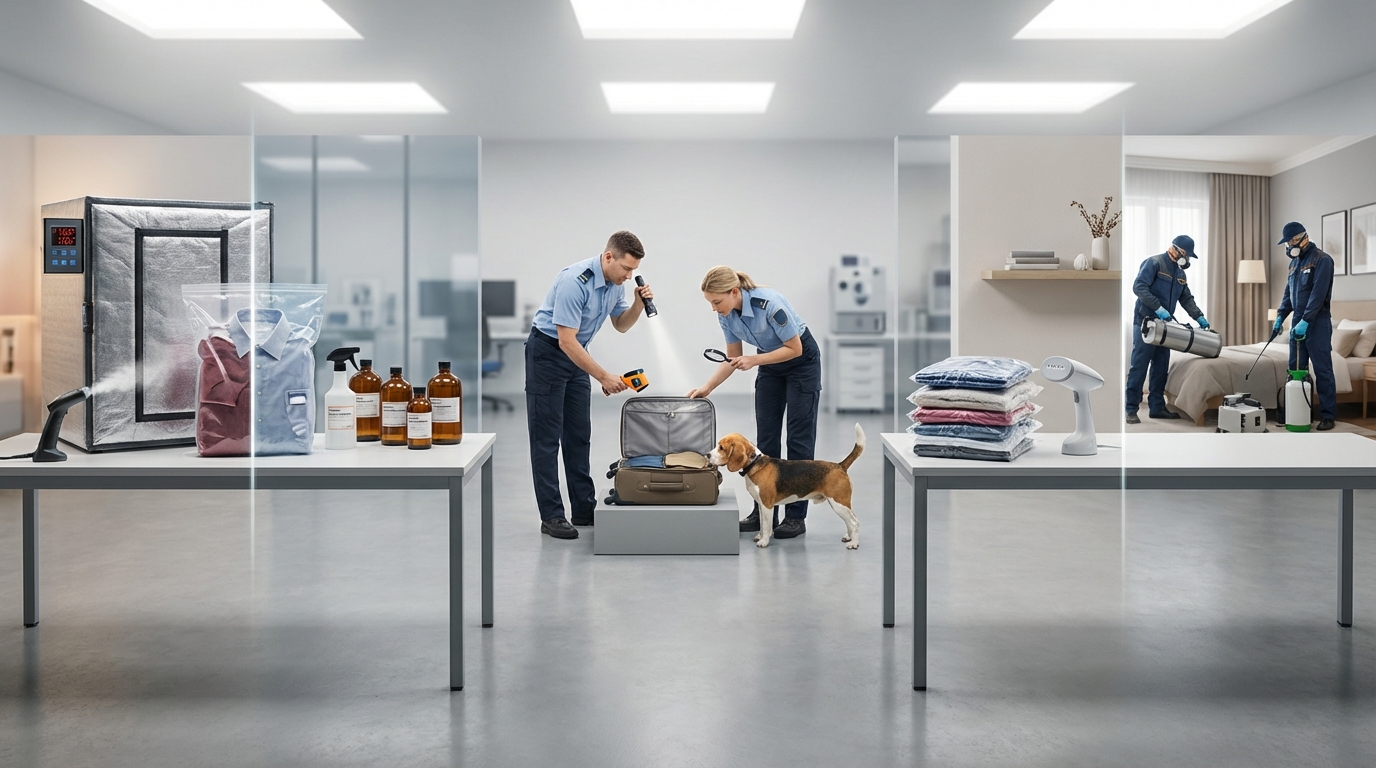
First thing to know: bed bugs die at 56°C and above. That's the key figure. Anything above this temperature for at least 30 minutes kills them, adults, nymphs and eggs included. That's why washing at 60 degrees remains the most accessible and reliable method of treating your clothes when you return from a trip. Just take everything out of the suitcase, place it in a sealed garbage bag and head for the machine. No sorting on the bed, no piles on the sofa. Straight to the machine.
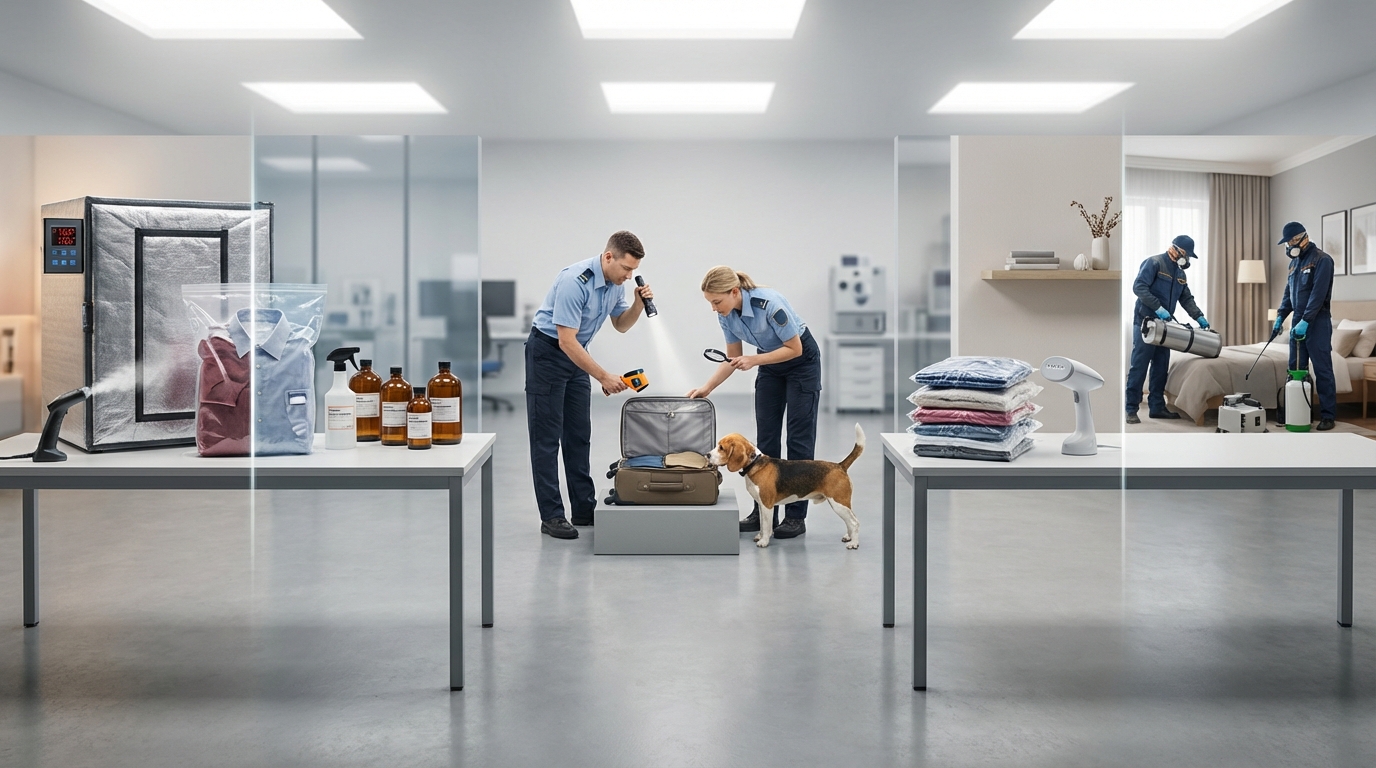
For textiles that can't stand 60°C (wool, silk, some synthetics), there's the opposite option: cold. Freezing also kills bedbugs, but you need to be patient. We're talking 72 hours minimum at -18°C. Not 48 hours, not overnight. 72 hours. Put your belongings in an airtight bag, place them in the freezer and forget about them for three days. It's restrictive, but it works.
Third option, and frankly the most effective on the luggage itself: dry steam. A professional device shoots steam at 180°C. At this temperature, nothing survives. We treat the suitcase's seams, pockets, wheels, zippers - every nook and cranny where a bedbug could hide. The advantage of dry steam is that it penetrates the fibers without soaking them. Your suitcase is dry in just a few minutes.
Now, let's talk about insulation. The principle of the hermetic bag is to confine the problem. You enclose your suspicious items in an airtight bag, cutting off oxygen and the possibility of leakage. It's useful as an emergency measure, especially if you can't wash up immediately. Special airtight bags for bedbugs are available in supermarkets and online. They're thicker than conventional rubbish bags and have a really tight seal.
But let's be clear: insulation alone doesn't kill bedbugs. It contains them. If you leave a sealed bag closed long enough (we're talking months, because an adult bedbug can survive up to a year without feeding under certain conditions), they'll eventually die. Nobody wants to wait a year. Isolation is a containment step, not an eradication solution.
My advice? Combine the two approaches. First insulate in airtight bags as soon as you arrive. Then treat them thermally: machine at 60 degrees for the clothes, freezer for the rest, dry steam for the suitcase itself. This combination covers 99% of cases. And don't make the classic mistake: never store your suitcase in the bedroom until you've treated it. The garage, the terrace, the bathroom, anywhere but where you sleep.
Manual inspection vs. canine detection: Selection criteria for assessing infestation risk
You've taken care of your luggage. The question remains: did a bedbug still manage to escape into your home? That's where inspection comes in, and there are two schools of thought.
Manual inspection is what you can do yourself, right away, without buying anything. Signs of bedbugs are pretty typical when you know what to look for. Little black spots on the sheets or mattress (these are their droppings), traces of dried blood (when you crush a blood-drenched bedbug while turning over at night), translucent molts, and of course the insects themselves: oval, flat, reddish-brown, between 4 and 7 mm in adult size.
For an effective suitcase inspection, take a flashlight and a bank card (or any thin, rigid object). Run the card along the seams, inside pockets and under labels. Bedbugs love to lodge themselves in the interstices. Do the same on your mattress: lift the corners, inspect the topstitching, look behind the headboard. In older Brussels apartments, check baseboards, electrical outlets and cracks in the walls. These homes have charm, but also lots of hiding places.
Bedbug eggs, on the other hand, are a different story. They measure around 1 mm, are white, sticky and often laid in very inconspicuous places. With the naked eye, even an experienced professional can miss them. This is where canine detection comes into its own.
Dog detection in Brussels is carried out by dogs specially trained to detect the scent of live bedbugs and their eggs. The reliability rate of a well-trained dog is around 95%, compared with 30 to 40% for a human visual inspection. The difference is enormous. A dog will sweep an 80 m² apartment in 15 to 20 minutes. A human would take two hours for a much less reliable result.
So, when to choose what? If you've traveled to a high-risk area (and to answer the question many people ask: the countries most affected are the USA, France, Australia and the UK, not necessarily the ones you'd imagine), if you've had suspicious bites, or if you've slept in questionable accommodation, canine detection is the rational choice. It costs between €150 and €250 in Brussels, depending on the surface area, and gives you a clear answer in less than half an hour.
Manual inspection, on the other hand, remains relevant as a first approach. You come home, see nothing suspicious, no bites, no spots: do your own check and remain vigilant for the next two weeks. If spots appear (often in rows or clusters, which is typical), go for canine detection without delay. Two weeks is the time it takes for the eggs to hatch and the first nymphs to start biting. After that, if all goes well, you can relax.
A point we often forget: bedbugs are not seasonal in the strict sense. I'm regularly asked when bedbug season ends. The answer is that there really is no season. They're active all year round in our heated interiors. The peak of infestations corresponds to the return of the summer vacations, simply because people travel more. The risk, however, is permanent.
DIY preventive treatment vs. professional intervention: Recommendations before returning to your room
Let's say the doubt persists. You've found a suspicious spot, or you've had a few bites but no visual confirmation. Should you treat preventively? And if so, alone or with a professional?
On the DIY side, the return-from-travel protocol I recommend is pretty straightforward. First, vacuum the entire room: mattress, box spring, baseboards, headboard, carpet if you have any. Immediately empty the vacuum bag or bin into a closed garbage bag, and take it out of the house. Remember, vacuumed-up bedbugs are alive. Next, install interceptor traps under the legs of the bed. These are small plastic bowls with a rim that bedbugs can't climb over. If bedbugs are present and try to climb onto your bed at night, they get trapped. This gives you confirmation within a few days.
When it comes to over-the-counter insecticides, let's be frank: most mainstream bedbug insecticides are not very effective. Bedbugs have developed considerable resistance to pyrethroids, which form the basis of the majority of sprays available in stores. You're going to spray, it's going to smell strong, and the bedbugs are going to disperse into other rooms instead of dying. Result: you've made the problem worse rather than solving it.
Diatomaceous earth, on the other hand, works differently. It's a mineral powder that damages the waxy cuticle of bedbugs and dehydrates them. It's non-chemical, non-toxic to humans in reasonable use, and bedbugs can't become resistant to it. Apply a thin layer (really thin, not a heap) along baseboards, under the box spring, behind the headboard. It's a good complement, not a miracle solution.
When should you call in a pest control company? As soon as you have visual or canine confirmation. Not «when it gets worse». Not «when I've tried three sprays». Immediately. Every day counts when you consider the reproductive cycle of these bugs. A female lays 5 to 8 eggs a day. Do the math over two weeks of hesitation.
A professional treatment in Brussels generally combines two approaches. Heat treatment: the entire room is heated to 55-60°C for several hours. Everything dies, including the eggs hidden in the smallest cracks. And a residual treatment with latest-generation professional insecticides, to which bedbugs are not yet resistant. These products are not available over the counter, and that's just as well: their application requires specific training and protective equipment.
How much does it cost? Expect to pay between €400 and €800 for a standard apartment in Brussels, depending on surface area and level of infestation. It's a budget, yes. But compare it with the cost of a new mattress, nights in a hotel while you wait for «it to go away», and, above all, accumulated stress. Preventing an infestation always costs less than eradicating it after the fact.
One last point for those wondering why bedbugs sometimes come back after treatment: in 90% of cases, it's not a case of treatment failure, it's reinfestation. The neighbor is infested, or you've brought in a second-hand piece of furniture, or you've refurnished without taking precautions. Hence the importance of adopting a real preventive reflex every time you return from vacation, not just when you've had a scare.
Conclusion
Preventing a bedbug infestation when you return from vacation isn't paranoia. It's the method. Heat-treat your luggage before bringing it home. Inspect your home within two weeks. And if you have any serious doubts, call a canine detection service and then a professional if necessary.
At Punaises de Lit Bruxelles, we accompany dozens of Brussels families every year when they return from their travels with this anxiety in their stomachs. Our approach is simple: we check, we tell you the truth, and if treatment is necessary, we do it right the first time. Any doubts after your return? Just give us a call. Better an inspection for nothing than an infestation for real.
Frequently asked questions
What's the most effective way to disinfect luggage?
Heat treatment is unstoppable: wash your textiles at 60°C for 30 minutes, or place fragile items in the freezer for 72 hours at -18°C. For the suitcase itself, the use of high-temperature dry steam instantly eliminates adults and eggs.
How do I know if I've brought bedbugs home without seeing them?
Inspect your sheets for small black spots (droppings) or traces of blood. If in doubt, canine detection remains the most reliable solution in Brussels, with a success rate of 95% for spotting insects or eggs invisible to the naked eye.
Can a bedbug die on its own in a closed bag?
Only after a very long period: an adult bedbug can survive for up to a year without feeding. Isolation in an airtight bag is an excellent temporary containment measure, but must be followed by heat treatment to eradicate the threat.
Why are commercial insecticide sprays not recommended?
Most bed bugs have developed a strong resistance to over-the-counter products. The use of these sprays risks dispersing the colony to other rooms in your home, making the infestation more difficult and costly to treat by a professional later on.
When should you worry after returning from a trip?
Remain vigilant for two weeks after your return: this is the average time for eggs to hatch and the first bites to appear (often in rows). If any suspicious spots appear, don't delay in requesting a professional inspection to take action before proliferation.

 French
  English
  Dutch
Dutch