

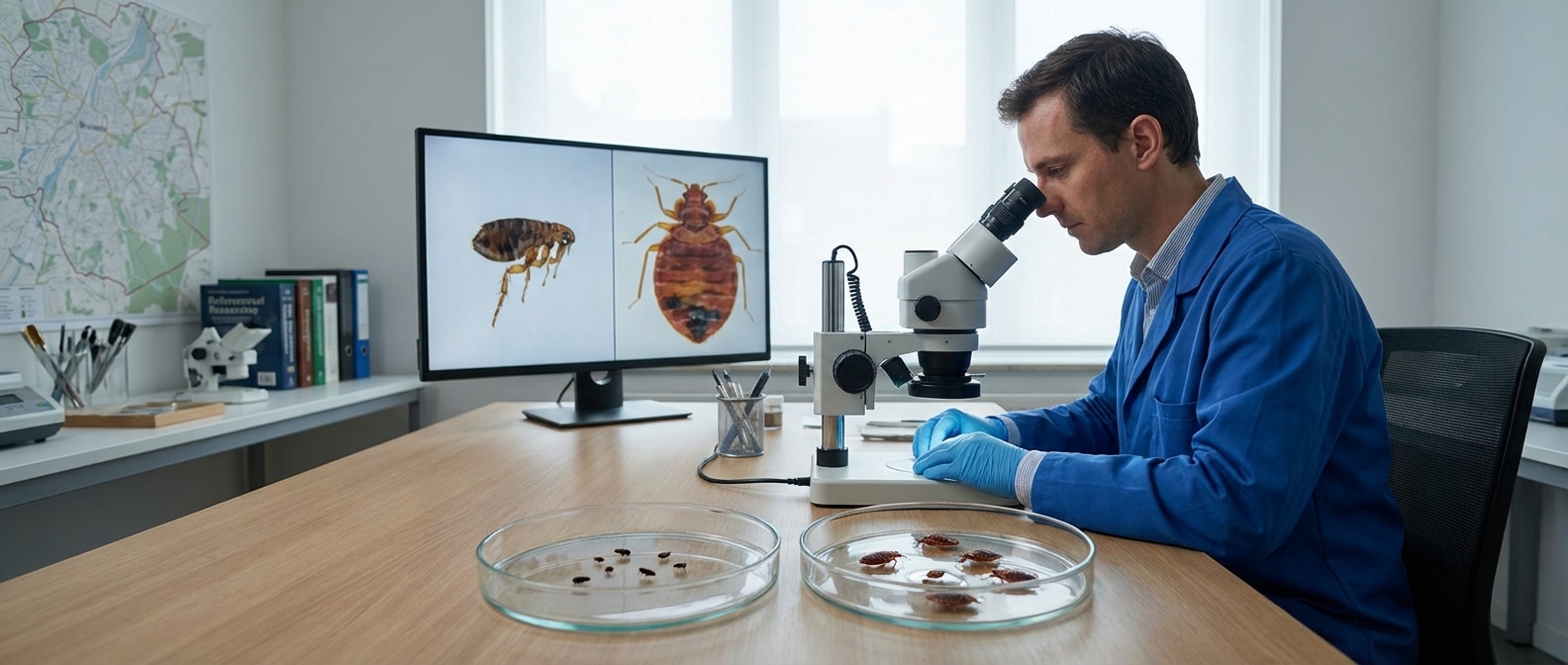
Bed fleas or bed bugs: don't be confused!
Contents
-
Bed fleas or bed bugs: the origin of a common language confusion
-
Morphology and bites: criteria for identifying the insect that attacks you
-
Why distinguishing these pests is crucial for effective treatment in Brussels
Every week, we receive calls from panicked Brussels residents who tell us, «I've got bedbugs, come quickly.» And in 9 cases out of 10, it's not fleas. They're bedbugs. The confusion is so widespread that it delays diagnosis, leads to the wrong products being used and wastes precious time while the infestation worsens.
Things to remember
-
This article deconstructs the myth of the ‘bed bug’ and explains why the term is scientifically incorrect.
-
By combining entomological expertise with a local Brussels approach, we help readers to identify their problem precisely and avoid costly and inappropriate treatments.
-
The origin of frequent language confusion
-
Compare the different options before deciding.
The problem is that «bed flea» doesn't really exist in entomology. It's a popular term that mixes two very different insects: the flea (cat, dog, floor) and the bedbug, or Cimex lectularius for close friends. Both sting, both leave red bumps, both ruin your nights. But their biology, lifestyle and, above all, treatment have nothing in common.
This article will give you the keys to distinguishing between fleas and bedbugs, understanding why this difference makes all the difference when it comes to elimination, and knowing when to call a professional in Brussels rather than trying solutions that don't work.
Bed fleas or bed bugs: the origin of a common language confusion
The term «bed bug» is everywhere on the Internet, in conversations, even with some pharmacists. But it's a misnomer. Strictly speaking, a flea is a jumping insect of the order Siphonaptera. It lives mainly on domestic animals: cats, dogs and sometimes rodents. Bedbugs, on the other hand, belong to the Cimicidae family. Two completely different bugs, two distinct families, two opposing lifestyles.
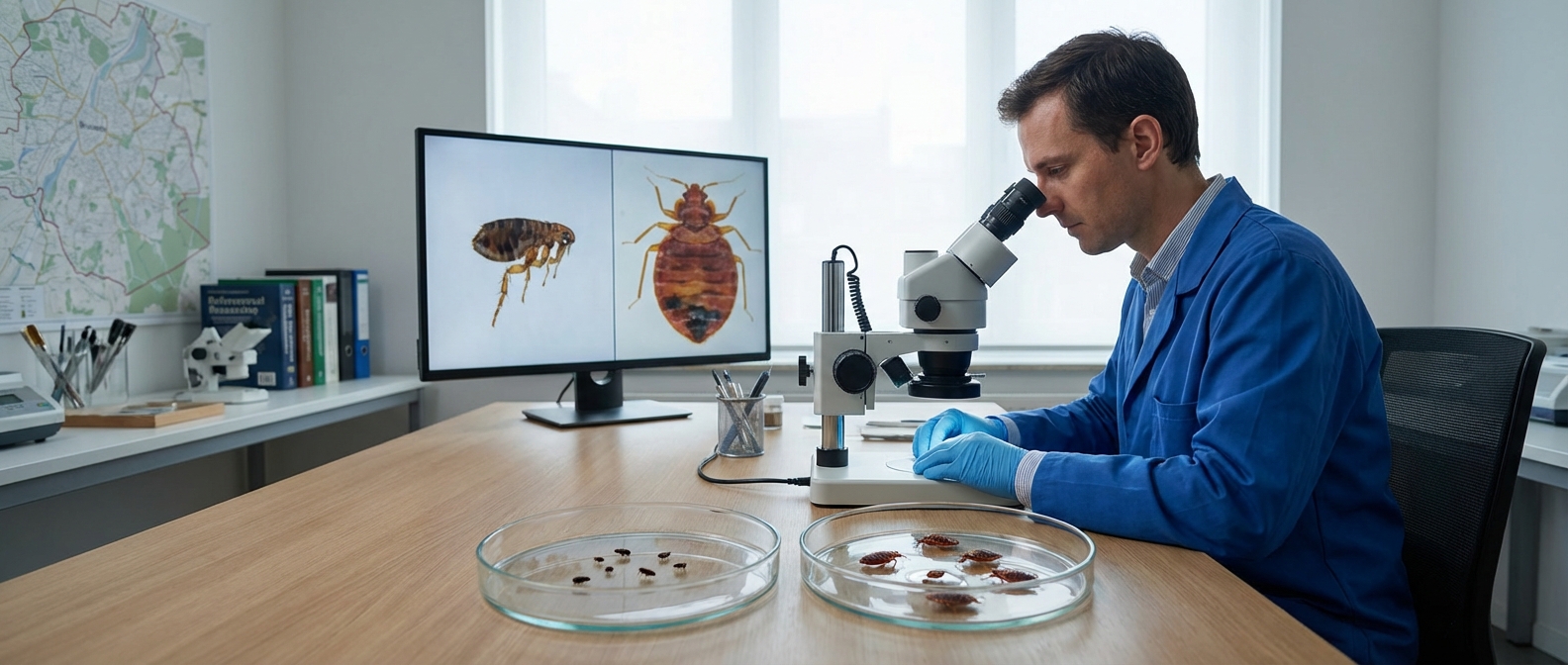
So why the confusion? Because both feed on blood and are often found in the bedroom. It's a quick shortcut. Someone wakes up with bites, sees a small insect near the mattress, and types «bed flea» into Google. The search engine understands and redirects to bedbugs, but the damage is done: in the reader's mind, fleas and bedbugs are the same thing.
There's also the legacy of floor fleas. Our grandparents were familiar with these fleas, which infested wooden floors, especially in homes with animals. These floor fleas (often Ctenocephalides felis, (the cat flea) laid eggs between the slats and bit the ankles. When bedbugs made a comeback in European cities from the 2000s onwards, many people reused the vocabulary they knew. «Bedbugs» made sense.
Except that the difference between a flea and a bedbug is fundamental to pest identification. A flea jumps, a bedbug crawls. A flea lives on its animal host, a bedbug hides in your mattress, box spring or baseboard, and only comes on you to feed at night. Confusing the two is like confusing a wasp and a fly because they both fly.
In Brussels, we see this confusion almost daily. A tenant calls us saying he has fleas, even though he doesn't have any pets. That's already a huge clue. Fleas need an animal host to complete their cycle. No cat, no dog, no rat around? Chances are they're bedbugs, not fleas.
Identifying the pest is the first step, and determines everything else. A flea treatment won't work on bedbugs. The molecules are not the same, nor are the areas to be treated, and the strategy is radically different. We'll come back to this later, but remember this: using the right word is the first step towards the right solution.
One final point that adds to the confusion: some e-commerce sites sell «anti-bed flea products». It's marketing that's playing on the confusion. Look at the composition and indications: in 100% of cases, these are products formulated against bedbugs. The term «bed flea» is just there to capture poorly formulated searches. Don't be fooled.
Morphology and bites: criteria for identifying the insect that attacks you
You wake up with red pimples and want to know what you're dealing with. Here's how to decide, point by point.
Let's start with their physical appearance. The adult bedbug measures between 5 and 7 mm, is oval, flattened (like an apple seed) and reddish-brown in color. After a blood meal, it swells and takes on a darker, almost burgundy hue. It doesn't fly or jump. It crawls, slowly, and hides in mattress seams, box spring cracks, behind headboards, in baseboards. Visit Cimex lectularius is a champion of hide-and-seek.
The flea is visually the opposite. It's tiny: 1 to 3 mm, dark brown to black, with a laterally compressed body (flattened on the sides, not on top). Above all, it jumps. Up to 30 cm high. If the insect you've caught jumps when you try to crush it, it's a flea. If it's a bedbug, you can easily squash it between your fingers - it doesn't move fast.
Now for the bites, because they're often the first warning signal. Flea bites concentrate on the lower part of the body: ankles, calves, feet. Fleas live on the ground or in the fur of animals, and bite whatever comes within their reach. The spots are small, highly itchy, often surrounded by a red halo, and scattered at random.
Bedbug bites, on the other hand, appear on exposed areas during sleep: arms, shoulders, neck, face, back. A characteristic detail for recognizing a bedbug: the bites are often aligned in a line or cluster. We call this «breakfast, lunch, dinner»: the bedbug bites, moves forward a little, bites again, moves forward again. Three red spots in a row is almost a signature.
Do bedbug bites itch? Yes, and sometimes violently. But not for everyone. Around 30% of people don't react to bites. This means that in a couple, one may be covered in pimples while the other feels nothing. It's not that bedbugs prefer one type of blood, it's a question of individual immune response.
The life cycle also differs. Bed bugs go through five nymphal stages before becoming adults. Each stage requires a blood meal. A female lays between 200 and 500 eggs during her lifetime, tiny (1 mm), white eggs stuck in dark nooks and crannies. The entire cycle takes 5 to 8 weeks, depending on temperature. At 25°C, it's rapid. That's why a bedbug infestation explodes so quickly in a heated Brussels apartment.
Fleas also have a four-stage cycle (egg, larva, nymph, adult), but their larvae live in carpet fibers, between floorboards, in the animal's bedding. They feed on organic debris, not blood. This cycle is linked to the host animal's environment.
Where to look for evidence? For bed bugs: inspect mattress seams and folds, box spring slats, screws and headboard corners. Look for small black spots (their droppings), blood trails on sheets, translucent molts. Bed bugs in mattresses always leave traces if you know where to look. For fleas: run a fine-toothed comb over your pet, lay a white sheet on the floor near its basket and watch for little black dots jumping out.
Why distinguishing these pests is crucial for effective treatment in Brussels
A customer contacted us last year after spending over 200 euros on insecticide sprays bought from chemists. He'd tried everything from drugstore bedbug treatments to «special flea» sprays and foggers. The result? The infestation had worsened. The bedbugs had dispersed into neighbouring rooms, fleeing the poorly-targeted products. Two months lost.
That's exactly why correct identification is so important. Treating bedbugs is nothing like treating fleas. Nothing at all.
For fleas, treatment starts with the animal. Veterinary anti-parasite on the cat or dog, intensive vacuuming of floors, washing of textiles at 60°C, and possibly a floor insecticide with a growth regulator to kill larvae in the floor. The problem usually resolves itself within a few weeks.
Bedbugs are a different story. Eliminating bedbugs requires a methodical approach, often involving several stages. A professional pest control expert will first make a precise diagnosis: location of outbreaks, level of infestation, configuration of the dwelling. Then, depending on the situation, he will combine heat treatment (dry steam at 180°C), targeted chemical treatment with professional-grade bedbug insecticides (not over-the-counter), and sometimes trapping.
Consumer insecticides against bedbugs pose a real problem. Many contain pyrethroids, to which bedbug populations are exposed. Cimex lectularius in Belgium have become resistant. Spraying an ineffective product just disperses the bedbugs without killing them. They leave the bedroom, colonize the living room and the children's room. A localized problem becomes a generalized nightmare.
We're often asked about natural bedbug treatments. Diatomaceous earth, essential oils and bicarbonate: do they work? Diatomaceous earth has a real mechanical action (it damages the insect's cuticle), but only as a complement to a real treatment, not on its own. Essential oils? Temporary repellent effect at best. No serious study has shown them to be effective in eliminating an infestation. Let's be honest: when faced with an established colony of bedbugs, natural solutions alone are not enough.
In Brussels, pest control is regulated. A serious treatment company must be able to show you its registration, explain the products used, detail the protocol and guarantee follow-up. With us, we don't just make one pass. We come back to check, adapt if necessary, and accompany you until the problem is completely solved.
Timing also counts. The longer you wait, the longer and more expensive it is to treat. A bedbug spotted early could mean one or two targeted treatments. An infestation that's been hanging around for three months, with unsuccessful attempts at home treatment, means potentially throwing out the mattress, treating several rooms, and making three to four visits.
How do you know if you have fleas or bedbugs when you're not sure? Call in a Brussels pest control expert for a diagnosis. A good professional will identify the pest in a matter of minutes, sometimes just by looking at the layout of the bites and inspecting the bedding. It's a small investment compared to the cost of misdirected treatment.
We operate in and around Brussels: Ixelles, Saint-Gilles, Schaerbeek, Uccle, Anderlecht, Molenbeek. Bed bugs don't distinguish between upmarket neighborhoods and others. They can be found in student studios and mansions alike. What makes the difference is the speed of reaction and the choice of the right treatment from the outset.
Conclusion
Remember the basics: there's no such thing as «bed bugs». If you wake up with bites all over your arms or back, and you don't have a pet in the house, they're probably bedbugs. The difference between fleas and bedbugs isn't just a matter of vocabulary: it's what separates effective treatment from a waste of time and money.
Don't let a bedbug infestation take hold. Every week you delay, another generation hatches. If you have even the slightest doubt, contact us for a rapid diagnosis in Brussels. We'll identify the problem, explain clearly what we're going to do, and take care of it. No unnecessary jargon, no surprise estimates: just a trusted professional who knows his business and your neighborhood.
Frequently asked questions
What's the difference between a bed flea and a bed bug?
There's no such thing as «bed fleas». If you find insects in your bed, they are more than likely bed bugs.
How do I know if I have fleas or bedbugs?
If you wake up to several concentrated bites, it's probably a bedbug infestation.
Where do bedbugs bite first?
Bed bugs generally bite the most exposed and accessible parts of your body. Since they often come from underneath (mattresses, bedding, beds, furniture, linen, etc.), the parts of your body most likely to be bitten are your back, arms, legs and neck.
Do bed flea bites itch?
Bed bugs (not bed fleas) can sometimes cause itching or even an allergic reaction (urticaria) linked to bed bug saliva. If you suffer from persistent itching, consult your doctor, who can prescribe a cream for relief.

 French
  English
  Dutch
Dutch