

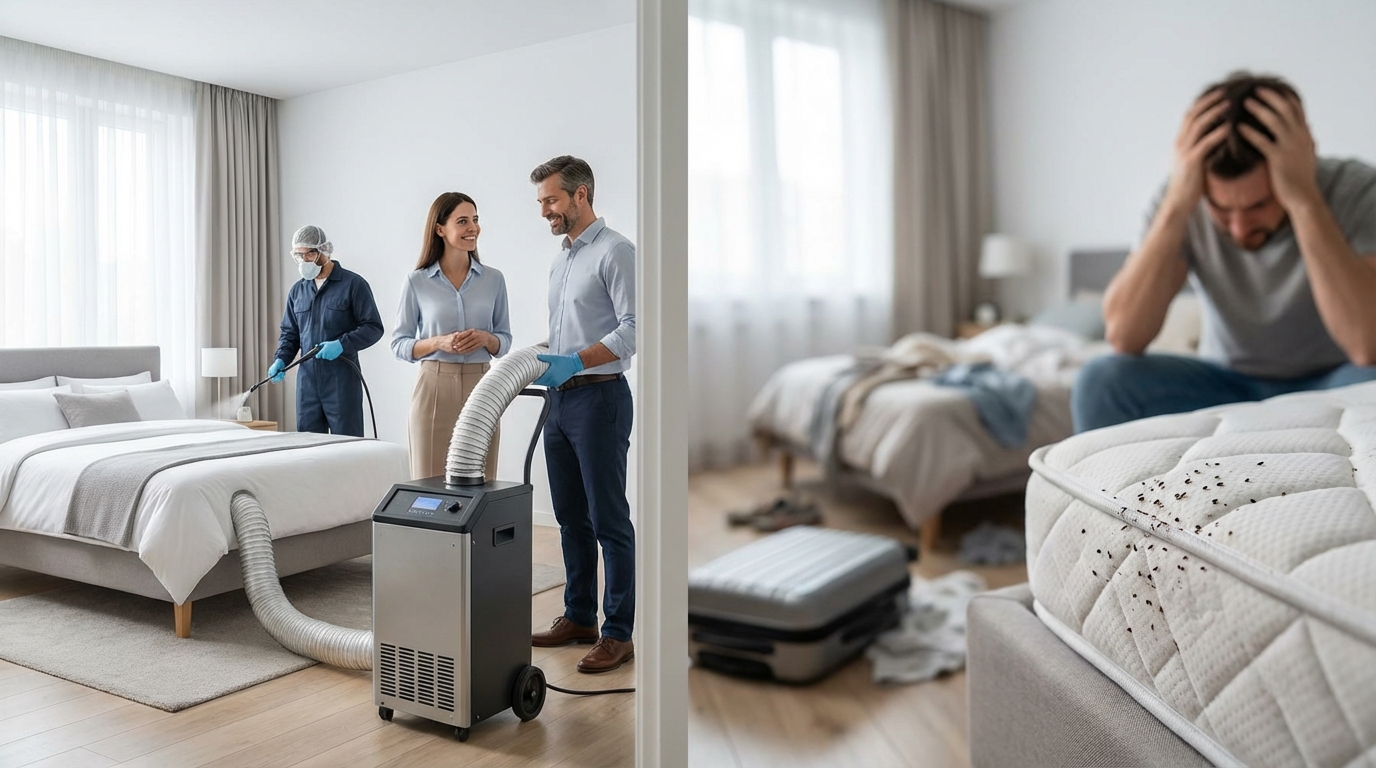
Bedbugs: Why is rapid intervention essential?
Contents
-
Heat treatment vs. chemical treatment: Which method to choose for rapid action?
-
The benefits of immediate action against proliferation risks
-
Selection criteria and recommendations for hiring an expert in Brussels
You found a small spot of blood on your sheet this morning. Or maybe you woke up to a suspicious itch, lined up in a three-point pattern on your arm. Your first instinct is to Google. And then you come across dozens of «miracle solutions»: essential oils, diatomaceous earth, washing at 60°C. Yes, it's true that washing at 60°C kills bed bugs on linen. But it doesn't solve the underlying problem. Bedbugs don't live in your sheets: they live in mattress seams, baseboards, electrical sockets, cracks in the parquet.
Things to remember
-
More than just a guide, this article demonstrates the real cost of inaction
-
We contrast the speed of biological proliferation with the radical effectiveness of professional treatments (thermal vs. chemical) to prove that intervening within 24 hours drastically reduces costs and psychological stress, while promoting the proximity of the Brussels expert.
-
Which method to choose for fast action?
-
The benefits of immediate action against proliferation risks
What I'm going to explain here is why every day that goes by without professional bedbug treatment makes the situation exponentially worse. Not linear: exponential. A female bedbug lays between 5 and 15 eggs a day. Do the math over a week, then a month. The cost of pest control doubles or triples, and the psychological stress that goes with it is real, documented and sometimes devastating. In Brussels, we regularly intervene in the homes of people who have waited «just a little» before calling. And every time, the conclusion is the same: they would have saved time, money and many sleepless nights by acting within 24 hours.
Heat treatment vs. chemical treatment: Which method to choose for rapid action?
Two approaches dominate the bedbug extermination market: heat treatment and chemical treatment. Both work. Both have their strengths. But they don't respond to the same situations, and that's the crux of the matter.
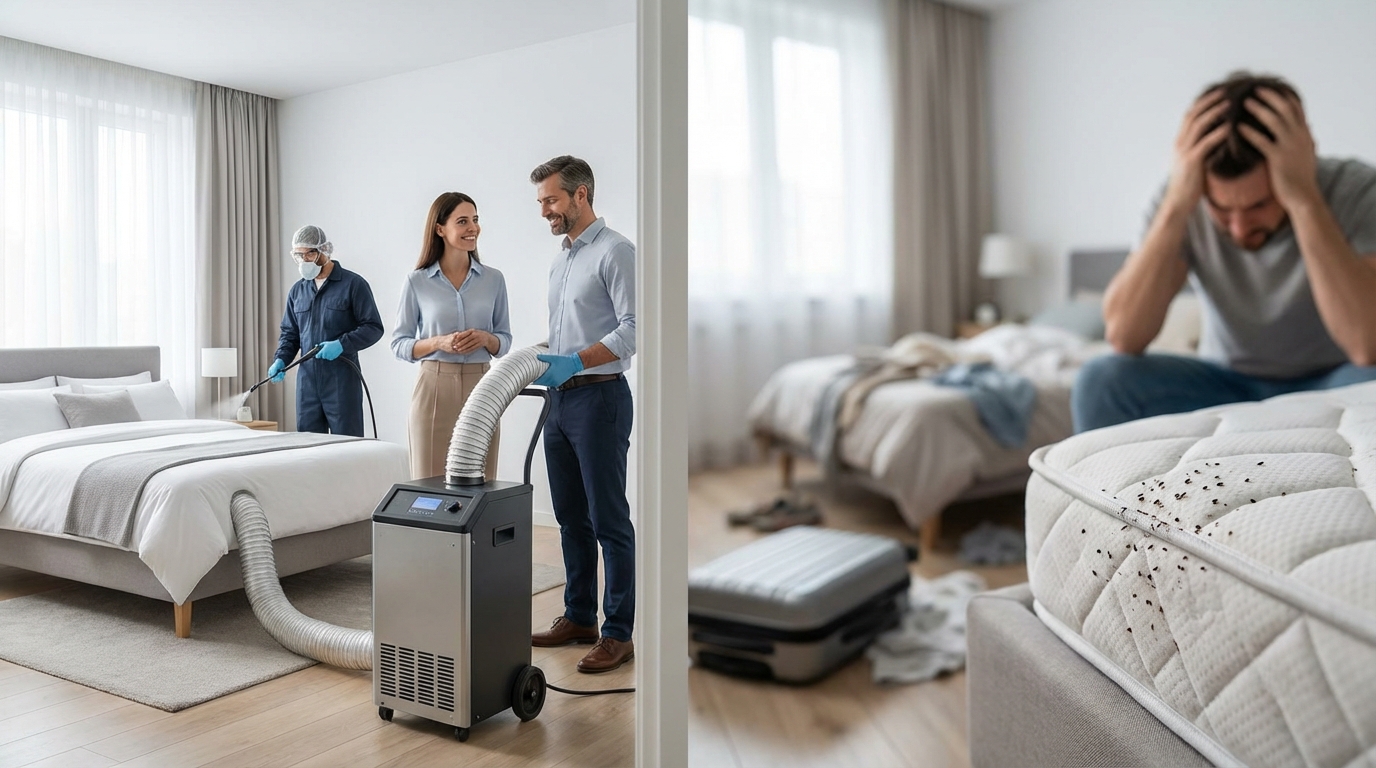
Heat treatment of bedbugs is based on a simple principle: heat kills. At temperatures above 56°C, bedbugs die at all stages of their development, including their eggs. This is a crucial point, because eggs are the number-one nightmare of conventional treatments. They're resistant to a lot of things. Not heat. In practice, we use professional heat generators that raise the room temperature to between 60 and 65°C for several hours. The result: immediate eradication, in a single session in most cases. No need to leave your home for days, and no chemical residues on your surfaces.
The effectiveness of chemical treatment, on the other hand, is based on professional residual insecticides. Products are sprayed in infested and transit zones. Bugs passing through these areas die within hours or days. The major advantage: the effect lasts over time. For 3 to 6 weeks after application, any bedbugs that come into contact with the treated surface are doomed. This is a formidable safety net against eggs hatching after the technician's visit.
So, which one to choose? Here's how I think when a customer calls me.
If the infestation is localized (a bedroom, a sofa), the customer wants a quick solution and has small children or pets, heat treatment is often the best choice. No chemicals, results in just a few hours. For more extensive infestations, affecting several rooms or an entire building, chemical treatment with its residual effect comes into its own. And in severe cases, we combine the two. Thermal for the initial shock, chemical for the follow-up. This is the most complete disinfection protocol we can offer.
A word about the «home remedies» you see everywhere. Can you get rid of bedbugs in two minutes? No. That's a myth. You can kill a visible bedbug in two minutes, yes. But an infestation, even an incipient one, involves dozens of individuals hiding in nooks and crannies you'd never suspect. Bedbugs are quick, discreet and shy away from light. Without professional equipment, you won't reach them.
At the end of the day, the real criterion for choice is speed of intervention. Whatever the method, a professional bedbug treatment applied within 24 to 48 hours of detection gives radically better results than a late treatment. The method counts, of course. But timing matters even more.
The benefits of immediate action against proliferation risks
Let's talk numbers, because that's where the urgency really comes in. The bedbug life cycle is frighteningly efficient. An egg hatches in 7 to 10 days. The nymph reaches sexual maturity in 5 to 6 weeks. And an adult female lays between 200 and 500 eggs in her lifetime. You can see where this leads: a single bedbug carried in a suitcase can generate a colony of several hundred individuals in two months.
The spread of infestation is not limited to multiplication. Bedbugs migrate. From one room to another, from one apartment to the next. They pass through electrical ducts, pipes and false ceilings. In Brussels, in older buildings in the city center, we regularly see infestations that have passed through three or four apartments because the first occupant affected waited too long. At this stage, the cost of disinsectisation has nothing to do with that of a targeted intervention at the outset.
To put it concretely: treating a room at the start of an infestation costs a few hundred euros. Treating an entire apartment that's heavily infested, with several passages necessary, easily exceeds a thousand. And if the whole building is affected, we're talking about several thousand euros divided between the co-owners, with coordination delays adding to the ordeal.
There is another cost that is systematically underestimated: the psychological cost. Studies clearly show this. People confronted with a bedbug infestation develop anxiety, sleep disorders, sometimes symptoms akin to post-traumatic stress. This is no exaggeration. When you can't sleep because you know something is biting you at night, when you start inspecting every nook and cranny of your bed before you go to bed, when you don't dare invite anyone into your home, it's heavy. Heavy.
Rapid bedbug intervention cuts this vicious circle at the root. Less spread means fewer surfaces to treat, a simpler protocol, a lower bedbug treatment price, and above all a much faster return to normal. I've seen customers back asleep the very next day after a well-executed heat treatment. Those who had waited three months? It took them weeks to feel safe in their homes again, even after complete eradication.
Canine detection of bedbugs, moreover, takes on its full meaning in this logic of speed. A trained dog locates infestation sites in a matter of minutes, with a reliability rate of over 95%. This allows the technician to target his intervention instead of treating blindly. Less product, less time, more efficiency. And above all, it confirms or refutes a suspicion without waiting for the infestation to become visible to the naked eye, i.e. when it's already well established.
Selection criteria and recommendations for hiring an expert in Brussels
Typing «bedbugs» into Google from Brussels brings up dozens of results. National franchises, platforms promising a technician in two hours, ads with no address or landline number. How do you sort them out?
First thing to do: check that the Brussels pest control company is registered. In Belgium, the use of professional biocides is regulated. A reputable service provider is registered and can show you this. If they can't, don't bother. This is non-negotiable.
Second point: responsiveness. When you request a quote for a quick intervention, look at the response time. A bedbug expert in Brussels who understands the urgency of these situations will call you back within an hour, not three days. Emergency insect control is his daily business. He knows that every extra night means dozens more eggs. If the service provider doesn't seem to be in a hurry, it's either because he's not aware of what's at stake, or because he doesn't have the resources to intervene quickly. In either case, look elsewhere.
Third criterion, and a fundamental one: guaranteed results. A professional who is confident in his or her protocol commits to a result. With us, this means we'll come back free of charge if bedbugs reappear in the weeks following treatment. This guarantee is not a sales pitch: it's proof that the service provider has mastered his subject and assumes the quality of his work. Beware of those who make no commitment.
Fourth element: diagnosis before quotation. A good professional doesn't give you a price over the phone without seeing the situation. He'll go out, inspect (ideally with canine detection), assess the extent of the infestation, and then propose a suitable protocol with a clear price. No surprises, no «extras» on the day. The price of bedbug treatment depends on the surface area, the level of infestation and the method chosen. Any company announcing a fixed price without prior inspection runs the risk of subcontracting or botching the job.
Fifth point, often overlooked: proximity. A local company is familiar with the specific characteristics of the buildings in Brussels. The Haussmann-style buildings of Saint-Gilles cannot be treated in the same way as the more recent apartments on Rue de la Loi. Mouldings, old parquet floors, double partitions: all of these create havens for bedbugs, which a technician accustomed to the terrain will spot immediately. You don't learn this local knowledge from a textbook. It comes from hundreds of interventions in the field, neighborhood by neighborhood.
One last practical tip: when you contact a service provider, ask specific questions. What method does he use? How many visits will they make? How long will it take before you can move back in? How should the apartment be prepared before the work is carried out? A real expert will give you clear answers, without unnecessary jargon, and take the time to explain each step. If you feel you're being pressured to sign without any explanation, that's a red flag.
Conclusion
You can't «manage» a bedbug infestation. It can be eradicated. And the faster you act, the simpler, more effective and more affordable the eradication. Every day you wait multiplies the number of individuals, extends the areas affected and adds to the financial and emotional costs.
If you're in Brussels and have the slightest doubt, don't be left alone with your questions. Contact us for a quick diagnosis. We'll assess the situation, explain the options, and if intervention is necessary, we can be at your home within 24 hours. No surprises, guaranteed results, and above all: a peaceful night's sleep.
Frequently asked questions
Why is it necessary to act within 24 hours in case of bed bugs?
The proliferation of bedbugs is exponential: a single female lays up to 15 eggs a day. Immediate intervention allows you to treat a localized area, drastically reducing pest control costs and psychological stress.
What's the difference between thermal and chemical treatment?
Heat treatment instantly kills adults and eggs using heat (60°C), enabling eradication in a single session without toxic products. Chemical treatment uses residual insecticides that eliminate insects over several weeks, ideal for widespread infestations in Brussels buildings.
Is washing at 60°C enough to eradicate an infestation?
Washing kills bedbugs on linen, but does not solve the underlying problem, as they nest in baseboards, sockets and mattresses. Without professional intervention to target these invisible hiding places, the infestation will systematically return after a few days.
How does canine bedbug detection work?
A sniffer dog inspects your home and locates precise outbreaks with a reliability of over 95 % in just a few minutes. This means you can target treatment only where it's needed, saving time and money.
Who pays for bedbug treatment in Brussels?
As a general rule, the cost of pest control is the responsibility of the landlord, in order to ensure the health of the property. However, if the landlord can prove that the introduction of pests is due to the tenant's fault, the costs may be charged to the tenant.

 French
  English
  Dutch
Dutch