


Bedbugs and libraries: how to detect and protect against them
Contents
A customer called me last week, completely panicked. He'd found three little black spots in a novel he'd borrowed from the local library. His question: «Did I bring bedbugs home with me?» The short answer: it's possible. And no, this is not an isolated case.
Things to remember
-
Faced with the psychosis of infestations in public places, this article brings the local expertise of Punaisesdelitbruxelles
-
We're moving on from the news to concrete action, proposing a rigorous method for inspecting books, barrier gestures for borrowing and a technical protocol for cold or heat treatment adapted to fragile works.
-
Why and how to detect bedbugs in libraries?
-
How can you avoid bedbugs when borrowing books?
Bedbugs in books are a subject that makes some people smile. Until it happens to them. The Cimex lectularius, the common bedbug, doesn't just live in mattresses. It crawls into anything that offers a dark, narrow space: sofa seams, electrical sockets, picture frames. And yes, book bindings. Public libraries, with their constant flow of books from home to home, are a much underestimated vector of propagation.
At Punaisesdelitbruxelles, we regularly intervene in private homes in Brussels whose infestation started exactly like this: a book on the bedside table. This article is what we explain to our customers when they call us. How to spot the signs, how to protect yourself, and what to do if the damage is already done.
Why and how to detect bedbugs in libraries?
First, an important clarification: bed bugs don't eat paper. They are not attracted by books as such. What they are interested in is shelter. A closed book is a dark, tight space with a stable temperature. For a bedbug looking for a place to hide between two blood meals, it's perfect.
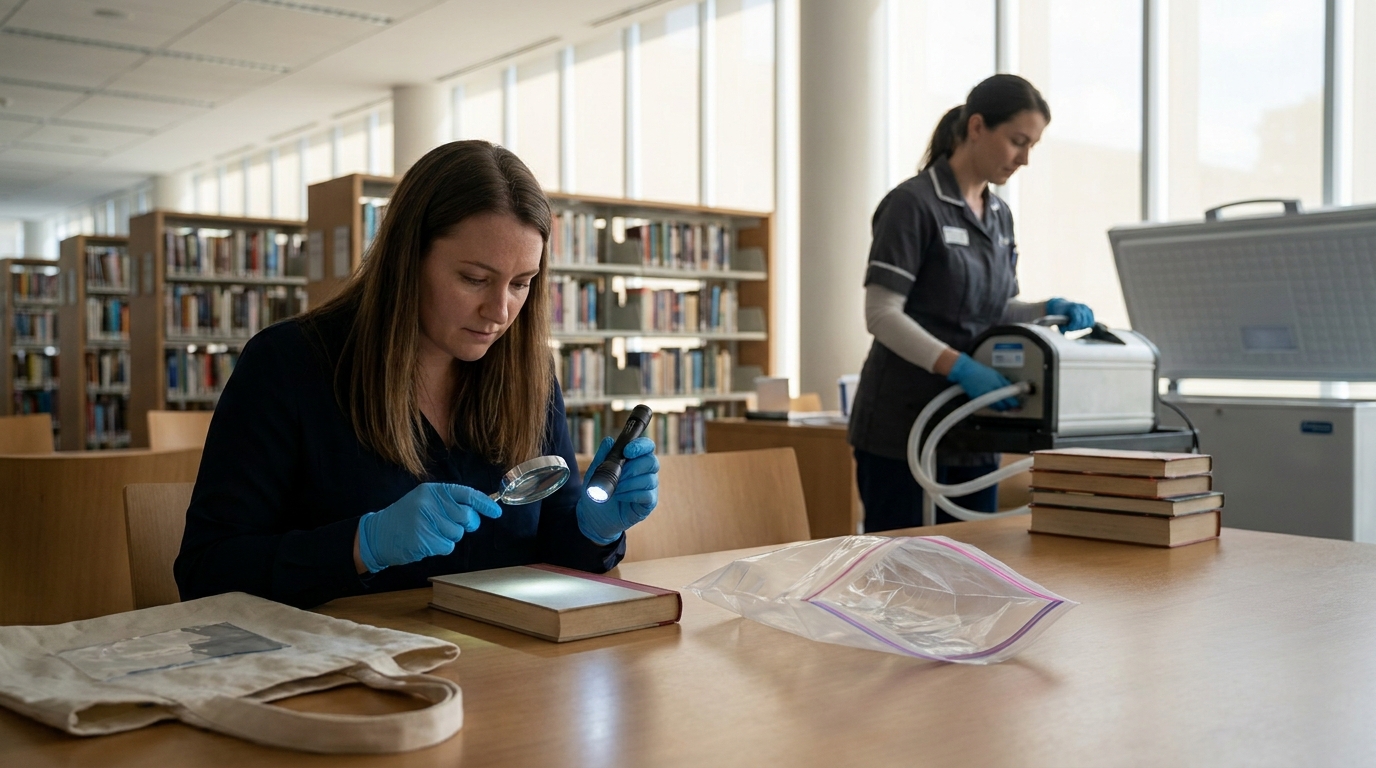
Do bedbugs really go on books? Yes. Not systematically, but when a dwelling is infested, they gradually colonize all objects close to resting areas. A book on a bedside table, left there for two weeks, may well return to the library with a stowaway. Or worse, with eggs.
To detect bedbugs in a book, you need to know what to look for. Here are concrete signs of infestation:
-
Small black or dark brown spots on pages, edges or bindings. These are bedbug excrements, composed of digested blood. They look like ink dots, often grouped together.
-
Reddish or rusty marks, This is a sign that a thumbtack has been crushed between the pages.
-
Bedbug eggs, They are tiny (about 1 mm), whitish, rice-grain-shaped. They are found stuck in the binding, between the spine and the pages, and sometimes in the folds of the cover.
-
Exuviae, the translucent molts that nymphs leave behind as they grow.
-
A sweet smell, It's rare for this to happen on a single book. On a single book, it's rare, but on an entire shelf, it can be noticeable.
In practical terms, when you pick up a book, take 30 seconds to inspect it. Open it flat, look closely at the binding, leaf through the first and last pages. Bedbugs love the ends of the book, where the glue creates small cavities. If you see black dots aligned along the inside seam, they're probably not printing stains.
Brussels' libraries are well aware of the problem. Some have set up inspection procedures when books are returned. But let's be honest: with thousands of books in circulation, systematic control is virtually impossible. The responsibility also lies with the users.
A detail that people often overlook: bed bugs go on objects far beyond the bed. Handbags, clothes, stuffed animals, picture frames. A book is just one object among many. The difference is that a book circulates. It passes from one potentially infested home to another healthy home, via a public place. It's this chain of transmission that makes the subject so serious.
How can you avoid bedbugs when borrowing books?
Should we stop borrowing books? No. Absolutely not. Libraries are still great places, and the risk, while real, is manageable if you adopt a few simple reflexes.
The first and most effective step: the hermetic bag. A zipped freezer bag, a vacuum bag, or even a simple, tightly sealed plastic bag. When you collect your books from the library, slip them into the bag before putting them in your backpack or shopping bag. The idea is to isolate the book from the rest of your belongings during transport. If there's a bug inside, it's contained.
Second reflex: never put a borrowed book directly on your bed or sofa. Ever. Sounds harmless, but that's exactly how infestations start. Where do bedbugs hide in a bed? In the seams of the mattress, the box spring, the headboard. A book placed on the pillow during evening reading is a direct bridge between the vector and the preferred nesting area.
Keep your borrowed books in a dedicated place: a shelf at the entrance, a plastic bin, a table away from sleeping areas. There's nothing complicated about it.
For those who use interlibrary loans, vigilance is even more important. These books sometimes travel between several establishments, passing through transit warehouses, and may have stayed in dozens of different homes. The risk is not enormous, but it is statistically higher than with a book circulating in a single local network.
A few additional preventive measures for regular users:
-
Visually inspect each book before you take it home (as mentioned above, bedbug droppings and eggs are visible to the naked eye if you know what to look for).
-
If you borrow a lot, invest in a plastic bin with a lid. All books are «quarantined» for 48 to 72 hours before being handled at home.
-
If in doubt about a book, don't return it silently. Report it to the library. Librarians prefer to be warned: it allows them to remove the book and inspect the relevant shelf.
For librarians reading this article: infestation prevention starts with you. A returns protocol that includes rapid inspection of bindings and temporary storage of returns in insulated bins before they are returned to the shelves makes all the difference. Some libraries even use pheromone traps placed discreetly in the shelves to monitor for any presence. Inexpensive and highly effective as an early warning system.
What about parents? If your children bring books home from the school library, the same rules apply. The children's sections, with their thick hardbacks and rigid bindings, offer ideal hiding places. An airtight bag in the schoolbag and a buffer zone at home: two precautions that avoid many problems.
Professional extermination protocol for bed bugs in books
You've found suspicious signs in a book, or worse, you've confirmed the presence of bedbugs in your home and suspect your books may be contaminated. How can I treat books for bedbugs without destroying them?
Let's face it: treating books is a tricky business. You can't spray them with insecticide, dip them in anything, or microwave them (yes, some have tried). You need methods that kill bedbugs at all stages - adults, nymphs and eggs - without damaging the paper, ink or binding.
Freezing: the reference method for books
Freezing bedbugs is the technique most commonly used by professionals to treat fragile objects, including books. The protocol is precise:
-
Place the book in an airtight bag (to prevent moisture condensation on thawing).
-
Put it in the freezer at -18°C minimum.
-
Leave it at least 72 hours. Not 48, not «one night». A full 72 hours. Bedbug eggs are tough, and it takes that long for the cold to penetrate to the heart of the binding.
-
Take the book out and let it return to room temperature in its bag, without opening it immediately. This prevents condensation on the pages.
This method works at 100% if the temperature is kept constant. A standard domestic freezer will do the trick, as long as you don't open it every two hours for ice cream. Every time you open it, the temperature rises again, which can compromise the treatment.
For the freezing of old or precious books, we recommend consulting a professional. Some very old paper or animal glues may not react well to repeated freeze/thaw cycles.
Heat treatment
The other approach is heat. All stages of bedbugs die out at 50°C for 30 minutes or more. For books, we use a «heat box», an insulated box fitted with a heating element that gradually rises in temperature.
The advantage of the thermal box: it's fast. In 4 to 6 hours, processing is complete. The disadvantage: you need to control the temperature rise so as not to exceed 60°C, a threshold beyond which some bindings and glossy papers can suffer. That's why at Punaisesdelitbruxelles, we use probes placed directly in the books during treatment. We don't rely on the temperature of the ambient air in the box: we measure the temperature at the heart of the book.
This heat extermination protocol is the one we deploy for libraries that contact us after identifying a problem on a batch of books. We sometimes treat 200 to 300 books in a single session, with an efficiency rate of 100% verified by post-treatment inspection.
What not to do
-
Insecticide sprays They're ineffective on eggs, toxic to you, and impregnate the paper. You don't want to read a book soaked in permethrin.
-
The hair dryer temperature is insufficient and too localized. You'll curl the pages without killing anything.
-
Leaving the book in the sun even in the middle of a Brussels summer (dream on), the core temperature of the book will not reach the required 50°C.
-
Throw away the book If it's a borrowed book, the library won't take kindly to it. And if it's a book you really want, there are solutions.
One last technical point: treating bed bugs in books is not enough if there's an active infestation in your home. Treating the books without treating the apartment is like mopping the floor without turning off the tap. If you find bedbugs in your books, chances are they're elsewhere too. In that case, call in a professional for a full inspection.
Conclusion
Bedbugs in libraries are neither an urban legend nor a reason to panic. It's a real, documented risk, but one that's perfectly manageable with the right reflexes. Inspect your books, isolate them at home, and when in doubt, freezing is your best ally.
If you're in Brussels and suspect contamination via books or other objects, contact Punaisesdelitbruxelles. We'll come to you, inspect, and suggest a protocol tailored to your situation. No panic, no over-treatment: just what's needed, where it's needed.
Frequently asked questions
Can bedbugs really hide in books?
Yes, bed bugs like dark, narrow places like book bindings or spines. They don't eat paper, but use books as secure hiding places to lay their eggs or rest between meals.
How can you tell if a library book is infested?
Inspect the binding and pages for small black dots (excrement), dried blood spots or tiny whitish eggs. A sickly-sweet odor may also be present if several books are affected on the same shelf.
What are the best ways to borrow a book safely?
Carry your loans in an airtight bag, and never put a library book on your bed or sofa. Ideally, create a dedicated reading area, away from sleeping areas, to avoid any transmission to your bedding.
How to treat a contaminated book without damaging it?
The safest method is freezing: place the book in a zipped bag in the freezer at -18°C for at least 72 hours. This kills the adults and eggs without damaging the paper or the binding glue.
Can I use an insecticide or the microwave to disinfect a book?
We strongly advise against this: sprays stain and are toxic to the touch, while microwaves can burn paper or melt glues. Always opt for cold treatment, or call in a professional for controlled heat treatment.

 French
  English
  Dutch
Dutch