

Bedbug protocol in daycare centers: the complete treatment guide
Contents
-
Heat treatment vs. chemical treatment: criteria for choosing a nursery
-
The 6-step intervention protocol: pre-purchase recommendations
-
Proactive vs. reactive prevention: advantages and disadvantages of each strategy
A call on a Monday morning, a crèche director in Brussels, her voice tense: «We've found stains on the sheets of the nap cots.» Three words that turn a week on its head. Because when we talk about bedbugs in crèches, we're not talking about a simple nuisance. We're talking about infants. Worried parents. Of an establishment whose reputation can be shattered in 48 hours.
Things to remember
-
A ‘Zero Toxic’ professional protocol focused on infant safety
-
Unlike generic guides, this article proposes a rigorous methodology combining heat treatment and transparent communication to reassure parents and protect early childhood establishments.
-
Criteria for choosing a crèche
-
Pre-purchase recommendations
The problem is that most of the protocols available online are designed for hotels or apartments. Not for a nursery with three-month-old babies. Not for a place where the slightest chemical residue is a real risk. This guide proposes a radically different approach: a «Zero Toxic» protocol that combines heat treatment, early detection and transparent communication with families. No miracle recipes, no dubious products. Just a rigorous method, field-tested in Brussels.
Whether you're a nursery manager, a childcare worker or a parent trying to understand what your child's nursery does (or should do), the following is of direct concern to you.
Heat treatment vs. chemical treatment: criteria for choosing a nursery
56°C. This is the temperature at which bed bugs die, in all stages: adults, nymphs and eggs. Remember this number, it's at the heart of everything.
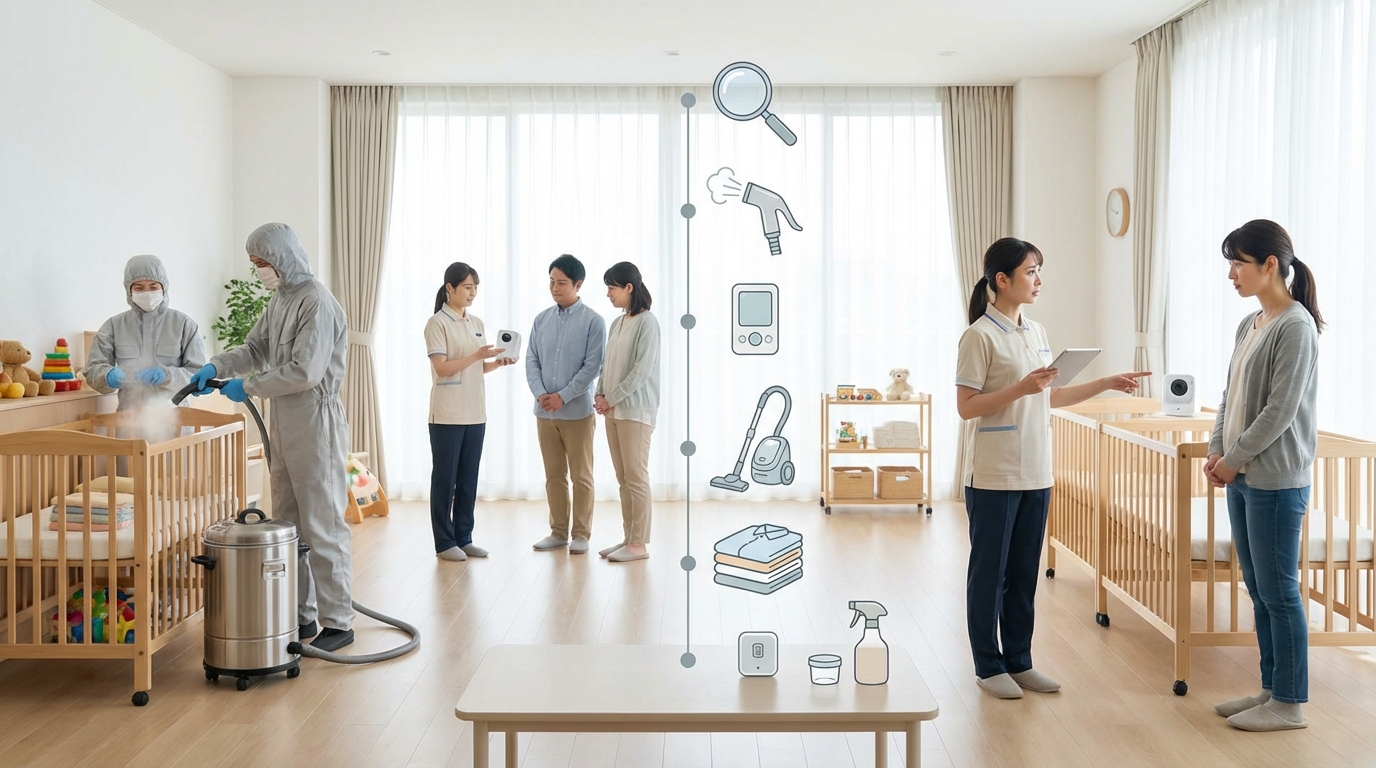
When a pest control professional intervenes in a conventional dwelling, there are several approaches to choose from. Chemicals (residual insecticides, pyrethroids), thermal treatment using dry steam or heat guns, diatomaceous earth, trapping. In an adult apartment, these options are debatable. In a nursery? The debate is quickly settled.
Visit heat treatment of bed bugs is the only serious option in an early childhood setting. Here's why:
-
Zero residue. Dry steam against bedbugs leaves no substance on surfaces. Nothing on nap mats, nothing on play mats, nothing in the air children breathe. An insecticide, even a registered one, leaves active residues for weeks. That's how it works. In a room where infants crawl on the floor and put everything in their mouths, this is unacceptable.
-
Immediately effective. Heat kills on contact. No need to wait for the insect to cross a treated area. Dry steam rises to 180°C as it leaves the nozzle, reaching nooks and crannies, mattress seams and baseboards - exactly where bedbugs nest.
-
No resistance possible. Bedbugs are developing resistance to insecticides. It's a documented fact. Against heat, no adaptation is possible. Physics always wins.
Does chemical treatment still have advantages? Yes, one: cost. A conventional chemical treatment often costs less per unit. Except that in a crèche, you have to add the cost of prolonged closure (ventilation time, product drying time), the cost of crisis communication with parents, and the legal risk if a child has a reaction. When all is said and done, the chemical-free nursery disinfestation is the same or even cheaper.
One point we often forget: regulations. Day-care centers are subject to strict standards governing the products used on their premises. The ONE (Office de la Naissance et de l'Enfance) in Belgium, like the PMI in France, can demand accountability. An intervention report that mentions only dry steam is a clean document. A report that lists biocides is a discussion starter.
Last but not least, the downtime of the premises. After heat treatment, the part can be reused as soon as it has cooled down. Just a few hours. After a chemical treatment, allow 24 to 72 hours, depending on the product, with mandatory ventilation. For a day-care center that welcomes children five days a week, this difference is enormous.
My advice is simple: if a service provider offers you chemical treatment in day-care centers, ask them about dry steam. If they don't have one, look for another provider.
The 6-step intervention protocol: pre-purchase recommendations
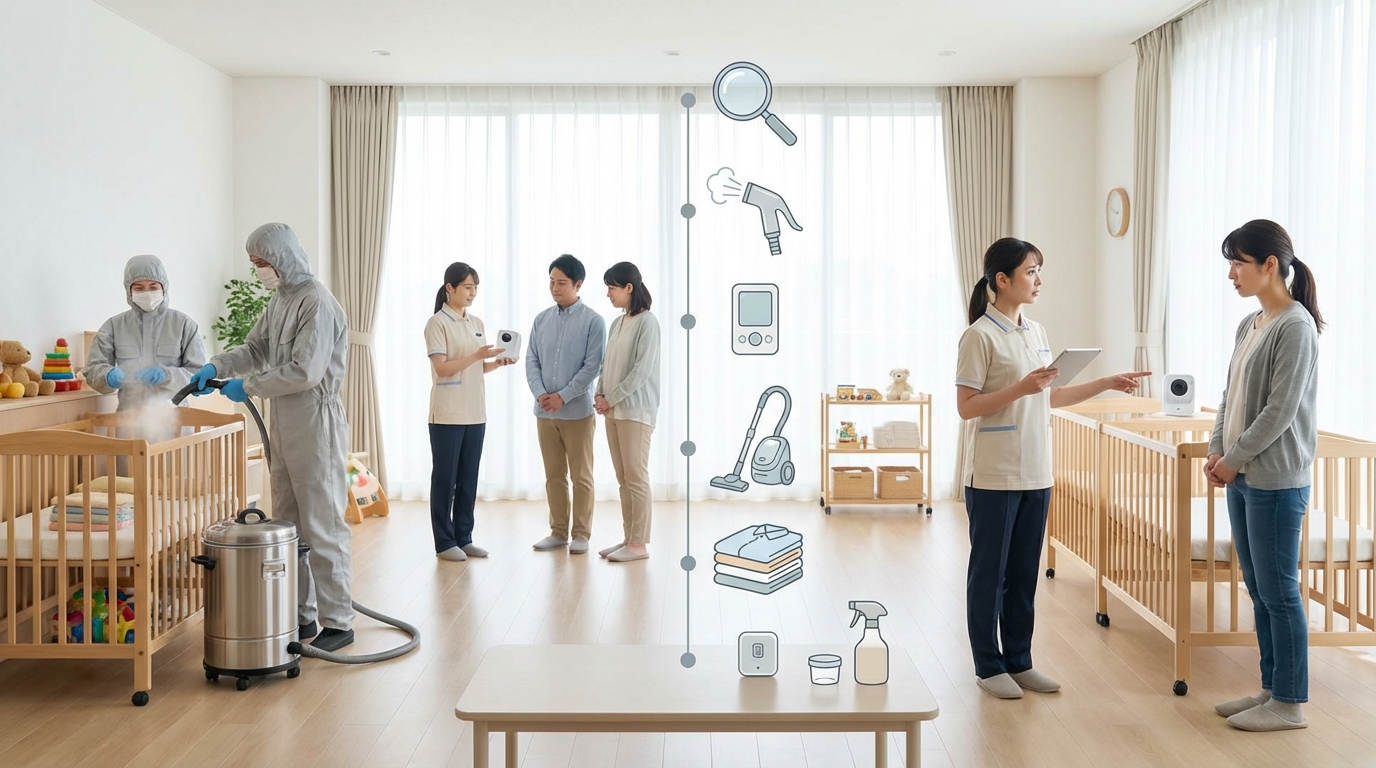
Before you pick up the phone to call an exterminator, there's some work to be done in-house. This work determines the effectiveness of the entire intervention. Too many nurseries call in a panic, without any preparation, and the results suffer. Here are the six steps of a hygiene protocol adapted to a bedbug infestation in a crèche.
Step 1: Confirm infestation. Bites on a child are not enough. Bedbug bites in children are like many other things: mosquitoes, allergies, eczema. What confirms it are the physical traces: small black spots (droppings) on sheets or mattress seams, traces of blood, translucent molts. If in doubt, the dog detection in day-care centers is extremely effective. A trained dog locates outbreaks in just a few minutes, with a reliability rate of over 95%. It's an investment that saves you from having to treat blindly.
Step 2: Isolate and document. Identify the part(s) concerned. Photograph everything. Make a note of the dates of the first observations, the beds affected and the children with bites. This file will be useful for the service provider, for the ONE, and for communicating with parents. Don't move mattresses from one room to another: you risk spreading the infestation.
Step 3: Inform parents. This is where many managers hesitate. The temptation to solve the problem «silently» is strong. Resist it. Parents always find out, and if they find out from someone other than you, trust is broken. A factual, non-dramatizing letter explaining what has been detected and what's going to be done is the right approach. Mention the choice of heat treatment, the absence of chemicals and the planned timetable. Parents of children in daycare want transparency, not secrecy.
Step 4: Prepare the premises. Before the operation, you need to prepare. Wash all bed linen, comforters and covers at 60°C minimum. Anything that can't be washed should be tumble-dried for 30 minutes at high heat. Pack clean items in airtight bags. Clear baseboards and move furniture away from walls. This preparation is essential: if not done correctly, the treatment loses its effectiveness.
Step 5: Professional intervention. The service provider uses dry steam on all surfaces: mattresses, box springs, bed frames, skirting boards, carpets and curtains. Every nook and cranny is methodically treated. For eliminating bedbugs in daycare centers, In order to achieve this, a minimum of two passes is required, spaced 10 to 14 days apart. The first kills adults and nymphs. The second eliminates any eggs that may have hatched in the meantime. A single pass is never enough, no matter what anyone tells you.
Step 6: Monitoring and follow-up. Two weeks after the second visit, a control is essential. Dog detection or thorough visual inspection. If it's clean, you're back on track. If traces remain, a third pass is necessary. Document every step, every report. This file will protect you in the event of questions from the authorities or parents.
This protocol requires rigor. It also takes time and organization. But that's the difference between a problem that's dealt with properly and an infestation that drags on for months. Children in crèches deserve to have things done right.
Proactive vs. reactive prevention: advantages and disadvantages of each strategy
90% of the nurseries we support in Brussels call us after discovering an infestation. Almost never before. It's human, but it's a problem.
Visit bed bug prevention is based on a simple principle: detect early and act fast. The later an infestation is detected, the more expensive it is, the more difficult it is to treat, and the more stress it generates for everyone involved. An outbreak limited to one mattress can be treated in a single operation. An infestation that has spread to three rooms requires three times as much time, three times as many visits, and an almost inevitable partial closure.
So what does a proactive strategy look like in practice?
-
Regular visual inspections. Train staff to check mattress seams, bed slats and baseboards. Once a week, ten minutes per dormitory. Nursery nurses are in the best position: they handle sheets every day.
-
Quarterly dog detection. Use a sniffer dog every three months, even if there's no sign of infestation. This costs between 150 and 300 euros per visit, depending on the surface area. Compared to the cost of a complete treatment (easily 1,500 to 3,000 euros for a crèche), this is derisory.
-
Anti-flea covers on all mattresses. Certified, full-zip covers. They prevent bedbugs from settling in the seams and make them easier to detect (you can see them on the smooth surface of the cover).
-
Linen reception protocol. Soft toys and blankets brought from home are a classic vector. Provide a system: individual locker, airtight bag, or systematic tumble-drying on arrival.
Can children get bedbugs at daycare? Yes, and it's a common scenario. Bedbugs travel in bags, clothes and comforters. A child whose home is infested may unknowingly be carrying eggs or nymphs in his or her diaper bag. Visit managing an infestation in a school environment or day-care centers requires this awareness: there is no such thing as zero risk, but early detection changes everything.
Do bedbugs bite children? Yes, and reactions are often more visible than in adults. Infant skin is thinner and more reactive. Red spots in rows or clusters, especially on areas uncovered during sleep (face, arms, legs), should raise the alarm. It's not always bedbugs, but it's worth checking bedding immediately.
The reactive strategy, which consists of waiting for a problem to occur before taking action, has an apparent advantage: it costs nothing until an infestation occurs. Except that when a problem does occur, it comes with all its attendant costs: stress for staff, anxiety for parents, temporary closure, high intervention costs, damage to reputation. For a crèche disinsectisation in Brussels, Depending on the period, the response time can range from 48 hours to a week. A week with bedbugs in an infant dormitory is a long time.
Proactive prevention requires an annual budget. Expect to pay between 600 and 1,200 euros a year for a medium-sized crèche (quarterly dog detection + covers + staff training). This budget is an insurance policy. And like any insurance, you're happy to have it when you need it.
One final point that makes all the difference: communication. A crèche that can tell parents «we have an active prevention protocol, with quarterly checks» inspires confidence. A crèche that announces an infestation without ever having mentioned the subject before, much less so. Transparency is not a risk, it's a protection.
Conclusion
Dealing with bedbugs in day nurseries is above all a question of method. Heat treatment protects children. The six-step protocol structures the intervention. Proactive prevention drastically reduces the risk of re-experiencing the situation.
If you run a crèche in Brussels and are faced with a suspected or confirmed infestation, don't be left alone with the problem. Contact a professional who specializes in treating bedbugs in day-care centers, who has mastered dry steam and understands the constraints of a childcare environment. When it comes to infants, every day counts.
At Bedbugs Brussels, We intervene exclusively with methods compatible with early childhood. Call us for a diagnosis or to set up your prevention protocol. Your children, your teams and your parents deserve peace of mind.
Frequently asked questions
Why opt for heat treatment (dry steam) in nurseries?
Heat treatment is the only 100% method without chemical residues, which is crucial for the health of infants who crawl and put everything in their mouths. High-temperature dry steam instantly eliminates bedbugs and their eggs, enabling dormitories to be reused as soon as surfaces have cooled.
Do bedbugs pose a health risk to babies?
Although they don't transmit disease, their bites can cause allergic reactions and intense itching on the fragile skin of toddlers. The impact is above all psychological and organizational, requiring rapid intervention to preserve the children's well-being and the establishment's reputation.
How can you tell if a child has been bitten by a bedbug?
Bedbug bites generally form small red pimples in rows or clusters on areas uncovered during naps (arms, legs, face). If in doubt, immediately inspect mattress seams and sheets for small black spots of excrement.
What's the point of dog detection in a crèche?
The sniffer dog is more reliable than 95% and can inspect several dormitories in a matter of minutes without moving furniture. It's the ideal tool for quarterly proactive prevention or to confirm a suspected infestation without unnecessarily triggering a heavy treatment protocol.
Should the crèche be closed in the event of infestation?
Total closure is not always necessary if the infestation is localized and treated with dry steam, as this method does not impose an eviction period linked to air toxicity. However, rigorous organization is required to isolate treated areas and manage the flow of families' comforters and changing bags.
How to prevent bedbugs from entering a nursery?
There is no such thing as zero risk, as bedbugs travel via bags and clothing, but simple measures can limit their spread. Using certified bedbug covers on all mattresses and storing personal belongings in individual lockers or airtight bags remain the best preventive barriers.

 French
  English
  Dutch
Dutch