


Are bedbugs afraid of light? The complete guide
Contents
-
Light on vs. Darkness: Why brightness won't protect you from bites
-
LED UV lamp vs. visual inspection: Comparison of detection methods
-
Selection criteria and recommendations before buying a detection kit
First night of insomnia, first suspicious stings on waking, and the first reflex that follows: leave the light on, hoping that's enough to keep them at bay. I get this question at least three times a week from panicked Brussels residents. «If bed bugs are afraid of light, I sleep with the ceiling light on, don't I?» The short answer: no, that won't work. The long answer deserves a closer look, because it reveals a fascinating paradox.
Things to remember
-
Beyond the simple biological response, this article examines the paradox of light: a false bulwark for peaceful sleep, but a crucial technological ally for detection.
-
We compare DIY methods using UV lamps with professional inspections to offer Brussels residents a concrete solution.
-
Why clarity won't protect you from bites
-
Compare the different options before deciding.
Bed bugs and light have a relationship that many people misunderstand. Yes, they're fireflies, preferring the dark. But «prefer» and «fear» are not at all the same thing. What's interesting is that light, useless as an anti-biting shield, becomes a formidable tool when used in the right form to detect bedbugs. UV lamp, black light, visual inspection: we'll untangle it all together, compare what really works, and save you from spending your money for nothing.
Light on vs. Darkness: Why brightness won't protect you from bites
A figure to start with: a female bedbug lays between 200 and 500 eggs in her lifetime. Her reproductive cycle doesn't stop just because you leave your bedside lamp on. Nor does it stop if you sleep with the ceiling light on full blast. The biological reality is brutal: hunger trumps light annoyance, every time.
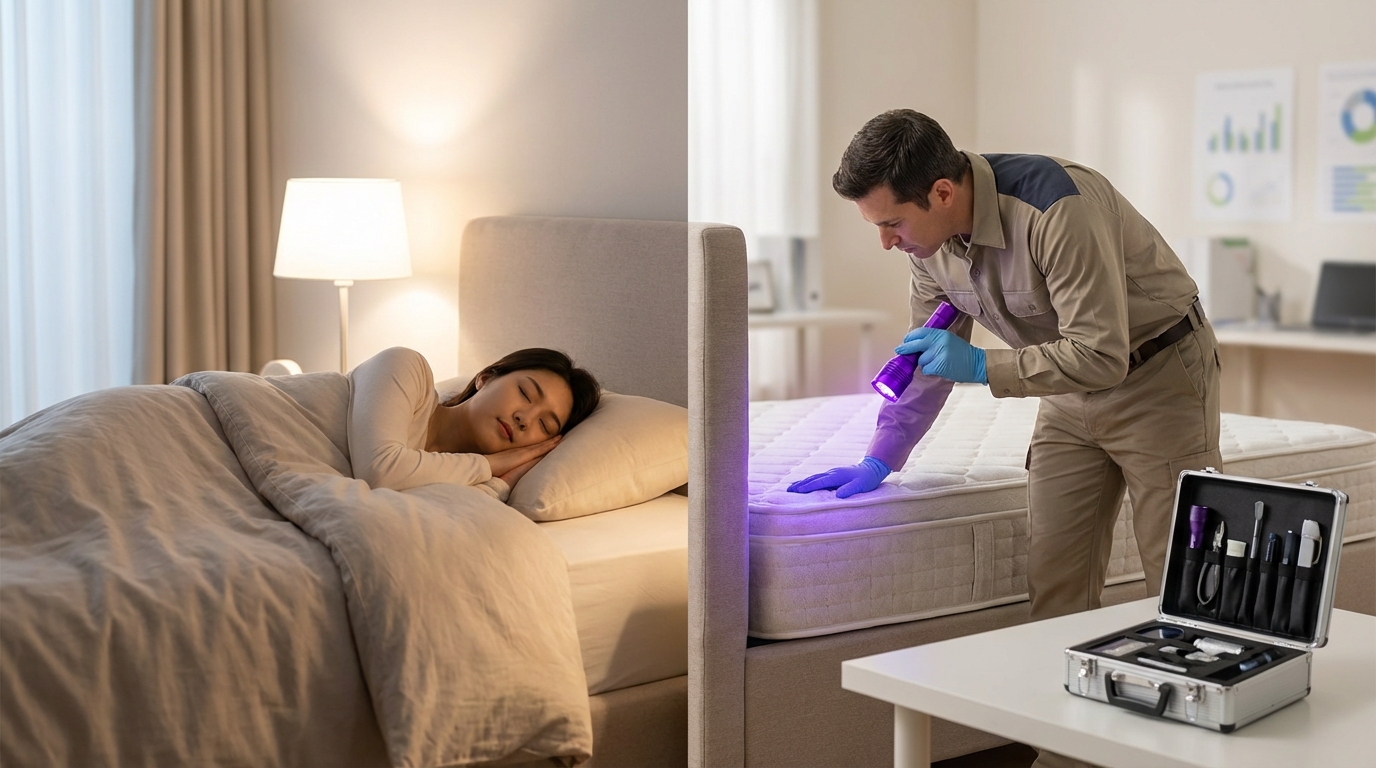
It's often said that bedbugs are nocturnal. This is true under normal conditions. In the laboratory, when given the choice, they emerge en masse between 2 and 5 a.m., when you're deepest asleep. They detect the CO2 you breathe out, the warmth of your body, and they get going. Room light? It's a secondary parameter in their decision-making. Not an insurmountable wall.
I've seen infestations in hotel rooms where the corridor light was left on 24 hours a day, with a ray under the door. The bedbugs didn't give a damn. I've also seen cases in children's bedrooms where parents, reassured by the nightlight, let the infestation fester for weeks. Sleeping with the light on when you have bedbugs is a placebo. Nothing more.
Why does this idea persist? Because it's half true. Bed bugs prefers darkness. Given the choice between a dark and a light environment, it will choose the dark. But when hunger mounts, after five to seven days without a blood meal, light is no longer a match for the survival instinct. And that's when the trap closes in on people who think that sleeping with the lights on will protect them from bedbugs.
There's another underestimated problem: lack of sleep. You don't sleep well in the light, your body doesn't recover, your stress increases, and all the while the bedbugs' reproductive cycle continues unabated. Eggs hatch in 6 to 10 days. Nymphs need five blood meals to become adults. Whether the light is on or off, this cycle continues. With every day that passes without real treatment, the population grows exponentially.
So where do you sleep when you've got bedbugs? The temptation is to change rooms. A bad idea in 90% of cases. You take bedbugs with you (on your clothes, in your belongings) and contaminate a second room. Best advice: stay in the infested room, but act fast. Anti-bug covers on mattresses, interceptors under bed legs, and above all, call in a professional. Light won't save you. Targeted intervention will.
What are bed bugs most attracted to? CO2, body heat and certain odors from your skin. Not darkness itself. Darkness is just when they feel safest to come out. Important nuance. This means that permanent lighting doesn't remove the main attraction: you, asleep in bed.
LED UV lamp vs. visual inspection: Comparison of detection methods
You may have seen these videos on social networks: someone turns off the light, pulls out a UV lamp, and suddenly fluorescent spots appear on the mattress. Impressive. But does it really work to detect bed bugs? The answer is nuanced, and that's precisely why we need to talk seriously about it.
A UV bedbug lamp, typically between 365 and 395 nanometers in wavelength, can actually reveal certain biological traces. Bedbug droppings, which contain digested blood, sometimes react to black light. So do traces of fresh blood on bed sheets. And trails of eggs or exuviae (molts) can appear more clearly under this black detection light than with the naked eye.
The key word here is «sometimes». Because fluorescence depends on many factors: the age of the marks, the type of fabric, the power of the lamp, the cleanliness of the substrate. On a freshly laundered white sheet, a UV lamp will bring out just about anything, including detergent residues, fibers and traces of perspiration. The result: false positives galore. You see stains everywhere and panic, when there may be nothing there at all.
The classic visual inspection is based on what you know to look for. Concrete signs: small black spots (droppings) aligned along mattress seams, traces of blood on sheets, translucent dead skin, and of course the insects themselves, living or dead. A good, powerful white flashlight with a concentrated beam and a magnifying glass are often all a trained eye needs to confirm an infestation.
Let's compare. The UV lamp has one advantage: it can reveal traces invisible to the naked eye under certain conditions, particularly on dark surfaces where the droppings blend in with the fabric. It is also useful for rapidly scanning large surfaces, such as an entire bed base. However, it cannot distinguish a bedbug track from a dried coffee stain or household product residue. You have to interpret what you see, and without experience, interpretation can get out of hand.
Visual inspection has the advantage of certainty. When you find a live bedbug, there's no doubt. When you identify a cluster of excrement in a mattress fold with exuviae next to it, it's confirmed. The problem is that this method misses early infestations. Five or ten bedbugs in an apartment are virtually undetectable to the naked eye if you don't know exactly where to look.
How to spot bedbugs at night? Some people try waking up at 3am with a flashlight. Honestly, it's exhausting and unreliable. Bedbugs freeze at the slightest vibration. By the time you reach for your flashlight, they've already slipped through a crack. Black light doesn't help here either, because the insect itself doesn't fluoresce spectacularly.
My clear opinion: the UV lamp is a complement, not a stand-alone tool. It can give you clues, confirm suspicions, but it doesn't replace the expertise of a professional or a methodical area-by-area inspection. Used alone by someone who has never seen an infestation with their own eyes, it generates more anxiety than answers.
Selection criteria and recommendations before buying a detection kit
Before you whip out your credit card, ask yourself one simple question: what do you intend to do with the result? If the lamp confirms suspicious traces, your next step will still be to call an exterminator in Brussels. If it doesn't, will you be reassured? Probably not, because the absence of fluorescence doesn't guarantee the absence of bedbugs.
That said, if you want a pre-diagnostic tool, here's what really counts when buying a detection lamp.
Wavelength. Aim for 365 nm. This is the wavelength at which biological traces react best. Many inexpensive lamps claim «UV» but emit at 395 nm or more, producing mostly visible violet light and very little real fluorescence. The price difference between a 365 nm and a 395 nm lamp is often 15 to 30 euros. Well worth it.
Power. A minimum of 3 watts for domestic use. Below this level, the beam is too weak to detect marks more than 10 centimetres away. Professional models go up to 10-15 watts, but for occasional use, 3 to 5 watts are sufficient.
Autonomy and power supply. AA battery models are practical, but quickly run out of UV. USB-rechargeable models last longer. If you're inspecting an entire apartment (mattresses, box springs, baseboards, electrical sockets, door frames), allow 45 minutes to an hour minimum. Your lamp needs to last.
Filters. A Wood filter (Wood glass) blocks stray visible light and lets through only pure UV. Without this filter, you'll get a violet halo that reduces contrast and makes tracks harder to spot. Lamps with integrated filters cost a little more, but UV efficiency is much higher.
Now, let's talk frankly about what a DIY kit can't do. It can't tell you the level of infestation. It can't identify with certainty whether the traces are from this week or six months ago. It can't scan inside walls, behind sockets, under wooden floors. A professional, on the other hand, combines visual inspection, sometimes canine detection (sniffer dogs have a reliability rate of 95% versus 30 to 40% for an untrained human), and field experience.
In Brussels, a professional inspection costs between €80 and €150, depending on the surface. A proper UV lamp costs between 25 and 60 euros. The price difference is small when you consider what's at stake: for every week lost, the bedbug population doubles. Buying a detection lamp makes sense if you travel a lot and want to check hotel rooms before packing your bags. To confirm an infestation at home, the most cost-effective investment is to call in an exterminator in Brussels, who will make a reliable diagnosis and suggest a suitable treatment.
One final, often overlooked point: UV light is harmful to the eyes. Never look directly into the beam, wear UV-protective goggles, and keep the lamp out of reach of children. It's not a gadget, it's a tool that requires a minimum of precautions.
Conclusion
To summarize. The bedbug is a fire-fighting insect, preferring shade, but having the light on won't stop it from coming to feed. Sleeping with the light on is not a solution, it's a loss of sleep. Black light and UV lamps, on the other hand, can be used as a pre-detection tool if you choose the right model (365 nm, Wood filter, sufficient power) and know how to interpret what you see.
But let's be clear: no gadget can replace professional intervention when infestation is confirmed. If you're in Brussels and have the slightest doubt, don't waste time tinkering. Contact a specialist, have your home inspected, and deal with the problem before it gets out of hand. Every day counts.
Frequently asked questions
Does sleeping with the light on prevent bedbugs from biting?
No, light is not a barrier. Although lucifuges, bed bugs prioritize their need to feed over their discomfort with light: if they're hungry, they'll come out and bite you, even in broad daylight or under a lighted ceiling lamp.
Why do bedbugs prefer the dark?
Darkness is a safety signal for these insects, which naturally flee brightness to escape predators. It's during the night that they best detect CO2 and body heat, their main indicators for locating prey.
Is a UV lamp effective in detecting bedbugs?
The UV lamp (ideally 365 nm) is a complementary tool that fluoresces biological traces such as eggs or droppings. However, it is no substitute for careful visual inspection, as it can generate false positives with detergent residues.
What are the best tools for spotting infestations yourself?
Use a powerful white flashlight to inspect mattress seams and dark nooks and crannies for black spots. A magnifying glass and a UV lamp with a Wood filter are useful additions to confirm the presence of eggs or moults invisible to the naked eye.
When should you stop DIY and call in a professional in Brussels?
As soon as the first signs are confirmed, or if doubt persists despite your investigations. An infestation grows exponentially: the expertise of an exterminator is essential to effectively treat inaccessible areas such as inside walls or electrical outlets.

 French
  English
  Dutch
Dutch