

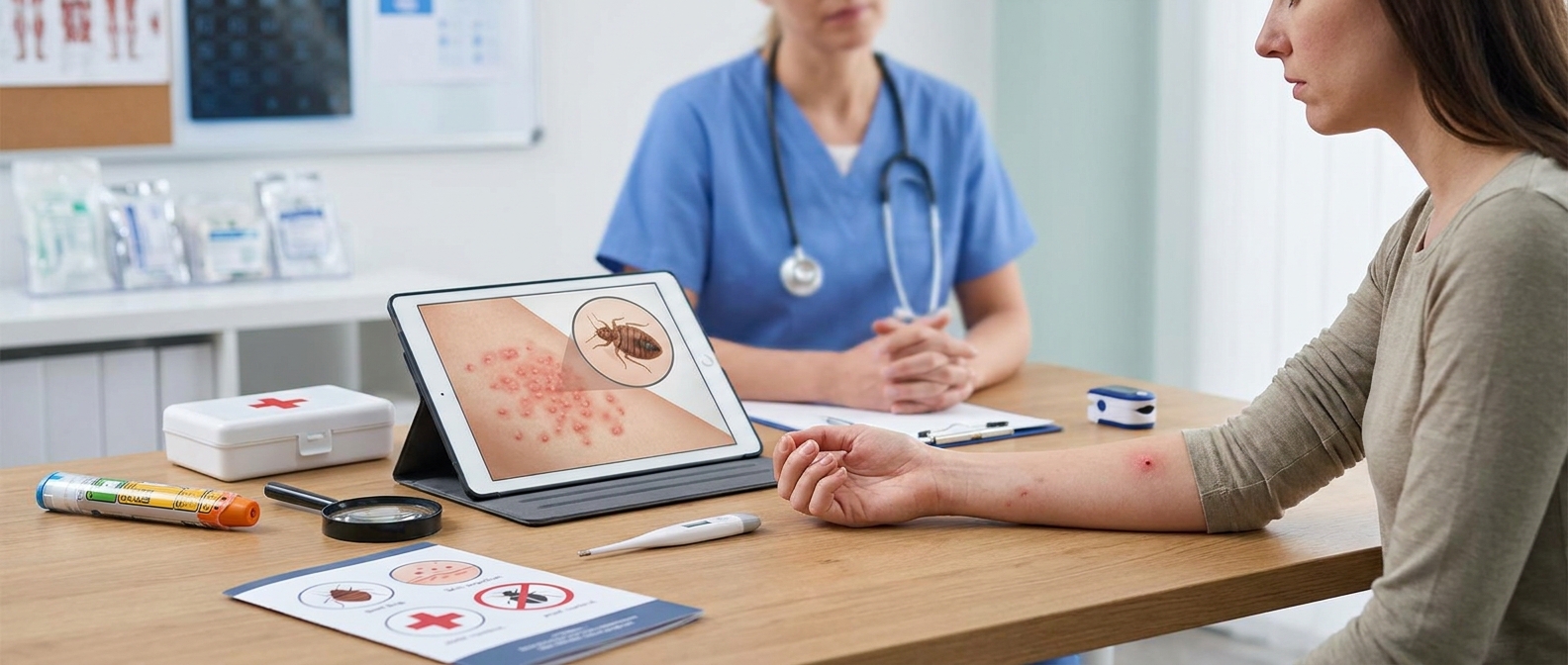
Bedbug allergy: recognizing emergency signs
Contents
Three red pimples lined up on your arm, itching that wakes you up at 4am. Most people scratch, apply a little cream and move on. But for around 20% of those stung, the skin reaction doesn't stop there. It escalates. And sometimes, it becomes downright dangerous.
Things to remember
-
This article sets itself apart by focusing on immediate medical triage.
-
It transforms symptom identification into a life-safety protocol, explaining precisely how to differentiate a common skin reaction from a respiratory emergency or anaphylactic shock.
-
Understanding the mechanism of allergy to bedbug bites
-
when an injection becomes a medical emergency
At Punaisesdelitbruxelles, we intervene every week in the homes of Brussels families who discover an infestation after consulting a doctor about symptoms they didn't understand. Swollen patches all over the body, puffy eyelids on waking, and in the most serious cases, respiratory discomfort that requires a trip to the emergency room. Bedbug allergy is a real health issue, not just a temporary discomfort.
This article isn't yet another guide to «how to recognize a sting». We're going to talk about medical triage. How to distinguish between a trivial reaction and a life-threatening emergency. What symptoms should make you pick up the phone immediately. And above all, how to get to the root of the problem, because no antihistamine will protect you as long as the bugs are in your mattress.
Understanding the mechanism of allergy to bedbug bites
When a bedbug bites you, it doesn't just suck your blood. First, it injects its saliva. This bedbug saliva contains a cocktail of proteins: anticoagulants to keep the blood fluid, vasodilators to widen the capillaries, and anesthetics so you don't feel a thing at the time. It's precisely this mixture that causes problems.
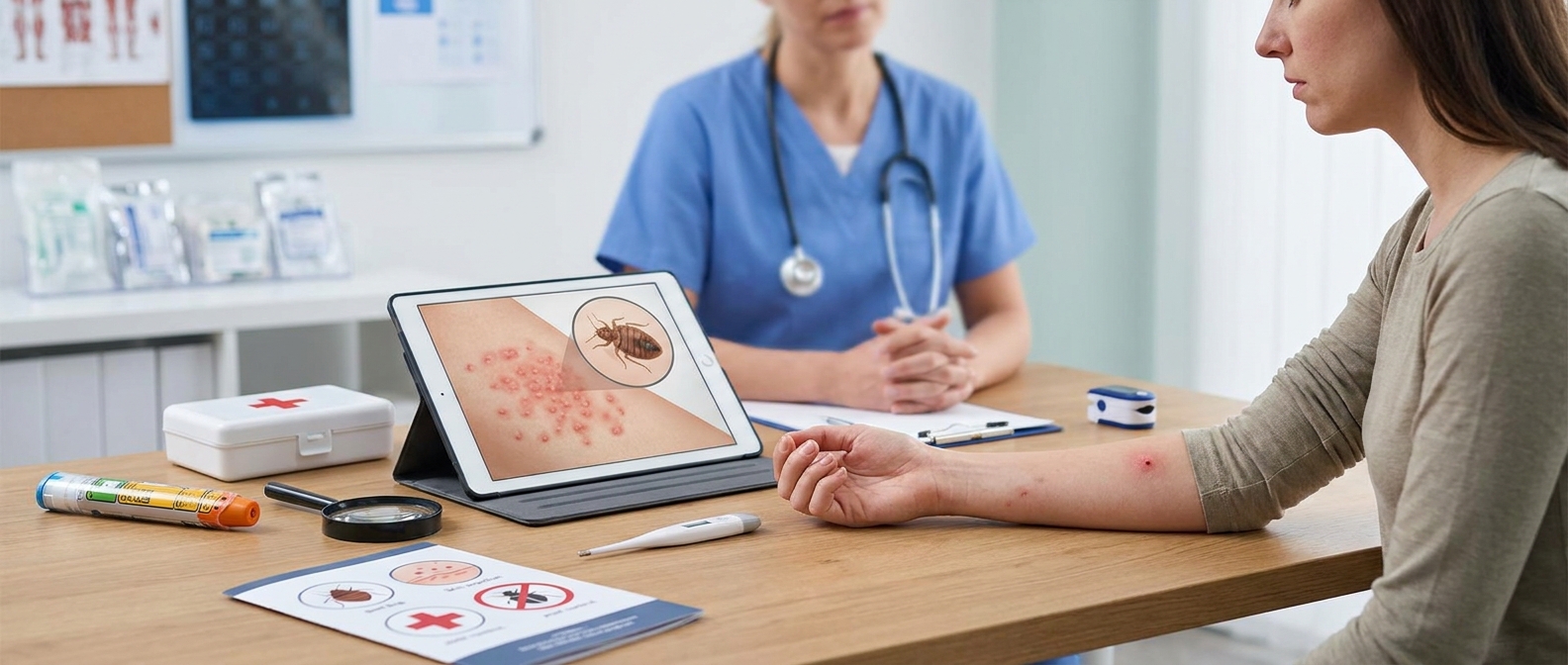
Your immune system identifies these salivary proteins as intruders. In a non-sensitized person, the first series of stings often goes unnoticed. Zero pimples, zero itching. The body hasn't yet learned to react. That's why some people think they're not being stung, when in fact they are, night after night.
Sensitization builds up over time. After a few weeks, your body begins to produce specific IgE antibodies against the proteins in saliva. At the next sting, these antibodies activate mast cells, which release massive quantities of histamine into the tissues. Histamine is the fuel of the allergic reaction. It's what causes red spots, swelling and unbearable itching.
What makes bedbug allergy particularly treacherous is its progressive nature. The skin reaction intensifies over time. The first visible bites produce small, discreet, slightly pinkish pimples. A few weeks later, the same stings give rise to papules measuring 2 to 3 centimetres, hard, warm and itchy for days. And in predisposed individuals, the reaction can go up another notch.
A point many people confuse: bedbug bites are not mite bites. Bed mites are itchy droppings, not bites. Mite bites in the strict sense are rare in a domestic context. If you wake up with pimples lined up in groups of three or four, often on the arms, shoulders, neck or legs (parts of the body exposed during sleep), this is the typical bedbug pattern. Bed mites, on the other hand, are more likely to cause diffuse itching, without well-defined pimples.
How can you tell if you're allergic to bedbugs? The first clue is the disproportion between the bite and the reaction. If a small puncture point triggers a 5-centimetre red patch that swells for 48 hours, you're in allergic territory. Some people also develop delayed reactions: nothing for 24 hours, then a massive rash. This time lag complicates the diagnosis, because there's no longer any link with the previous night.
The symptoms of a bedbug allergy go beyond simple pimples. Intense itching that disrupts sleep, anxiety, chronic insomnia, superinfection of lesions due to scratching. I've seen children's arms covered in scabs because they scratched until they bled. It's not anodyne.
Warning signs: when a bite becomes a medical emergency
95% allergic reactions to bedbug bites remain localized. Unpleasant, yes. Dangerous, no. The problem is the remaining 5%. And when it comes down to it, things can happen very quickly.
First warning sign: generalized hives. You wake up and the pimples are no longer confined to the bitten areas. Raised, red patches appear on your stomach, back and thighs - places that have had no direct contact with bedbugs. This means the allergic reaction has spread throughout the body. Histamine circulates massively in the blood. It's time to see a doctor, not within a week, but within the day.
The second, much more serious stage is angioedema. The swelling is no longer confined to the skin around the stings. The lips swell, the eyelids close and the tongue thickens. If you feel swelling in the throat, a feeling of tightness, difficulty swallowing, it's an absolute emergency. Angioedema can obstruct the airways in a matter of minutes.
The third and most critical stage is anaphylactic shock. This is rare after bedbug bites, but is documented in medical literature. The signs are clear: sudden breathing difficulties, drop in blood pressure, intense dizziness, rapid and weak pulse, chest tightness, loss of consciousness. If you observe even two of these symptoms simultaneously, call 112 immediately. Not tomorrow. Not after googling your symptoms. Now.
Here is a summary to help you assess the situation:
-
Normal reaction Localized red spots, moderate itching, disappears in 3 to 7 days. No need for a doctor unless superinfection occurs.
-
Moderate allergic reaction : very swollen pimples (over 3 cm), intense itching, lesions that extend beyond the stung areas. Consult a general practitioner or dermatologist.
-
Severe allergic reaction Generalized hives, facial swelling, fever. Seek urgent medical attention the same day.
-
Vital emergency swelling of the throat, difficulty breathing, malaise, drop in blood pressure. Call 112.
An important detail: the severity of the reaction can increase from one exposure to the next. Did you have a mild reaction last week? That's no guarantee that the next one will be the same. The immune system sensitizes itself. Each new series of stings can trigger a stronger response. That's exactly why waiting and hoping «it'll pass» is a bad strategy when you're living with an active infestation.
Children and the elderly deserve special vigilance. In toddlers, a severe allergic reaction sometimes manifests itself in an atypical way: extreme irritability, refusal to eat, inconsolable crying. Parents suspect teething or a virus. Meanwhile, the bedbugs continue their work every night.
Another point often overlooked is the psychological side-effects of bed bugs. Chronic insomnia, bedtime anxiety, social shame. Studies show that 30% of people confronted with an infestation develop symptoms compatible with post-traumatic stress. It's not an exaggeration. When you know that insects are biting you every night and your body is reacting more and more violently, the stress is perfectly rational.
Treating allergy and eliminating the source: the complete protocol
To put it bluntly, treating symptoms without eliminating bedbugs is like taking paracetamol for an abscessed tooth. It relieves for a while, but the problem gets worse. The protocol must be twofold: medical and practical, in parallel.
On the medical side, there was immediate relief. For a moderate allergic reaction, an oral antihistamine (cetirizine, loratadine) reduces itching and swelling in 30 to 60 minutes. Take it in the evening before bedtime if you know you're going to be stung tonight. It's not a luxury, it's crisis management until the bedbugs are eradicated.
Applied topically, a soothing hydrocortisone cream (available over-the-counter in pharmacies) calms pimple inflammation. Apply it twice a day to the lesions, for no more than 7 consecutive days without medical advice. For nocturnal itching that prevents sleep, some doctors prescribe a first-generation antihistamine such as dexchlorpheniramine, which has the advantage of being sedating.
If you have a severe allergy, with generalized urticaria or a history of edema, your doctor may prescribe a short course of oral corticosteroids and possibly an adrenaline auto-injector pen to keep with you. Don't make this kind of decision alone.
When it comes to eradication, there are no half-measures. Insecticide sprays and bombs sold in supermarkets hardly work on bedbugs. Worse still, they can spread the colony to other rooms and create resistance. If you're allergic, each additional night of exposure increases the risk of a severe reaction. Time is on your side.
For pest control in Brussels, call on a professional who combines heat treatment with targeted chemical treatment. At Punaisesdelitbruxelles, we use a minimum of two treatments, spaced 15 days apart, to catch any eggs that may have hatched in the meantime. Heat treatment (steam at 180°C) kills bedbugs at all stages of development, including eggs, with no chemical residue in your bedding.
In the meantime, here are a few practical steps you can take to limit stings:
-
Install certified bedbug covers on mattresses and box springs. This traps bedbugs inside and prevents others from gaining access.
-
Place interceptors (passive traps) under the foot of the bed to monitor activity.
-
Move the bed at least 10 cm away from the wall. Bedbugs don't fly or jump: they climb.
-
Wash all bedding at 60°C minimum and tumble dry pillows for 30 minutes on high.
One last point that makes all the difference: don't move your belongings from one room to another in a panic. This is the best way to spread the infestation throughout your apartment. Every item of clothing, every cushion, every bag can carry eggs or nymphs. Put suspect textiles in airtight garbage bags before transporting them to the washing machine.
Allergic reactions to bedbug bites are not inevitable, but they can't be solved with home remedies. Appropriate medical protocol to manage symptoms, professional intervention to remove the source. The two together, in this order of priority: first protect your health, then eradicate the pests.
Conclusion
A bedbug bite that swells abnormally, patches that extend beyond the bitten area, swelling of the face or throat: these signals should never be ignored. There's a fine line between an unpleasant reaction and a medical emergency, and it can be crossed without warning.
If you're in Brussels and suspect an infestation, don't wait for the allergy to get worse. Contact Punaisesdelitbruxelles for a rapid diagnosis and appropriate intervention. We know these bugs, we know where they hide, and we have the tools to eliminate them for good. Your sleep and your health are worth more than one more night as a meal.
Frequently asked questions
How do I know if I'm having an allergic reaction to bedbugs?
An allergic reaction is characterized by spots that swell abnormally (over 3 cm), become very hot and cause unbearable itching. Unlike a classic sting, the redness can extend far beyond the bitten area.
What are the signs of a medical emergency after a bite?
This is a life-threatening emergency if you experience swelling of the face or throat (angioedema), difficulty breathing, or general malaise. In these cases, don't wait - call 112 immediately.
Why does my bedbug allergy seem to be getting worse over time?
This is the phenomenon of sensitization: your immune system produces more and more antibodies with each new exposure. What started out as a small pimple can turn into a severe inflammatory reaction after a few weeks of infestation.
What's the difference between a bedbug bite and a mite bite?
Bedbugs leave red bumps, often three or four in a row, on exposed areas (arms, legs). Mites, on the other hand, don't actually bite, but cause respiratory allergies or diffuse itching without clearly defined spots.
How to soothe itchy allergies right away?
Applying a hydrocortisone cream and taking an oral antihistamine can quickly reduce inflammation. However, these treatments are only temporary until the source of the allergy in your mattress is eliminated.
Is it possible to stop the allergy without treating the infestation?
No, no medical treatment will be effective in the long term if bedbugs continue to bite you every night. Professional eradication of the colony is the only way to stop your body's allergic reaction once and for all.

 French
  English
  Dutch
Dutch