

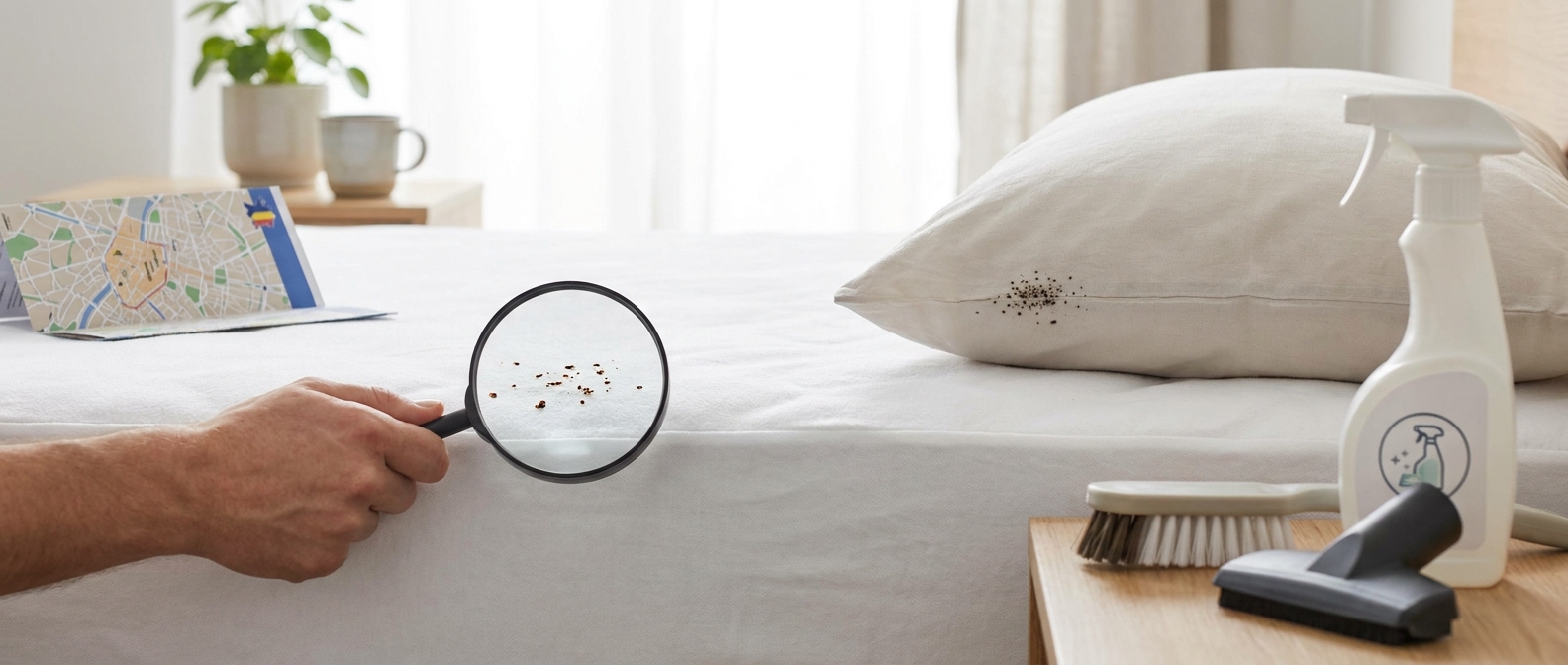
Black spot bed bugs: Identification and diagnosis guide
Contents
You've just removed your sheets and there's a surprise: little black stains dot the mattress. Maybe even on the box spring, along the seams. Your first instinct is to look for a reassuring explanation. Mildew, a leaked pen, a forgotten coffee stain. Except that in 8 out of 10 cases when we are called to Brussels with this kind of discovery, it's bedbug droppings.
Things to remember
-
A field guide that goes beyond mere description to offer Brussels residents a genuine diagnostic tool
-
We help remove the doubt between droppings and household stains by integrating specific cleaning advice and the expertise of a local professional close to you.
-
Understanding the origin of black stains on mattresses and sheets
-
Location and key indicators
I've written this article to help you decide. Not just to describe what those black marks look like, which you'll find everywhere. The idea here is to give you a real diagnostic tool: how to distinguish a bedbug stain from an ordinary stain, where exactly to look, and what to do once you're in doubt. We're going to talk about what we see every day in the field in Brussels.
Because the difference between an infestation caught in time and one that gets out of hand is often a week. A week of doubt, when bedbugs have no doubts at all.
Understanding the origin of black stains on mattresses and sheets
First thing to know: a bedbug doesn't leave just one kind of mark. It leaves several, and black spots are the most common. These are its excrement. Bedbug excrement is made up of digested blood, the blood they have taken from you during the night. Once digested, this blood becomes very dark, almost black, and the bedbug deposits it in the form of small, semi-liquid droplets.
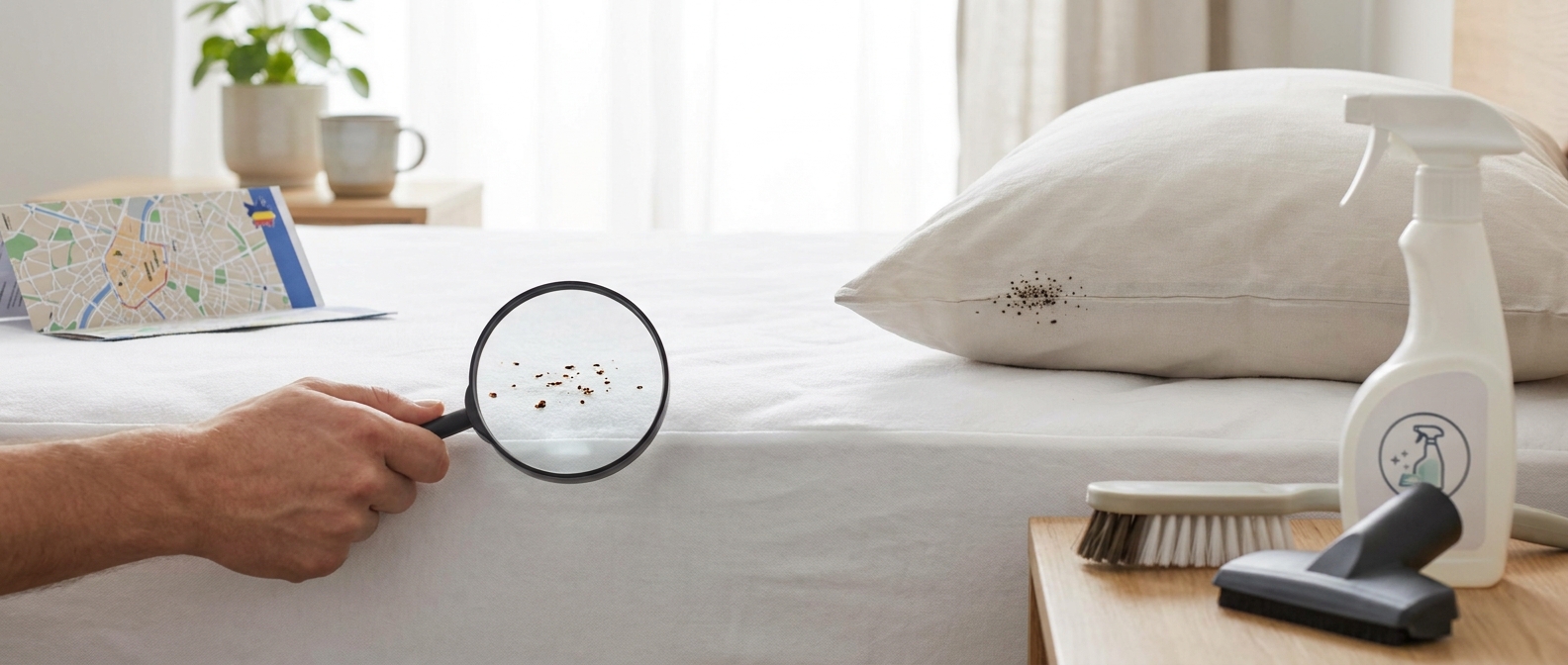
When these droppings fall onto a fabric (sheet, mattress cover, pillowcase), they become impregnated and form dots 1 to 3 mm in diameter. On a white mattress, they look like dots of black ink. On a colored sheet, it's sometimes harder to spot, but to the touch, the texture is slightly granular once dry.
What is the exact color of these spots? From very dark brown to pure black. Never bright red. If you see bright red, it's probably a bug you've crushed in your sleep, gorged with fresh blood. The two clues often coexist: black spots (digested blood, i.e. excrement) and small red traces (fresh blood). When you find both on your sheets, there's really no room for doubt.
How can you tell the difference between these black marks and an ordinary mold or dirt stain? A simple test: take a damp cloth and rub the stain. Bedbug droppings are partially diluted in water, leaving a reddish-brown trail. Mould, on the other hand, doesn't react in the same way: it remains on the surface, often greenish or greyish, and gives off a characteristic odour. A pen stain cannot be diluted with plain water. This little water test is the first step I recommend to all our customers.
A detail that surprises many people: bedbugs don't deposit their excrement just anywhere. They mainly do so in their resting places, i.e. in the immediate vicinity of their hiding places. So if you find black stains concentrated along a mattress seam or in a fold of the box spring, it's a strong signal. Spots scattered randomly all over the sheet are less typical of a bedbug infestation.
Another point: quantity. Three or four isolated spots could be the beginning of a recent infestation with a few individuals. Dozens of spots grouped in clusters indicate a colony that has been established for several weeks. The density of black spots on your mattress gives you a fairly reliable indication of the stage of infestation. The more there are, the more urgent it is to take action.
Signs of infestation: Location and key clues
Finding suspicious stains is one thing. Confirming that they are indeed bedbug tracks is quite another. To make a true diagnosis of infestation, you need to cross-reference several clues. Spots alone aren't always enough.
Let's start with where to look. Bed bugs love dark, narrow, light-proof nooks and crannies. On a bed, this means: the seams of the mattress (especially the piping), cracks in the box spring, wooden slats, screws and dowels, the bed frame if it's made of wood. Take a flashlight, turn the mattress over and inspect every nook and cranny of the box spring. Cracks in the box spring are a classic: this is where you'll find the most important colonies, well hidden in the interstices of the wood.
What are we looking for besides black spots? Molting. Bedbugs moult five times before reaching adulthood. Their exuviae (the translucent skins they shed) accumulate in hiding places. If you find small, beige, almost transparent envelopes the size of a grain of rice: this is a bedbug moult. Combined with the black spots, the diagnosis of infestation is almost certain.
Eggs are also a clue, but harder to spot. White, oval, about 1 mm long. They are often stuck in cracks, in clusters of 5 to 15. Without a magnifying glass, they can be mistaken for dust grains. If you see any, the infestation is active and reproducing.
And the bugs themselves? Adults are between 4 and 7 mm long, flat (except after a meal) and reddish-brown in color. They don't fly or jump. They move by walking and avoid light. So seeing them in broad daylight is rare, except in cases of severe infestation where overpopulation pushes them out of their usual hiding places.
An often overlooked clue: the smell. A heavy infestation gives off a sweet, slightly nauseating odor, which some people compare to coriander or rancid almonds. If, in addition to the traces of bedbugs on your mattress, you smell this odor in your bedroom, the infestation has probably been present for some time.
Where to look beyond the bed? Bedbugs don't always stay confined to the mattress. Inspect bedside tables, skirting boards, electrical sockets (they love to crawl behind plates), picture frames hanging on the wall, curtains at the hems. In Brussels, in older apartments with strip parquet flooring, they are regularly found between the floorboards.
To sum up the diagnosis: black spots concentrated in specific areas + molting + bites on your body (often lined up in threes, called «breakfast, lunch, dinner») = confirmed infestation. Any one of these signs may have other explanations. All three together, no.
Practical guide: How to clean traces and treat infestation
You've identified the stains, confirmed the clues. Now two questions arise: how do you remove the black stains, and above all, how do you get rid of the bedbugs?
Let's start by cleaning the stains. To remove bedbug stains from sheets and mattress covers, machine wash at 60°C minimum. This is the temperature that kills bedbugs and their eggs, and it's also the temperature that removes most digested blood stains from fabric. If the stain persists after washing, apply a mixture of hydrogen peroxide (10 parts by volume) and washing-up liquid directly to the area, leave for 15 minutes, then run the cycle again. This works very well on white cotton.
To remove black stains from mattresses (which obviously can't be put in the washing machine), the method is different. Mix baking soda with a little water to form a paste. Apply to the stain, leave to dry completely, then vacuum up. For stubborn stains, a steam cleaner at 110°C minimum is ideal: it cleans and kills bedbugs at the same time. In fact, it's a tool we use systematically during our interventions.
On wooden box springs and bed frames, a cloth soaked in rubbing alcohol will dissolve the droppings. Rub, let dry and repeat if necessary. Don't use bleach on untreated wood: it discolors it and won't kill bedbugs.
Now for the crucial point: cleaning the stains without treating the infestation is strictly pointless. The stains will come back the next night. Cleaning is the last step, not the first. The absolute priority is to eliminate the bedbugs.
Can you treat it yourself? For a very recent infestation (a few individuals, rare and localized stains), certain measures can help: thoroughly vacuum every nook and cranny of the bed and box spring (immediately disposing of the bag in an outside container), wash all bed linen at 60°C, install certified anti-mite covers on mattresses and box springs. Diatomaceous earth, applied in a thin layer in crevices, can complete the system.
But let's be honest: in the majority of cases we see in Brussels, when someone discovers stains and calls us, the infestation is already beyond the «home treatment» stage. Bedbugs reproduce quickly. A female lays between 2 and 5 eggs a day. Within three weeks, a handful of individuals become a colony of several dozen. At this stage, only professional insect control can provide reliable results.
In Brussels, serious pest control generally involves at least two treatments, spaced 10 to 15 days apart, to eliminate adults and then nymphs from eggs that may have survived the first treatment. Techniques vary: targeted chemical treatment (professional insecticides not available to the general public), heat treatment (raising the temperature of the room to 55-60°C for several hours), or a combination of both.
Our advice: don't leave it to chance. If you've found suspicious black spots and the wet water test shows a reddish-brown streak, contact a professional for a diagnosis. A good technician will identify the level of infestation within 30 minutes and suggest a suitable treatment plan. The longer you wait, the more time-consuming, costly and painful the treatment will be.
Conclusion
A black bedbug spot isn't just a stain. It's an alarm signal. Now you know how to recognize it (water test, brownish-black color, location at seams and in cracks), how to distinguish it from a common stain, and what other clues to look for to confirm your suspicions.
If after your inspection the signs agree, don't wait. Every day counts. At Punaises de Lit Bruxelles, we intervene quickly, diagnose on the spot and tell you exactly where you stand. No jargon, no inflated estimates, just a professional who knows these bugs by heart and how to get rid of them. Give us a call and we'll talk.
Frequently asked questions
How can you tell if a black spot is a bedbug?
To find out, rub the stain with a damp cloth: if it dilutes, leaving a reddish-brown trail, it's blood digested by a bedbug. What's more, these droppings generally measure between 1 and 3 mm and are concentrated in clusters near resting areas, such as mattress seams.
What color are bedbug droppings?
Bedbug excrement ranges in color from very dark brown to pure black, due to the digested blood. If you see traces of bright red blood on your sheets, it's more likely to be from an insect inadvertently crushed while you were sleeping.
Where do bedbugs mainly hide in the bedroom?
They flee from light, lodging themselves primarily in mattress seams, bed base cracks and wooden slats. In the case of larger infestations, they also colonize baseboards, electrical outlets, bed frames and the interstices of old wooden floors.
How do I remove black bedbug stains from a mattress?
Apply a fine paste of baking soda and a little water directly to the affected area, allow to dry completely, then vacuum up. To disinfect thoroughly and eliminate insects at the same time, using a steam cleaner at over 110°C is the most effective method.
When should I call in a pest control professional in Brussels?
As soon as you observe several concordant signs (grouped black spots, transparent molts and stings aligned on the skin). Given the speed with which these pests reproduce, the intervention of a local expert is essential to eradicate the colony completely and permanently.

 French
  English
  Dutch
Dutch