

Bedbugs on SNCB trains: Everything you need to know to travel with peace of mind
Contents
-
Bedbugs at the SNCB: The current situation and real risks for passengers
-
The SNCB vigilance protocol: Cleaning, detection and sanitary measures
-
How to protect yourself from bed bugs on the train: A practical guide and preventive measures
At the end of 2023, the bedbug psychosis crossed the French border into the daily lives of Belgian commuters. Photos of train seats shared on social networks, sometimes exaggerated testimonials, and one question that came up again and again: «Am I at risk of bringing bed bugs home with me after a SNCB train journey?» The short answer: the risk exists, but it's much lower than the networks would have you believe.
Things to remember
-
A comprehensive overview that goes beyond the simple news story to offer local expertise
-
We analyze the SNCB's actual measures and provide expert advice on insect control to reassure commuters in Brussels and Belgium about the real risks in the cab.
-
The current situation and real risks for travelers
-
Cleaning, detection and sanitary measures
At Punaisesdelitbruxelles, we deal with infestations on a daily basis. We see what these bugs do in apartments, hotels and houses. We also know the difference between a real alert and a media hype. This article is our expert look at the real situation on Belgian trains, the measures taken by the SNCB and, above all, what you can do to travel with peace of mind.
No unnecessary panic. No downplaying either. Just the facts, figures where they exist, and advice that really works.
Bedbugs at the SNCB: The current situation and real risks for passengers
Zero confirmed cases of mass infestation on SNCB trains. That's the starting point, and it needs to be hammered home. When the wave of reports swept across France in September-October 2023 (cinemas, TGV, Paris metro), Belgium was understandably worried that the phenomenon would spread. The Belgian media relayed the concern, Brussels commuters began inspecting their seats, and the SNCB had to react publicly. But there's a world of difference between vigilance and infestation.
What we know: bed bugs in Belgium are a very real problem, and one that has been steadily increasing over the last ten years. Large cities such as Brussels, Antwerp and Liège are particularly hard hit. Accommodation, hotels and youth hostels are the main breeding grounds. Public transport? They are a potential vector, not a colonization site. The nuance is crucial.
A bedbug doesn't settle in a train seat as it would in a mattress. It needs a sleeping host, accessible for several hours, in a stable environment. A 45-minute journey between Namur and Bruxelles-Midi is not her ideal habitat. What can happen, however, is that a traveler (unknowingly) drops a bedbug or eggs on the seat. This bug could then find its way into another passenger's bag or clothing. The scenario is plausible. It doesn't happen very often.
SNCB train seats, especially fabric ones, do indeed offer seams and folds where a bedbug could temporarily hide. Older models, with their thick padding, are potentially more at risk than the leatherette seats of recent trains. Have bedbugs ever been found in a Belgian railcar? The SNCB has never confirmed a case of infestation on board. A few reports have been processed and inspections carried out, but no colonies have been identified.
To put things into perspective: in France, where the situation was objectively more tense, SNCF also put things into perspective. Out of millions of daily passengers, confirmed cases of bedbug bites on trains remained marginal. In Belgium, with a smaller network and shorter journeys, the risk is mechanically even lower.
That said, we're not going to tell you to «sleep easy, there's nothing there». Bed bugs are transportable, that's a fact. They travel in suitcases, backpacks and clothes. Every form of public transport - train, bus, streetcar - is a breeding ground. The real risk is not the train itself, but the volume of people in transit. And Brussels, with its daily commuters, tourists and international institutions, is a high-traffic city. The train is just one link in a larger chain.
The SNCB vigilance protocol: Cleaning, detection and sanitary measures
In autumn 2023, SNCB publicly announced its vigilance measures. This was no cosmetic reaction: the rail company had anticipated the concerns and strengthened its procedures even before the first press articles appeared in Belgium.
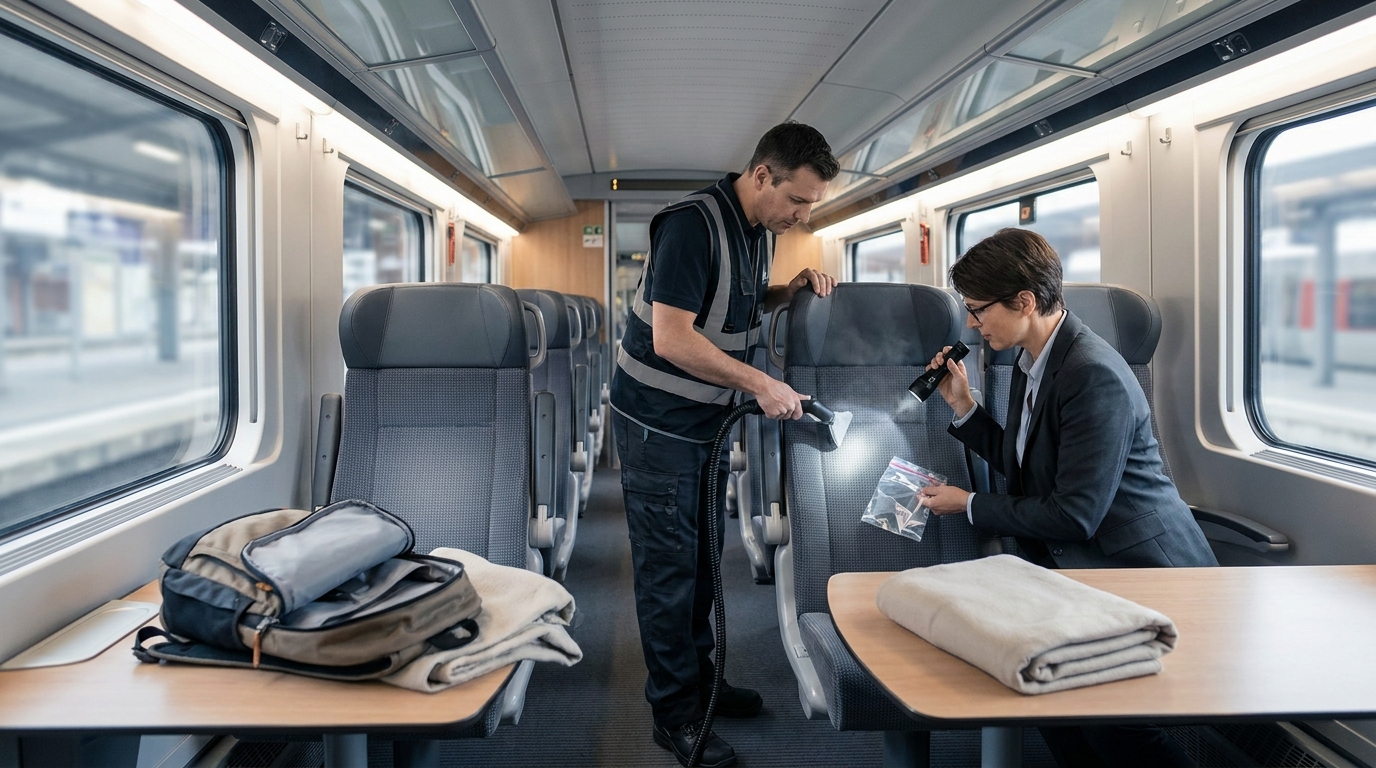
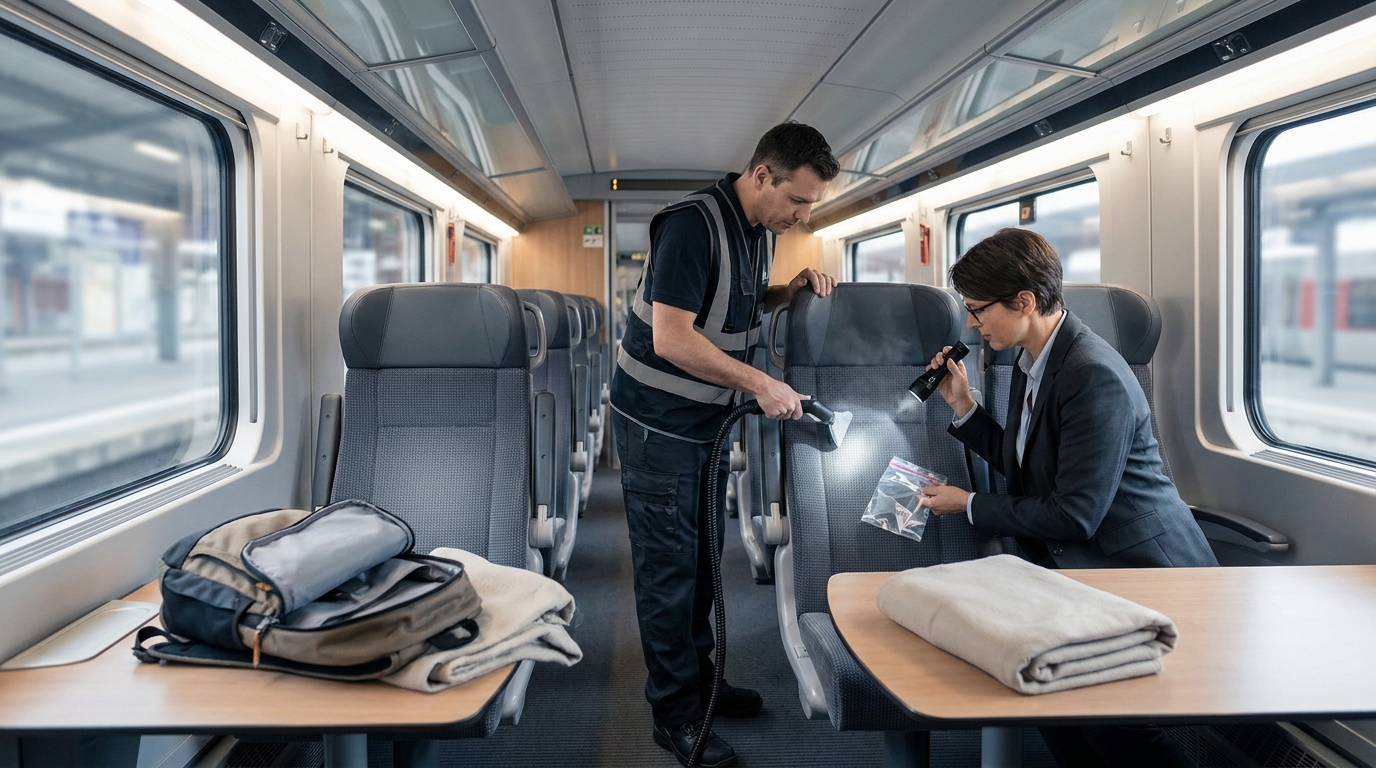
In concrete terms, here's what's been put in place. SNCB cleaning agents, who work at each terminus and during rotations, have been given specific instructions on how to spot signs of bedbugs. We're talking about small black spots (droppings), reddish marks on fabrics, or the presence of live insects in seat seams. These teams, already trained in the daily maintenance of the trains, have been made aware of the particularities of the bedbug: its size (5 to 7 mm adult), its reddish-brown color, and its tendency to hide in dark nooks and crannies.
The SNCB also called in companies specializing in pest control to audit certain trains and validate the absence of contamination. This type of preventive intervention is exactly what we recommend in our profession. Waiting until there's a visible problem before taking action is already too late with bedbugs. They reproduce quickly: a female lays between 200 and 500 eggs in her lifetime. An undetected pair of bedbugs can create a colony in just a few weeks.
The SNCB cleaning protocol includes regular vacuuming of seats, cleaning of contact surfaces and, in the event of a report, immediate removal of the train concerned for thorough inspection. This last point is essential. If a passenger reports a problem via the SNCB app or to on-board staff, the procedure calls for the wagon to be removed for inspection. This is a responsible approach.
Do we need to go further? Probably. Gradually replacing fabric seats with smooth materials (imitation leather, molded plastic) would be an effective structural measure. It's much harder for bedbugs to cling to and hide on a smooth surface. Several European transport networks have already made this choice, not just for bedbugs, but also for ease of maintenance and general hygiene. The SNCB is working on this as part of its rolling stock renewal program, but these transitions take years.
A point often overlooked: canine detection. Specially trained dogs can detect the presence of bedbugs with a reliability rate of over 95 %. Some transport companies have tested this method. The SNCB has not yet announced the use of sniffer dogs, but it is an existing tool that could supplement visual inspections, which are necessarily limited when hundreds of trains are involved.
The most important thing to remember about SNCB's measures is that they are real, proportionate to the identified risk, and in line with what other European operators are doing. Vigilance is stepped up, not because there is an infestation, but because prevention costs infinitely less (and causes infinitely less stress) than curative treatment.
How to protect yourself from bed bugs on the train: A practical guide and preventive measures
97 % of the infestations we treat for our customers in Brussels have an identifiable origin: a journey, a second-hand purchase, or a carrier visitor. The train can be one of these vectors, even if it's not the most common. The good news is that prevention of bed bugs in transport is based on simple gestures. You don't need a hazmat suit to take the IC to Ostend.
Before you sit down, take a look. It takes ten seconds. Visually inspect the seat, especially the side seams and the space between the seat and backrest. Signs to look for: tiny black dots (droppings look like felt-tip marks), small rusty spots, or a sweet, slightly disgusting smell in severe cases. If something looks suspicious, move. It's that simple.
Keep your luggage off the floor and away from adjacent seats. Place your bag on your lap or on a high rack. Bedbugs don't fly or jump. They crawl. Reducing the points of contact between your belongings and the textile surfaces of the train means reducing the risk of unintentional transport. A bag lying on the floor of a carriage corridor for an hour is an open invitation.
Light-colored clothing helps. Not to repel bedbugs (they don't care about color), but to make it easier to spot an insect on you as you get off the train. An adult bedbug on a pair of beige pants is easy to spot. On black jeans, much less so.
When you return home, the airlock reflex. This is the advice we always give to travelers, whether after a train, plane or hotel stay. Don't put your bag directly on the bed or sofa. Put it in the hallway, on a hard floor if possible. If in doubt (long journey, suspicious seat, trip abroad), tumble dry your clothes at 60°C for 30 minutes. Heat kills bedbugs at all stages, including eggs. This is the most reliable and accessible method.
Anti-bug sprays sold in pharmacies? Let's be frank: for preventive use on your luggage before a trip, it's virtually useless. Commercial repellents have no proven effectiveness against bedbugs. They don't react to the same molecules as mosquitoes. Save your money.
But what if you notice suspicious bites in the days following a journey? Bedbug bites on trains or elsewhere often appear in lines or clusters, on areas exposed during sleep or rest (arms, neck, legs). They itch, sometimes intensely, and usually appear a few hours after the bite. If you have three bites in a row, the famous «breakfast, lunch, dinner» of the bedbug, don't delay in inspecting your bedding and contacting a professional.
To avoid bedbugs on trains and elsewhere, the golden rule is vigilance. Not paranoia, vigilance. Observe, limit unnecessary contact between your belongings and at-risk surfaces, and deal with doubt quickly if something goes wrong. Commuters to Brussels who make this daily journey don't need to live in anxiety. They need to adopt a few automatisms, like checking that they have their keys before closing the door.
Conclusion
Bedbugs on SNCB trains are neither a fiction nor a health catastrophe. It's a small but real risk, in a context where these insects are on the increase throughout Europe. The SNCB has taken the subject seriously with concrete vigilance measures, and passengers have the means to protect themselves with simple gestures.
If you're a commuter and the subject worries you, adopt the reflexes we've described. And if you discover bedbugs in your home, whether from a train, a hotel or a piece of antique furniture, don't wait for the problem to get worse. Get in touch with us. At Punaisesdelitbruxelles, we intervene rapidly throughout the Brussels region, with effective methods and clear guidance from start to finish. An infestation dealt with early means a quick solution.
Frequently asked questions
Is there a real risk of catching bedbugs on an SNCB train?
The risk exists, but remains very low. Bed bugs do not colonize trains, as they need a sleeping host for several hours, but they can be transported involuntarily from one passenger to another via fabric seats.
What measures has the SNCB taken against bedbugs?
Prevent bedbug infestation when traveling
to detect the presence of bedbugs. Place your suitcase on the luggage rack after inspecting it, not on the bed, which may be infested. Leave your luggage closed when you don't need to take anything from it.
How can I tell if a train seat is contaminated with bedbugs?
Before settling in, quickly inspect the seams and folds of the fabric. Look for tiny black dots (droppings), small russet blood spots or the presence of a 5-7 mm reddish-brown insect.
What simple steps can you take to avoid bedbugs when traveling?
To protect yourself, avoid placing your bag or suitcase on the ground or on an adjacent fabric seat, preferring a high luggage rack or your knees. Wearing light-colored clothing will also help you spot any suspicious insects immediately.
What should I do with my luggage and clothes after a train journey?
Never put your luggage on your bed or sofa when you arrive. If in doubt, place your belongings on a hard floor and immediately put all your clothes in the tumble-dryer at 60°C for at least 30 minutes, which removes adults and eggs.
How to recognize a bedbug bite after a trip?
Bedbug bites appear as small, red, itchy pimples, often clustered or aligned in a straight line (the typical «breakfast, lunch, dinner» pattern). They usually appear a few hours to a few days after transport.

 French
  English
  Dutch
Dutch