


Bedbugs and income: the guide to affordable eradication
Contents
-
The link between income level and the persistence of bedbugs: an analysis
-
Practical guide: how to eradicate bed bugs on a limited budget
866 euros. That's the average cost of a bedbug treatment in France, according to the Anses report. For a household earning 1,200 euros a month, this represents over 70 % of the monthly budget. In other words, many people never call a professional, not because they don't want to, but because they simply can't.
Things to remember
-
This article deconstructs the link between financial insecurity and the persistence of bedbugs.
-
Based on Anses figures, we offer a human and local perspective (Brussels) to propose concrete solutions and assistance to low-income households in order to break the cycle of reinfestation.
-
Bedbug analysis Brussels
-
Why is wrestling so expensive?
In Brussels, we see this scenario repeated every week. Families living with infestation for months on end, trying home-made solutions, buying sprays over and over again, and ending up spending as much or more than a professional treatment. All to no avail. The link between bedbugs and income is not an abstract subject: it's a concrete reality affecting thousands of households in the Belgian capital.
We wrote this article for them. Not to moralize, not to sell dreams. It's about putting the figures on the table, explaining why it costs what it costs, and, above all, showing that there are ways to get by, even when your bank account doesn't add up.
The link between income level and the persistence of bedbugs: an analysis
A figure from the Anses report on bedbugs should give everyone pause for thought: households on the lowest incomes are twice as likely to suffer a long-lasting infestation. Not because they're less clean (bedbugs don't give a damn about hygiene), but because they don't have the means to react quickly. And in this war, speed is everything.
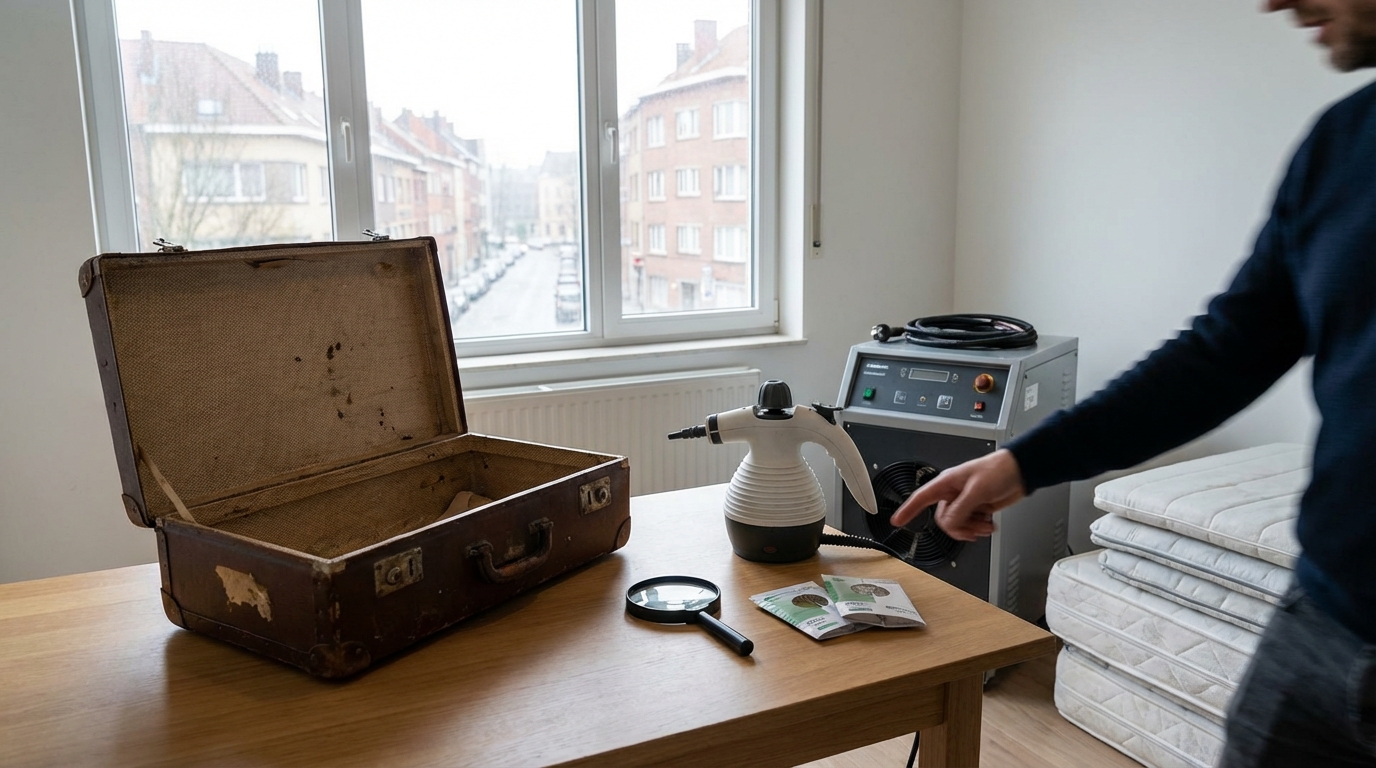
When a bedbug lays between 5 and 15 eggs a day, each week's delay in treatment multiplies the problem. A couple of bedbugs in January means potentially hundreds of individuals in March. The persistence of the infestation is directly linked to the delay between detection and intervention. And this delay almost always depends on one thing: the money available.
The income factor plays a role on several levels. First, there's the cost of the treatment itself: 866 euros on average, sometimes more when the infestation has been in place for a long time. Then there's everything that's invisible: lost working days, replacement of bedding, intensive washing costs. For a modest household, it's a double whammy.
We often hear the question: what attracts bed bugs the most? The answer is simple: the CO2 you exhale and your body heat. It has nothing to do with the cleanliness of your home or your neighborhood. A spotless studio in the center of Brussels can be just as infested as a dilapidated apartment in Molenbeek. The difference is what happens afterwards. The well-off tenant calls in a professional within a week. The insecure tenant hesitates, tries cheap solutions, and the infestation takes root.
The Anses report also points to a vicious phenomenon: bedbugs returning after an incomplete treatment. When you don't have the budget for a two- or three-pass treatment (which is often necessary), you end up with partial eradication. A few eggs survive, hatch, and the whole thing starts all over again six weeks later. Modest households then find themselves in a cycle of reinfestation that costs them far more in total than a complete treatment from the outset.
In Brussels, this is particularly true of social housing and apartment blocks. An infestation in a studio apartment can spread to its neighbors via electrical ducts, skirting boards and false ceilings. If only one tenant in the building cannot afford to treat, the whole building remains vulnerable. The persistence of bedbugs then becomes a collective problem, not an individual one.
Breakdown of treatment costs: why is control so expensive?
When you tell a customer about the cost of insect removal, the reaction is almost always the same: «That much?» Yes. And no, it's not stealing. Let's take a look at what really makes up the budget for bedbug extermination.
The price of a professional treatment can be broken down into several items. The first is skilled labor. A technician trained in bedbug control can't be improvised. You need to know the insect's life cycle, where to look (and believe me, these bugs hide in places you'd never think of), and how to use products and protocols. In Brussels, an experienced technician charges between €80 and €120 an hour, and an intervention rarely lasts less than two hours.
The second item is products. Professional insecticides are nothing like what you find in the supermarket. They are more effective, more targeted, and considerably more expensive. A conventional chemical treatment requires at least two passes spaced 10 to 15 days apart to kill the bugs that hatch after the first treatment. Each pass costs money.
Heat treatment, on the other hand, is often more effective in a single pass, but is also more expensive. We're talking about machines that raise the housing temperature to 55-60°C for several hours. The equipment is expensive to buy, expensive to maintain, and consumes a lot of energy. A heat treatment for a two-bedroom apartment in Brussels easily costs 1,000 to 1,500 euros.
And then there are the hidden costs. The ones that no one mentions in the estimates. Preparing the home, for example: before the work is carried out, all linen has to be washed at 60°C, cupboards emptied, skirting boards sometimes removed and bedding wrapped in special covers. All this takes time. Time you don't spend at work. For someone paid by the hour or on a temping contract, it's a direct loss of earnings.
You'll also need to consider replacing the mattress and box spring. When the infestation has been going on for months, the mattress may be so colonized that it's better to throw it out. A decent mattress costs 200 to 400 euros. The same goes for a box spring. For a household on a tight budget, that's a wall.
Who should pay for bedbugs? In Belgium, it's normally the landlord's responsibility to pay for disinsectisation if the infestation is not caused by the tenant. In practice, it's often a tug-of-war. The landlord blames the tenant, the tenant can't afford to pay, and in the meantime, the bedbugs continue to multiply. This legal vagueness always penalizes the same people: those with the least resources to defend themselves.
In the end, when you add up treatment, preparation, furniture replacement and lost days, you're often looking at more than 1,500 euros for an average infestation. The cost of bedbug treatment isn't just the figure on the exterminator's bill. It's the whole ecosystem of expenses involved.
Practical guide: how to eradicate bed bugs on a limited budget
Stop. Before I tell you what works, I'll tell you what doesn't: commercial sprays, essential oils, ultrasound. We've seen dozens of customers in Brussels who had spent 200 or 300 euros on useless products before calling us. That's money down the drain, while the infestation gets worse.
Now let's talk about concrete solutions for eradicating bedbugs on a small budget.
Step one: work fast and well with what you have. Washing all bed linen, clothes and textiles at 60°C is free (or almost). Careful vacuuming of mattress seams, baseboards and bed frames is also free. These gestures alone are not enough, but they drastically reduce the bedbug population and make professional treatment much more effective. Proper preparation of the home is half the battle.
Step 2: Seek financial assistance for bed bugs. In Brussels, there are several possibilities. The CPAS (Centres Publics d'Action Sociale - Public Social Action Centers) can help finance insect control for people in difficulty. It's not automatic - you have to apply and put together a file - but social assistance for insect control does exist. Some Brussels communes also have specific programs. Schaerbeek, Saint-Gilles and Anderlecht have already helped tenants in this way.
Step 3: Negotiate with your landlord. Put everything in writing. A registered letter reporting the infestation, with supporting photos, is a first legal step that costs just a few euros. Under Belgian law, the landlord is obliged to provide decent accommodation. Bedbugs are not decent. If the landlord refuses to take action, the matter can be referred to the Regional Housing Inspection Service.
Step four: choose the right treatment at the right price. Not all companies charge the same. In Brussels, price differences for insect removal can range from one to three. Always ask for several quotes. There is such a thing as affordable heat treatment: some companies (including ours) offer packages tailored to small budgets, with easy payment terms. Heat treatment remains the most reliable solution for preventing reinfestation, because it also kills eggs in a single pass.
Fifth step: prevent reinfestation. This is where many people let their guard down. After treatment, install bedbug covers on mattresses and box springs. Place interceptor traps under bed legs. Inspect seams and nooks regularly. If you live in an apartment, talk to your neighbors: a collective approach is the only one that works in a building. One untreated dwelling, and everyone is recontaminated within weeks.
Bed bugs in Brussels are not a new phenomenon, but their resurgence is affecting more and more households. They're back, and back with a vengeance. Local solutions do exist: it's just a matter of knowing what they are and daring to ask for help. There's no shame in asking for help from a CPAS or negotiating a repayment schedule with a professional. What would be a real shame is to let the infestation take hold through lack of information.
Conclusion
The persistence of bedbugs in modest households is not inevitable. It's as much an economic problem as a health one, and can be solved with the right tools: rapid intervention, appropriate financial support, and serious professional treatment.
If you find yourself in this situation in Brussels, don't be left to deal with the problem alone. Contact us for a free diagnosis and a transparent estimate. Together we'll find a solution that respects your budget, because no one should have to choose between paying the rent and sleeping soundly.
Frequently asked questions
What is the average price of a bedbug treatment in Brussels?
The average cost of a professional treatment is between €400 and €900, but can exceed €1,500 for a comprehensive heat treatment. This price generally includes two passes, professional insecticide products and a guarantee of results.
Do landlords or tenants have to pay for insect control in Belgium?
As a general rule, if the infestation is not due to the tenant's fault, it is the landlord's responsibility to cover the costs, as he must guarantee decent accommodation. In the event of a dispute in Brussels, the Service d'Inspection Régionale du Logement (Regional Housing Inspectorate) can decide who is liable.
Is there any financial aid available for bedbug eradication?
Yes, low-income households in Brussels can apply for assistance via their local CPAS (social welfare center) or specific municipal services (as in Schaerbeek or Anderlecht). These organizations can finance all or part of the insect removal costs, subject to income conditions.
How to get rid of bedbugs for free (or almost free)?
If it's difficult to get rid of them on your own, you can reduce the infestation by vacuuming nooks and crannies daily and washing all your laundry at 60°C. Avoid commercial sprays, which are often ineffective and disperse insects into neighbouring rooms.

 French
  English
  Dutch
Dutch