

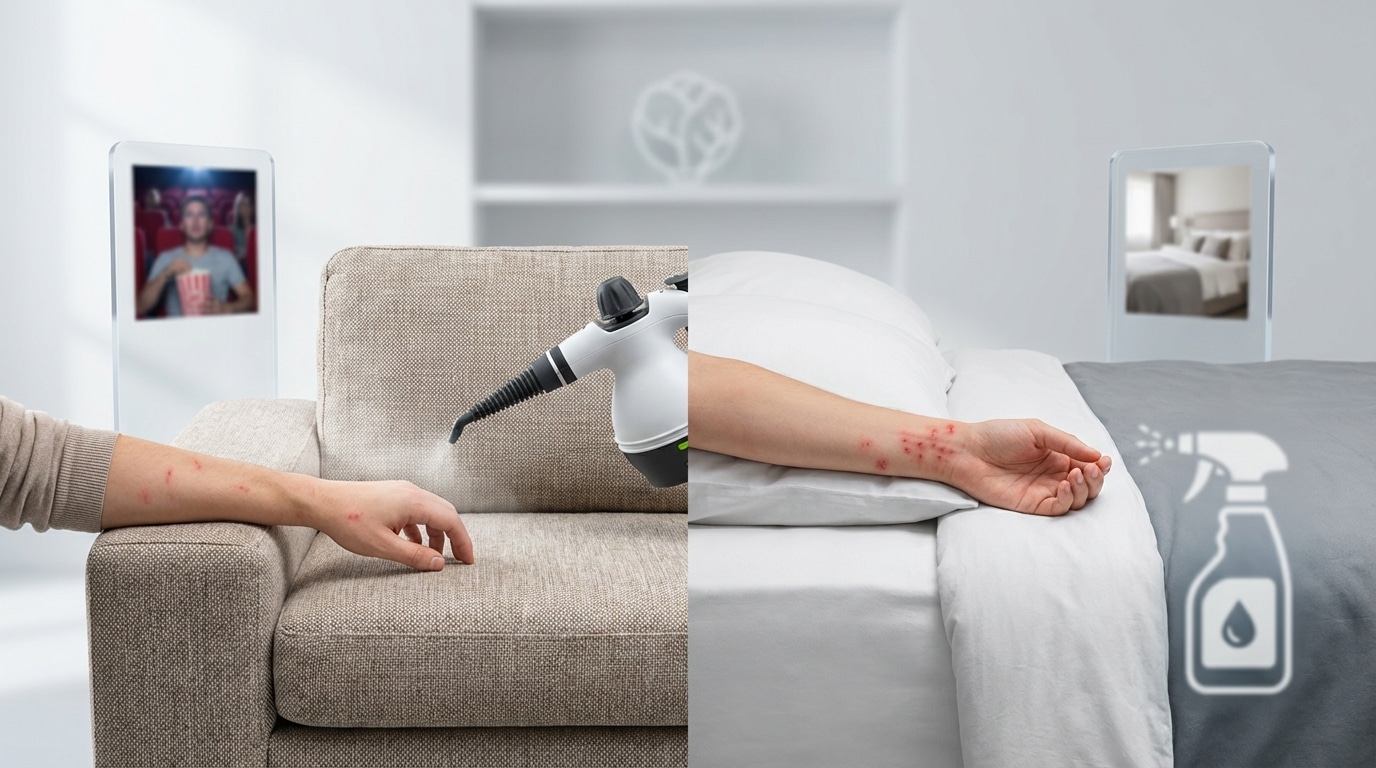
Rapid bedbug bites on a sofa or armchair: what to do?
Contents
-
Bed prick vs. couch prick: comparison of attack modes and rapidity
-
Is it at home or somewhere else? Criteria for identifying the source of infestation
-
Steam treatment vs. chemical insect control: recommendations for your furniture
You sat in front of the TV for an hour, and the next morning, three red spots lined up on your thigh. It's itchy, it's swollen, and the question keeps coming up: is my sofa infested with bedbugs? The short answer: it's quite possible, and even more common than you'd think in Brussels.
Things to remember
-
We deal with the urgency and psychology of the immediate attack: how long does it take to be stung on an infested seat?
-
We differentiate between the ‘resting’ prick (bed) and the ‘passing’ prick (sofa, cinema) to help customers identify the exact source of their problem, while making the most of our local expertise in Brussels.
-
Comparison of attack modes and speed
-
Compare the different options before deciding.
Bed bugs are almost always associated with mattresses, sheets and bedrooms. That's where they strike most often. But a fabric sofa, a club chair or a cinema seat are just as good hunting grounds for these bugs. The real difference is the length of exposure. And that's precisely what we're going to break down here, because understanding how and how quickly a bedbug bites a seat changes everything in the way you react.
At Punaisesdelitbruxelles, we intervene every week in cases where the infestation doesn't come from the bed, but from the living room. We see families searching for weeks in the bedroom when the bedbug nest is in the seams of the sofa. This article is designed to help you avoid wasting time and act quickly.
Bed prick vs. couch prick: comparison of attack modes and rapidity
A bedbug takes between 3 and 10 minutes to complete a full meal of blood. This is a well-known figure in entomology, and it doesn't change depending on whether it's in your mattress or the armrest of your armchair. What changes radically is the context of the bite.
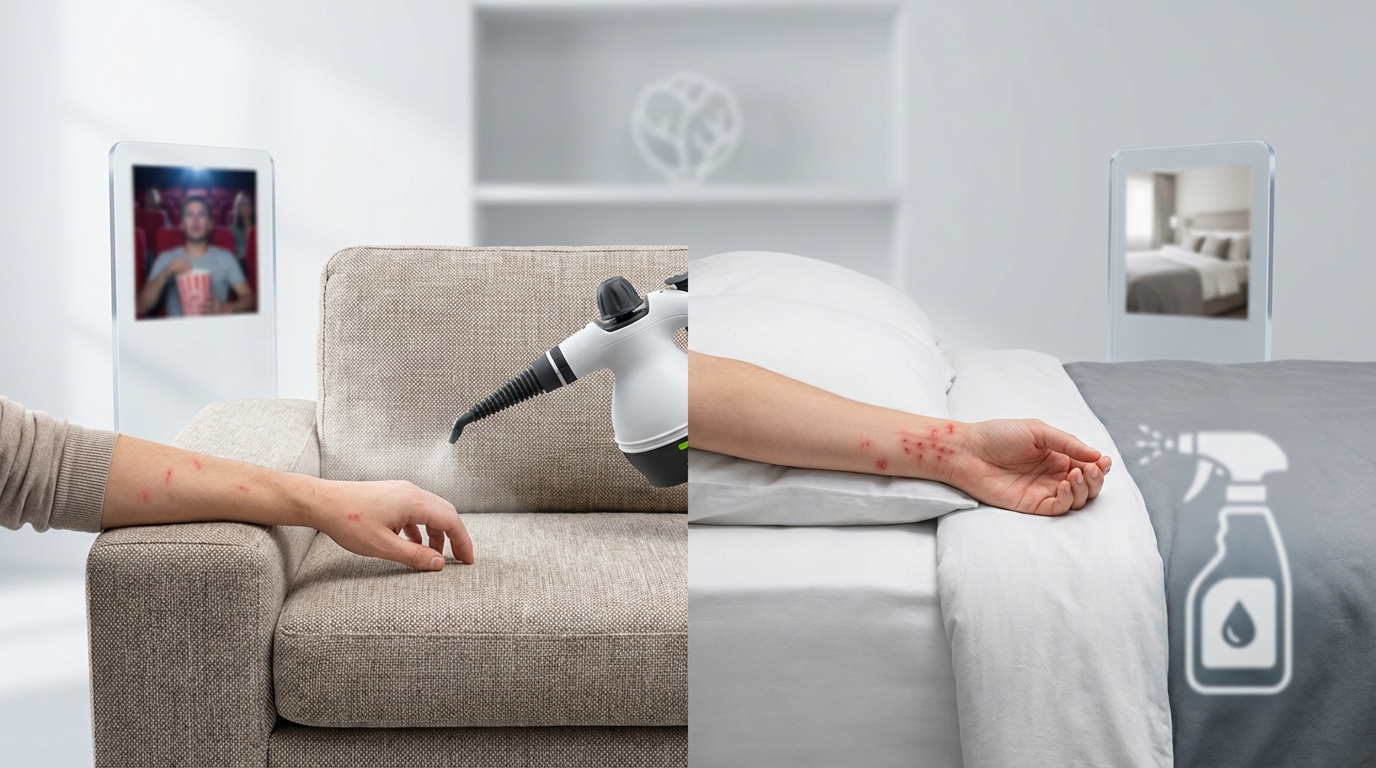
In bed, you sleep. You're immobile for 6, 7, 8 hours. The bedbug has all the time in the world. It emerges from its hiding place, crawls to your skin, pierces, injects its anesthetic saliva, feeds, then quietly leaves. Often, it stings the same area several times, resulting in those famous three-button lines known as «breakfast, lunch and dinner». The speed of the bedbug's bite is not a limiting factor in this case: it has the whole night.
The situation is different on a sofa. You sit for 30 minutes, an hour, two hours max for a film. You move, you change position, you get up to fetch a glass of water. The bedbug has to be opportunistic. They bite faster, sometimes incompletely, and sometimes get crushed or dislodged before they've finished their meal. As a result, rapid bedbug bites on sofas are often more scattered and less clustered than those on beds. Isolated spots are seen on the arms, legs, lower back, wherever the skin touches the fabric of the seat.
The difference between these stings is a valuable clue. If you wake up to a regular pattern on your chest or shoulders, it's probably the bed. If you find pimples scattered over areas in contact with an armchair, after an evening of TV or a nap on the sofa, the living room furniture becomes suspect number one.
A point often overlooked: bedbugs don't jump. They don't fly. They crawl. On a sofa, they often nestle in the seams, the folds of fabric, the junction between the seat and the backrest. It only has to travel a few centimetres to reach your skin. The delay between the moment you sit down and the first bite can be as little as 10 to 20 minutes, the time it takes for your body heat and the CO2 you exhale to «wake» it up and attract it.
And no, the light doesn't really stop them. It's a persistent myth. A hungry bug will bite in broad daylight, lamp on, without a second thought. We've seen customers bitten in the middle of the afternoon on their sofas, with the blinds open. If the colony is established and hungry, it won't wait for the night.
Another thing to bear in mind: a fabric sofa offers far more hiding places than a leather or imitation leather one. The fibers, the seams, the nooks and crannies under removable cushions - it's a paradise for a bedbug looking to hide just a few millimeters from its food source. The signs of infestation on a sofa are the same as on a mattress: small black spots (droppings), traces of dried blood, translucent shed skins. If you turn over your cushions and see this, there's no doubt about it.
Is it at home or somewhere else? Criteria for identifying the source of infestation
Three buttons on your arm after a night out with friends, a weekend in an Airbnb, or a screening at an old Brussels cinema: the first question that arises is «did I bring anything home?»
The transport of bedbugs is the number one cause of urban spread. In Brussels, we see this every week. One adult bedbug or a few eggs stuck to an infested item of clothing, bag or coat on a seat or armchair: that's enough to start a colony in your home within a few weeks. A fertilized female lays between 5 and 15 eggs a day. Do the math over a month.
To identify the source, ask yourself these concrete questions:
-
When did the bites start? If it's after a trip, a hotel stay, a visit to someone's house, or after buying a second-hand piece of furniture, the outside trail is serious.
-
Where on the body? Injections only on areas in contact with a specific seat (thighs, buttocks, lower back, arms) point to that seat. Injections on the upper body, neck and shoulders point more towards the bed.
-
Are other people in the household affected? If everyone's scratching, the infestation is probably in your home. If it's just you, and coincides with a specific place you frequent alone, look elsewhere.
To identify a bedbug nest in your sofa, the method is simple but requires a great deal of care. Remove all cushions. Inspect every seam, every fold, every nook and cranny with a flashlight. Look under the sofa, in the wooden or metal frame if accessible. Bedbugs love wood, fabric and cardboard. They shun smooth metal and plastic, but will adapt if that's their only option.
What you're looking for: live insects (oval, flat, reddish-brown, 4 to 7 mm), smaller, lighter nymphs, tiny white eggs (1 mm, stuck to the fibers), black droppings, blood trails. If you find any of these, you've made the diagnosis. Your sofa is harbouring bedbugs.
A regular sight in Brussels is the second-hand sofa. Someone picks up a beautiful sofa at a flea market, on Marketplace, or even on the street. Two weeks later, the bites start. The furniture seemed clean, no suspicious odors, nothing visible. Except that bedbugs know how to hide in gaps of just a few millimeters. Without professional inspection, it's almost impossible to spot them on unfamiliar furniture.
What else could be biting you on your sofa besides bedbugs? Fleas, possibly, especially if you have pets. Dust mites cause allergic reactions, but don't actually bite. Mosquitoes leave isolated spots, not in a row. If the bites return systematically after using the same seat, and if you find the signs described above, bedbugs are by far the most likely hypothesis.
One last point: don't panic, but don't wait either. If a sofa infestation is treated quickly, the problem is solved in one or two interventions. An infestation ignored for three months means colonization spreading to the rest of the apartment, skirting boards, electrical sockets and door frames. Time is on your side.
Steam treatment vs. chemical insect control: recommendations for your furniture
You've confirmed the presence of bedbugs in your sofa or armchair. The next logical question is: how do you get rid of them without destroying the furniture? Two approaches dominate: high-temperature steam and chemical treatment. Both work, but not under the same conditions.
High-temperature steam (120 to 180°C at nozzle outlet) kills bedbugs at all stages, including eggs. That's its big advantage. A slow, methodical pass over every seam, every nook and cranny of the sofa eliminates everything in its path. No chemicals, no residue, no risk to children or pets using the furniture afterwards. For a bedbug treatment on a fabric sofa, this is often our first recommendation.
The problem is that steam has no residual effect. It kills on contact, period. If a bedbug is tucked away in a nook or cranny that the steam jet can't reach, inside the structure of the sofa for example, it will survive. That's why a steam treatment alone often requires two passes, 10-15 days apart, to allow any eggs spared to hatch and new nymphs to be exposed to the second treatment.
Chemical treatment works differently. A professional insect killer in Brussels applies a registered insecticide (generally pyrethroid- or neonicotinoid-based) on and around the furniture. The product has an immediate lethal effect on bedbugs that pass through it, and a residual effect that continues to kill for several weeks. Bugs hidden deep down eventually emerge to feed, cross the treated area, and die.
For an armchair or sofa, chemical treatment poses a number of practical questions. The furniture must be unusable for some time after application (usually 4 to 6 hours drying time, but check with your professional). If you have small children who put everything in their mouths, or pets who sleep on the sofa, this is a factor to take into account. The products used by professionals are approved and applied in controlled doses; they're not comparable to insecticide sprays bought in supermarkets. In fact, forget those consumer sprays. They disperse bedbugs instead of killing them, and make the problem worse in 90 % of cases.
Our approach at Punaisesdelitbruxelles: we often combine the two. High-temperature steam for initial cleaning of the sofa, eliminating most of the visible colony. Then targeted treatment with a residual product on strategic areas - the base of the furniture, the legs, the perimeter - to intercept the survivors. This combination makes it possible to eliminate bedbugs from an armchair or sofa with a very high success rate from the very first intervention.
Can you treat it yourself? Honestly, on a fabric sofa, it's very difficult. You can vacuum it (and dispose of the bag immediately in a closed garbage can bag), wash the removable covers at 60°C minimum, and use a domestic steam cleaner if you have one. It reduces the population, not eliminates it. Consumer steam cleaners don't reach sufficiently deep temperatures, and you don't have the right nozzles to treat seams in detail.
How do you get rid of bed bugs in a fabric sofa for good? By calling in a professional who knows the terrain. In Brussels, the types of furniture vary enormously from one home to another: old Ikea sofas, vintage armchairs found in the Marolles district, XXL corner sofas, velvet meridiennes. Each configuration requires its own approach. A professional insect remover in Brussels who knows these local realities will make the difference between an effective treatment and an approximate one.
Final tip: after treatment, protect your sofa. Washable integral covers, regular inspection of the seams, and above all, if you buy second-hand furniture, have it inspected or treated preventively before installing it in your home. Prevention costs ten times less than complete disinfestation.
Conclusion
Bed bugs on a sofa or armchair are not a rare or exotic occurrence. It's a daily reality, especially in a densely populated city like Brussels, where furniture circulates, where homes are close together, and where one infested seat can contaminate an entire apartment in a matter of weeks.
If you get any suspicious stings after using your sofa, inspect it tonight. Cushions removed, flashlight, seams and nooks and crannies. If you find even the slightest sign, don't waste time with haphazard home-made solutions. Contact Punaisesdelitbruxelles for a rapid diagnosis and treatment tailored to your furniture. The sooner you act, the easier it is to deal with.
Frequently asked questions
How to treat bedbugs on a sofa?
Bed bugs, larvae and eggs are heat averse. It is therefore possible to eliminate these pests with temperatures of over 60°C. If your sofa is a bedbug nest, wash the cover and all sofa fabrics in a machine at high temperature.
What could possibly bite me on my sofa?
If you have fleas on your sofa, you'll see little insects jumping up and down on them. Fleas can also bite humans, causing small irritating bites. Female fleas can lay up to 50 eggs a day, and when they hatch, the larvae hide in the sofa cushions.
How can I get rid of bedbugs in my armchair myself?
Try 15 drops of lavender spike mixed with 50ml of water. Don't forget to clean your fabric chair at least once a month. If, despite all these actions, the bedbugs don't go away, change your technique and call in a professional.
How can I get rid of bed bugs in a fabric sofa?
Use steam cleaning at 120°C, which destroys bedbugs; don't throw away bedbug-infested furniture (mattresses, armchairs, etc.) untreated, as it could contaminate other people.

 French
  English
  Dutch
Dutch