

The historical origins of bedbugs: from prehistory to the present day
Contents
-
Cave life vs. modern infestation: a 13,000-year evolutionary comparison
-
Advantages and disadvantages of the human host: parasite selection criteria
-
Old-fashioned remedies vs. current solutions: recommendations before choosing a treatment
Where do bedbugs come from? This question is often asked by my customers in Brussels, and the answer surprises them every time. Visit Cimex lectularius, This tiny parasite that poisons our nights is not new. It's been with us for at least 13,000 years. Long before memory foam mattresses, before cotton sheets, even before the invention of the bed, this little insect was already feeding on warm blood in the caves of the Middle East.
The story of bedbugs is, in fact, the story of our own civilization as seen through the eyes of a parasite. From prehistoric caves to Brussels apartments, from ancient Egypt to the inns of the Middle Ages, this bug has crossed the millennia without ever disappearing. And in 2026, it has never been so present in our European cities.
Things to remember
-
We retrace the odyssey of Cimex lectularius, from its cave-dwelling origins alongside bats to its worldwide infestation in 2026.
-
Combining archaeology and entomology, we explain how this parasite has evolved with mankind, and why its resilience over thousands of years now requires specific professional expertise in Brussels.
-
comparing 13,000 years of evolution
-
Compare the different options before deciding.
Understanding the historical origins of the bedbug is more than just an entomologist's curiosity. It's the key to understanding why this insect is so difficult to eliminate, why it adapts to everything, and why it takes trained professionals to get rid of it. Let's retrace this odyssey together, from bats to bedrooms.
Cave life vs. modern infestation: a 13,000-year evolutionary comparison
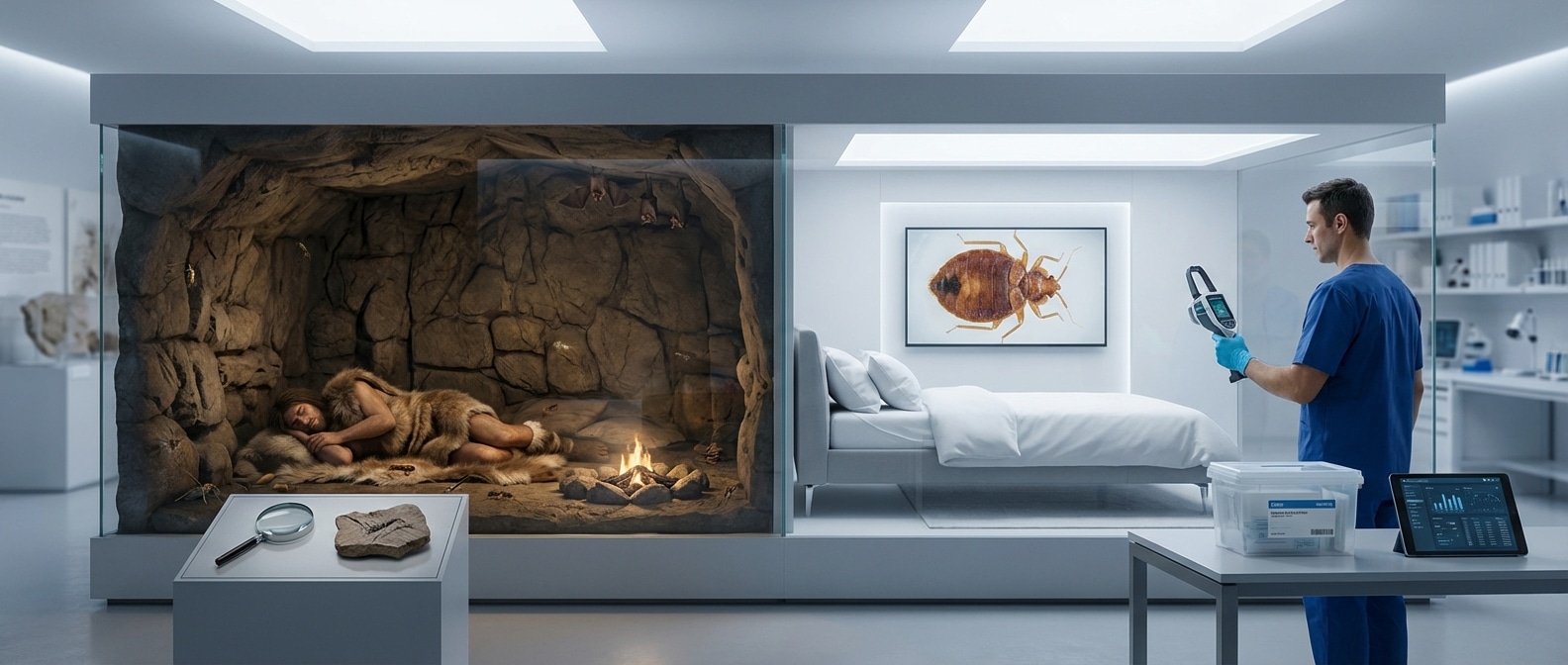
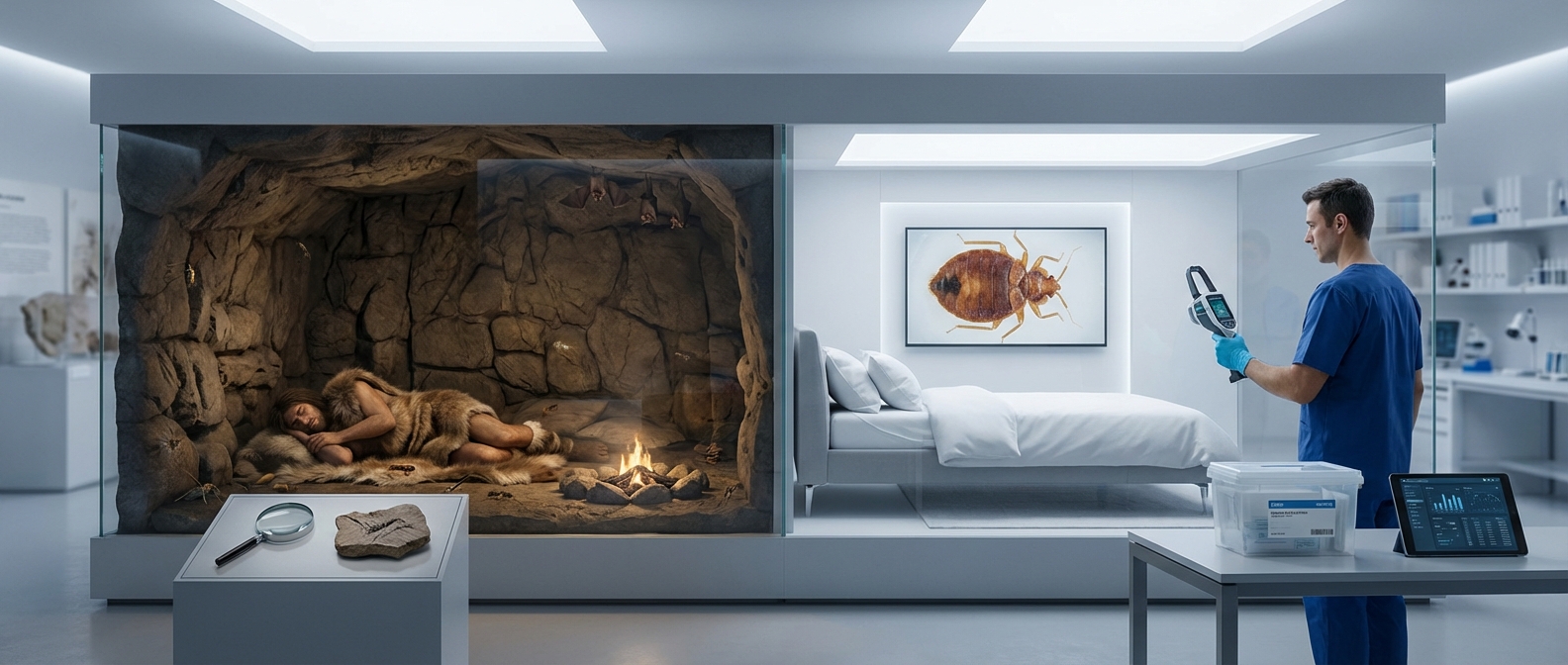
It all begins in the dark. Around 13,000 years ago, our ancestors used caves as shelters, and they weren't alone. Bats were already nesting there, and with them their parasites. Visit Cimex lectularius belonged to the Cimicidae family, a group of hematophagous insects specialized in chiropterans. The bugs fed on bat blood, quietly, in the dark. No one complained.
When humans started sharing these caves, the parasite made a choice. Well, «choice» is a big word: it was natural selection. Some bugs ended up biting humans rather than bats. And it worked. Very well, in fact. Humans sleep long and deep, and don't fly away at the slightest noise. A dream host.
The archaeological evidence is clear. Fossilized bedbug remains have been found in prehistoric sites in the Middle East. So the evolution of bedbugs has followed that of humankind, step by step. When we left the caves to build villages, they followed. When we built cities, they moved in.
In ancient Egypt, they were already known. Texts dating back 3,500 years mention blood-sucking insects in dwellings. The Romans also spoke of them, with Pliny the Elder describing them in his Natural history. In the Middle Ages, urban infestation was commonplace, almost accepted. We slept with it, for want of a better word.
What's striking when comparing cave life and modern infestation is the density. In a cave, a few dozen bedbugs cohabited with a small group of humans. Today, a single Brussels apartment can be home to thousands of individuals. Our heated buildings, carpets, skirting boards and electrical sockets are all ideal hiding places. The bedbug has never had so many places to hide.
The biological evolution of Cimex lectularius is fascinating in its apparent slowness. Morphologically, the insect has hardly changed in 13,000 years. It doesn't have to. Its flattened shape allows it to slip in anywhere, its resistance to fasting (up to a year without eating under certain conditions) ensures its survival, and its brutal but efficient mode of reproduction guarantees the survival of the species. More on this later.
What has changed, however, is its resistance to chemicals. DDT had almost eliminated it by the 1950s. Almost. The survivors passed on their resistant genes, and their descendants populate our cities today. A lesson in accelerated evolution.
Advantages and disadvantages of the human host: parasite selection criteria
Who «invented» bedbugs? Nobody, of course. But if anyone's to blame for their global success, it's us. Human beings tick all the boxes of the perfect host for a nocturnal ectoparasite.
Let's look at this coldly, from the bug's point of view. The human host offers considerable advantages. First: predictability. We sleep every night, in roughly the same place, for six to eight hours. For an insect that takes three to ten minutes to feed, it's a guaranteed feast. Bats, on the other hand, move around, change roosts and hibernate. Humans remain motionless in their beds.
Second asset: body temperature. Around 37°C, stable, with a regular release of CO2 which serves as a location signal. The bedbug locates its meal thanks to heat and carbon dioxide. No need for beady eyes, no need to hunt. Just follow the thermal gradient.
Third factor, and not the least: our homes. We build heated, insulated structures, with nooks and crannies everywhere. A mattress is a palace for a colony of bedbugs. Seams, hems, box spring slats, headboards: every nook and cranny becomes a potential nest. The bedbug's biological adaptation to our domestic environments is so advanced that it hardly survives in the wild.
So what did bedbugs do before beds were invented? They lived in the cracks of walls, the joints of stones, the straw mattresses on the floor. The «bed» is just a detail. What counts is proximity to a sleeping body.
On the downside for the parasite, humans aren't perfect either. We scratch. We move in our sleep. We wash our sheets (well, normally). And, most importantly, we end up noticing the bites, the bloodstains on the sheets, the little black dots along the seams. From then on, the war begins.
Bedbug reproduction deserves a paragraph of its own, because it explains why an infestation explodes so quickly. The male practices what is known as traumatic insemination: he literally pierces the female's abdomen to deposit his spermatozoa. Violent, yes. But frighteningly effective. A fertilized female lays between 200 and 500 eggs in her lifetime. The eggs hatch in one to two weeks, and the nymphs start feeding immediately. Within a few months, five bugs become five hundred.
This massive reproductive capacity, combined with the insect's discretion (active only at night, flattened like a credit card), explains why so many Brussels residents discover the problem when it's already well established. The first bedbug often arrives in a suitcase, second-hand furniture or second-hand clothing. A single fertilized female is enough to launch a colony.
Old-fashioned remedies vs. current solutions: recommendations before choosing a treatment
In the Middle Ages, lavender and sulfur were burned to drive away bedbugs. The Romans used mixtures of ash and olive oil. In ancient Egypt, some texts recommended rubbing fish fat into the feet of the bed. Did it work? Not really. It masked the problem, at best.
For centuries, one popular remedy followed another without ever resolving the infestation. Mercury fumigations, arsenic powders, tobacco decoctions: everything was tried, often at the risk of the health of the occupants as well as the parasites. The real turning point came with DDT in the 1940s-1950s. For the first time, we had an insecticide capable of massively eliminating bedbugs. In Western countries, we thought the problem had been solved.
We were wrong. The ban on DDT (for good ecological and health reasons), combined with the explosion in international tourism and the genetic resistance of surviving populations, led to a spectacular comeback in the 2000s. Today, urban infestation affects all major European cities. Brussels is no exception.
So, what are the solutions that really work these days? Bedbug treatment in Brussels rests on a few solid pillars, and I'll be blunt: the sprays sold in supermarkets aren't enough. They may kill bedbugs on contact, but they never reach the eggs or the individuals hiding in the nooks and crannies. Worse still, repeated use of these products encourages resistance. You're spending money to make the problem harder to solve.
Professional extermination combines several techniques. Firstly, heat treatment: the room is heated to over 55°C for several hours. At this temperature, adults, nymphs and eggs die. No chemicals, no resistance. This is the most reliable method for complete eradication, but it requires specific equipment and precise know-how. One degree lower, and the eggs survive.
A professional chemical approach is still necessary in some cases, particularly for infestations spread over several rooms or apartments in the same building. Our technicians use new-generation insecticides, applied in a targeted manner to areas of passage and nesting. Nothing to do with supermarket sprays: we're talking about specific, precisely dosed molecules, combined to overcome resistance.
My advice before choosing a treatment? Get an inspection. A good professional always starts with a diagnosis. He identifies the extent of the infestation, the areas affected and the stage of development of the insects. In Brussels, each dwelling has its own particularities: old buildings with strip parquet flooring, modern apartments with false ceilings, mansions with generous moldings. Each requires its own strategy.
Don't waste your time with the «home remedies» available on the Internet. Essential oils, thick layers of diatomaceous earth, freezing sheets: these approaches can slow down an incipient infestation, but they'll never stop it. Every week lost means another generation of bedbugs. And when the colony is well established, only eradication by a trained professional can deliver lasting results.
Conclusion
Thirteen thousand years of cohabitation, and the bedbug hasn't aged a day. It has survived caves, empires, pesticides and industrial revolutions. Its strength lies in its simplicity: a flat body, explosive reproduction and infinite patience. Faced with such an adversary, improvisation leads nowhere.
Understanding where bed bugs come from means accepting that they can't be eliminated with a spray and a bit of good will. It's an ancient problem that requires modern solutions, applied by people who know the insect and the terrain. In Brussels, at Punaisesdelitbruxelles, that's exactly what we do: we combine our knowledge of the pest with our experience of the local building environment to provide solutions that solve the problem. We mean it. If in doubt, give us a call. A quick diagnosis is better than an infestation that takes hold.
Frequently asked questions
What causes bed bugs?
Their presence can be caused by a variety of factors. Infestation often begins with the accidental introduction of a bedbug or its eggs into the home, whether via infested clothing, second-hand objects or second-hand furniture.
What did bedbugs do before beds were invented?
It is thought that bedbugs were originally cave-dwelling insects that fed on bat blood. With human evolution, it is also assumed that the history of mankind and that of bedbugs first crossed paths in the caves of the ancient Mediterranean, the cradle of civilization.
Who invented bedbugs?
The oldest bedbug fossils date back over 100 million years. These hematophagous parasites initially fed on the blood of bats in caves, before adapting to bite humans.
How does the first bedbug arrive?
Through infested used items purchased at flea markets, thrift stores, used furniture stores; when picking up infested furniture or objects left on the street; when traveling, in infested luggage, bags, clothing or sleeping bags.

 French
  English
  Dutch
Dutch