

Bedbug control in Koekelberg: the complete guide
Contents
-
Understanding the infestation: how to identify bed bugs in Koekelberg
-
Why choose a local expert in Koekelberg for your treatments?
One morning, you wake up with little red marks on your arms. At first you think it's mosquitoes, but it's the middle of November. You turn the mattress over and there, along the seams, are tiny brown spots. Welcome to the daily lives of dozens of households in Koekelberg who discover every month that they're living with bedbugs.
Things to remember
-
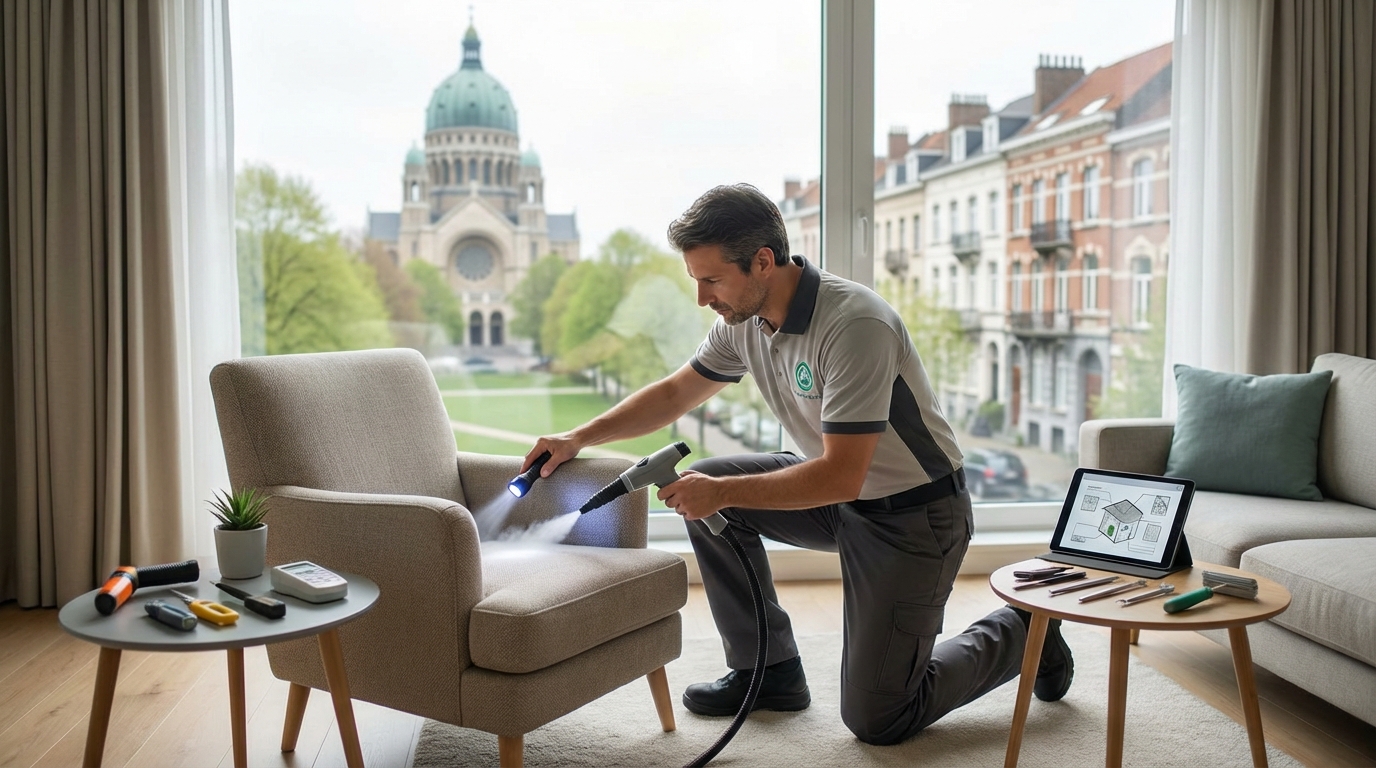
We take a neighborhood expert approach, detailing a typical intervention in the heart of Koekelberg.
-
The article combines technical expertise on the life cycle of bedbugs with local roots (proximity to the Basilica, parks, specific features of the 1081 building) to build immediate trust via a professional and reassuring narrative.
-
How to identify bed bugs in Koekelberg
-
A step-by-step guide to professional pest control in the home.
It's not a question of hygiene. Bed bugs in Koekelberg affect renovated apartments near the Basilica as much as mansions along the Avenue de la Liberté. These insects travel in suitcases, second-hand furniture and second-hand clothes. Once installed, they reproduce quickly: a female lays between 200 and 500 eggs in her lifetime. Without rapid intervention, the situation can degenerate in a matter of weeks.
This is the article I wanted to read before my first appearance on 1081. We're going to talk about identification, the actual course of a professional treatment and criteria for choosing the right service provider. No blah-blah, just concrete.
Understanding the infestation: how to identify bed bugs in Koekelberg
What are the first signs of bed bugs? The answer lies in three clues that you can check tonight, at home, without any special equipment.
Grouped insect bites. Bedbugs bite at night, while you sleep. Unlike mosquitoes, which leave isolated spots, bedbug bites often appear in lines or clusters, on exposed areas: arms, shoulders, neck, legs. Some people don't react at all (around 30 % of the population), which complicates detection. If your partner scratches and you don't, it doesn't mean that your side of the bed is spared.
Marks on bedding. Look at your sheets in the morning. Small blood spots, often no bigger than the head of a pin, indicate that a bedbug has been crushed after its meal. You can also spot tiny black dots along the seams of mattresses and box springs: these are their droppings. This is the most reliable sign of an infestation in 1081, or anywhere else for that matter.
The smell. When infestation is advanced, a sweet, slightly pungent odor emanates from the room. It's often compared to the smell of crushed coriander. If you've reached this point, the problem has probably been going on for several weeks.
In Koekelberg, buildings play an underestimated role. Many of the buildings in 1081 date from the late 19th or early 20th century. Old parquet floors with gaps, loose skirting boards, wallpaper that lifts slightly: all perfect hiding places for bedbugs. They measure between 4 and 7 mm in adulthood, are as flat as a credit card when they haven't eaten, and slip into cracks as small as 2 mm. Apartments near the Koekelberg Basilica, often in shared apartment buildings, present an additional risk: if your neighbor is infested and doesn't treat, bedbugs migrate through electrical ducts, pipes and false ceilings.
I'd like to make one thing clear: bed bugs can't be got rid of in two minutes. This idea is circulating on the Internet, and it's misleading. You can kill a visible bedbug in two minutes, yes. Vacuum the adults you spot, steam a mattress seam. But the eggs are resistant to almost anything except prolonged heat in excess of 60°C. And they hatch in 7 to 14 days. Without professional treatment, you start the cycle all over again.
Where exactly to look? Start with the bed: mattress, box spring (especially wooden slats), headboard. Then move on to nearby furniture: bedside table, chest of drawers. Check behind picture frames on the wall, inside electrical outlets (by switching off the power), under carpets. Bedbugs don't live on you, they live on you. near from you, within a radius of 1 to 2 meters around your bed. If you find live specimens or traces in the living room, the infestation has already progressed well.
A word of advice: take photos. When you call a pest expert in Koekelberg, these images will enable him or her to assess the situation before even coming out and preparing the right equipment.
The step-by-step guide to professional pest control in 1081
Three days. That's the average time between your first call and the start of treatment when you call a local exterminator in 1081. Here's how it works, step by step.
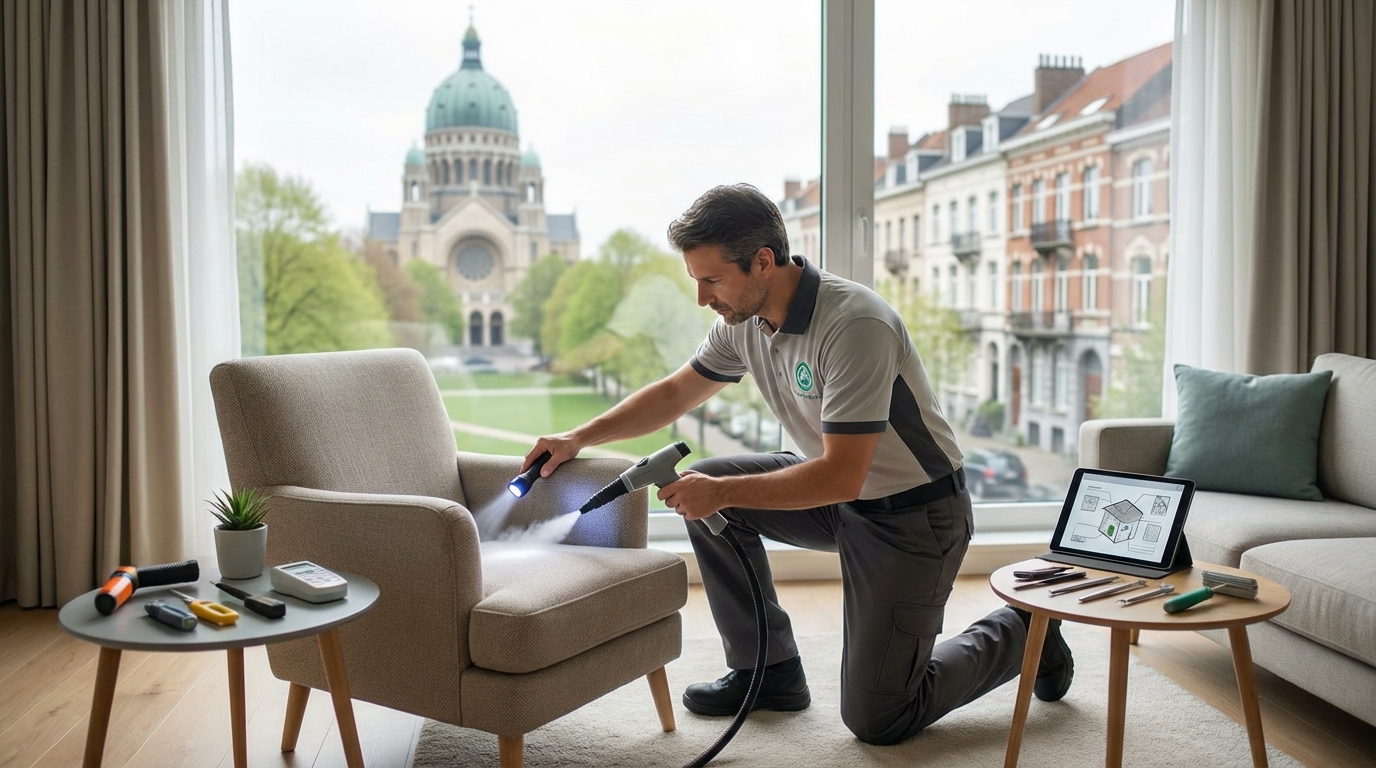
Step 1: On-site diagnosis. A technician visits your home to confirm the infestation and assess its extent. He inspects the rooms methodically, sometimes using a UV lamp or steam detector. Some service providers use canine detection: a specially trained dog spots live bedbugs and eggs with a reliability rate of over 90 %. This initial diagnosis is fundamental. It determines the bedbug treatment protocol best suited to your home.
Step 2: Preparing your home. Before the job, you'll be asked to prepare the premises. This means washing all bed linen and clothing at 60°C minimum, tumble-drying them (heat kills bedbugs at all stages), then storing them in airtight bags. Empty the drawers of infested furniture. Vacuum thoroughly, paying particular attention to nooks and crannies, and dispose of the bag immediately in an outside garbage can. Remove any loose baseboards. This preparation takes time - allow half a day for a two-bedroom apartment - but it determines the effectiveness of the treatment.
Stage 3: the treatment itself. In Koekelberg, professional insect control generally combines two methods:
-
Chemical treatment by spraying and fogging. The technician applies a residual insecticide to all contact surfaces: skirting boards, bed frames, gaps in the parquet and around sockets. The product remains active for several weeks, eliminating bedbugs that hatch after the application. The formulations used by professionals are far more concentrated and targeted than what you'll find in supermarkets.
-
Heat treatment. Some interventions use heat: generators raise the room temperature to 55-60°C for several hours. It's radical. Eggs, larvae, adults: nothing survives. This method is particularly well-suited to Koekelberg's older dwellings, where hiding places are numerous and difficult to access.
The choice between these two approaches (or their combination) depends on the level of infestation, the configuration of the dwelling and specific constraints, such as the presence of young children or animals.
Step 4: The second pass. This is where many «home-made» treatments fail. A single pass is almost never enough. Bedbug eggs are protected by a resistant shell, and some may escape the first treatment. A serious exterminator systematically schedules a second pass 10 to 15 days after the first, just when the surviving eggs would have hatched. This second pass is the difference between complete eradication and a relapse three weeks later.
Step 5: Post-processing control. Two to three weeks after the last visit, a check verifies that there is no further activity. No new traces, no bites, no live insects. At this stage, the Koekelberg insect control program is considered a success.
The whole process takes between 3 and 5 weeks from the first call to the final inspection. Longer than you'd hope when you discover the infestation at 2 a.m., I know. But it's the price of a lasting result.
Why choose a local expert in Koekelberg for your treatments?
450 to 600300 euros for a studio flat, 600 to 50000 euros for a two-bedroom apartment: this is the price range for a bedbug intervention in the Brussels region. Rates vary according to surface area, level of infestation and method used (thermal treatment is more expensive than chemical). It's true that this represents a budget. But compare it with the cost of a new mattress, sheets replaced three times, products bought from pharmacies that don't work, and sleepless nights for months. It doesn't take long to do the math.
Why a local service provider rather than a large national brand? There are several very concrete reasons.
Reaction time. When you call a pest control company in Brussels based on the other side of town, the first available time slot is sometimes ten days. An expert based in 1081 or its immediate vicinity knows the area, can often get here within 48 hours, and already knows what the buildings around here look like. The buildings around the Koekelberg Basilica, the terraced houses on Avenue Legrand, the small buildings on Rue de l'Église: each type of construction has its own specific features, and a local professional knows them inside out.
The eradication guarantee. A serious service provider commits to a result. With us, if bedbugs reappear in the weeks following treatment, we come back for free. This eradication guarantee is not a marketing ploy, it's a commitment. And a local service provider has every interest in honoring this guarantee: its reputation is built in the neighborhood, by word-of-mouth, not by large-scale Google ads.
Personalized follow-up. Eliminating bedbugs isn't just a matter of spraying a product and leaving. It means explaining to the customer how to avoid reinfestation, checking to see if neighbors are affected (and in an apartment building, they often are), adapting the protocol if the first approach hasn't yielded 100 % of results. You won't get this kind of follow-up from a company that manages 200 interventions a week throughout Belgium.
Price transparency. The price of pest control should never come as a surprise. Before any work is carried out, you should receive a detailed quotation, including the number of passes, the method used, the products applied and the duration of the guarantee. If a service provider refuses to give you a clear price before you start, don't bother. Local companies who work on their local reputation have no interest in inflating invoices or multiplying unnecessary passes.
One final point is very important to me: discretion. Nobody wants the whole building to know they've got bedbugs. A local technician arrives in an unmarked vehicle, without «EXTERMINATION» written in giant letters on the bodywork. He knows the neighborhood entrance codes, knows how to park without blocking the Rue de Ganshoren, and completes his work without your neighbors noticing. This kind of detail counts when you live in a commune where everyone meets at the Sunday market.
Bedbug extermination in Brussels, and particularly in 1081, requires a rigorous, site-specific approach. A standardized protocol applied without thought is not enough. What makes the difference is a professional who takes the time to understand your situation, who comes back to check his work, and who remains contactable if you have any questions three weeks later.
Conclusion
Bed bugs in Koekelberg are neither a fatality nor a disgrace. It's a concrete problem that calls for a concrete solution: a precise diagnosis, a treatment in at least two passes, and follow-up until complete eradication. The earlier you act, the faster the intervention and the lower the cost.
If you've spotted any suspicious signs, don't leave it lying around. Contact us for a free diagnosis in 1081 and surrounding areas. We'll come to you quickly, explain everything before we start, and don't let up until the problem is solved.
Frequently asked questions
How do I know if I have bedbugs in my Koekelberg home?
The signs are unmistakable: line or cluster bites on waking, small blood spots on your sheets or black spots (droppings) on the mattress seams. In the older buildings of 1081, check behind baseboards and in the crevices of wooden floors.
Why are bedbugs common in Koekelberg?
The density of old buildings, particularly near the Basilica, facilitates the migration of insects between apartments via electrical ducts or floors. This is never a lack of hygiene, but often the result of travel or the purchase of second-hand furniture.
How much does a bedbug treatment cost in Brussels?
In Koekelberg, you should expect to pay around €450 for a studio flat and between €600 and €800 for a two-bedroom apartment. Rates vary according to the method (chemical or thermal), and generally include two passes to guarantee total egg eradication.
Why isn't a single insect control operation enough?
Bedbug eggs are extremely hardy and hatch within 7 to 14 days. A second professional pass is essential to eliminate freshly hatched nymphs before they can reproduce.

 French
  English
  Dutch
Dutch