

Intervention bed bugs in kot: Who pays and what to do?
Contents
-
Professional solutions vs. in-house methods: Comparing costs and effectiveness
-
Pre-intervention recommendations: Prepare your shared apartment for guaranteed results
You've just found little brown spots on your mattress, prickles lining your arms when you wake up, and your roommate has the same. Welcome to the classic nightmare of the Brussels kot. Intervention against bedbugs in student kot is a subject we deal with regularly at Punaisesdelitbruxelles, and the first question we get is never «how to get rid of them». It's always, «Who pays?»
Things to remember
-
A focus on the Belgian market (kot) to clarify financial responsibilities between landlord and student
-
We offer a comparison between economical self-treatment and the professional expertise of Punaisesdelitbruxelles to secure small budgets in shared accommodation.
-
Liability criteria for treatment costs
-
Compare the different options before deciding.
The answer is not as simple as we'd like it to be. Between Belgian legislation on student accommodation, lease clauses and the reality on the ground, there's often a blur that neither the landlord nor the student knows how to untangle. We're going to clarify all this, and above all, we're going to compare the cost of professional insect control with the «home tricks» that can be found everywhere online. Spoiler: penny-pinching often ends up costing more.
Whether you're a student sharing a flat in Brussels or a kot owner, this article is for you. We lay down the legal foundations, put a figure on the options, and give you the exact protocol to get the job done right the first time.
Landlord vs. Tenant: Liability criteria for treatment costs
90% of the calls we receive from students begin with the same phrase: «My landlord says I have to pay.» And in 90% of cases, it's more nuanced than that. The question of who should pay for bedbugs in a kot depends on one central criterion: the origin of the infestation.
In Belgium, student housing legislation requires landlords to provide decent, pest-free accommodation when students move in. This is laid down in the Brussels Housing Code. If bedbugs were already present before you moved in, the landlord of the kot is liable. Point. He must finance the disinsectisation of the student accommodation and make sure that the problem is solved before handing over the keys to you, or failing that, take charge of the treatment as soon as it is reported.
The problem is proving that the infestation existed before. Bed bugs in Brussels kots are a phenomenon that has exploded in recent years. Rooms are rented out fast, students rotate quickly, and between two tenants, few landlords have their accommodation inspected. The result: a student moves in in September, discovers bites in October, and the landlord claims that «he's the one who brought them in».
Here's how to decide. If you notice signs of infestation in the first few weeks after moving in, this is a strong indicator that the problem already existed. Bedbugs don't reproduce en masse in a fortnight. A visible colony of nymphs, eggs and adults takes weeks or even months to establish. Document everything: dated photos, insect captures in a bag, testimonials from your roommates. This evidence will be decisive if the disagreement persists.
On the other hand, if the infestation appears after a trip or the arrival of second-hand furniture (very common in shared flats), responsibility may shift to the tenant. Belgian legislation on bedbugs doesn't do anyone any favors: the person who introduced the pest pays. But you still have to prove it.
What we often see in the field is an in-between situation. Nobody really knows where it's coming from. In such cases, our recommendation is clear: landlords and tenants need to come to an agreement. Some landlords take care of the professional treatment and ask the tenant to take care of the cleaning and preparation. Others share the cost of disinsectisation. The key is to act quickly. Every week of debate is a week of breeding for bedbugs.
A point often overlooked: the landlord's responsibility for insect control costs also applies to common areas. If you live in a shared apartment and bedbugs have spread to several rooms, the landlord can't ask each student to pay for «his» room. The infestation is global, so the treatment must be too, and the financial responsibility follows the same logic.
Final tip: check your lease. Some student rental contracts contain clauses on pest management. They may not always be legal if they contradict the Housing Code, but they do exist. If you're in any doubt, the legal aid departments of Brussels universities (ULB, VUB, UCLouvain & Saint-Louis) can help you free of charge.
Professional solutions vs. in-house methods: Comparing costs and effectiveness
Let's be honest for a second. When you type «how to get rid of bedbugs in 2 minutes» into Google, you already know that the answer will be disappointing. There's no miracle solution in two minutes. Nor in two hours. Bed bug treatment is a process, not a magic wand.
But let's compare the options anyway, because when you're a student on a tight budget, the temptation to «manage it myself» is understandable.
In-house methods: what works (a little) and what doesn't work at all.
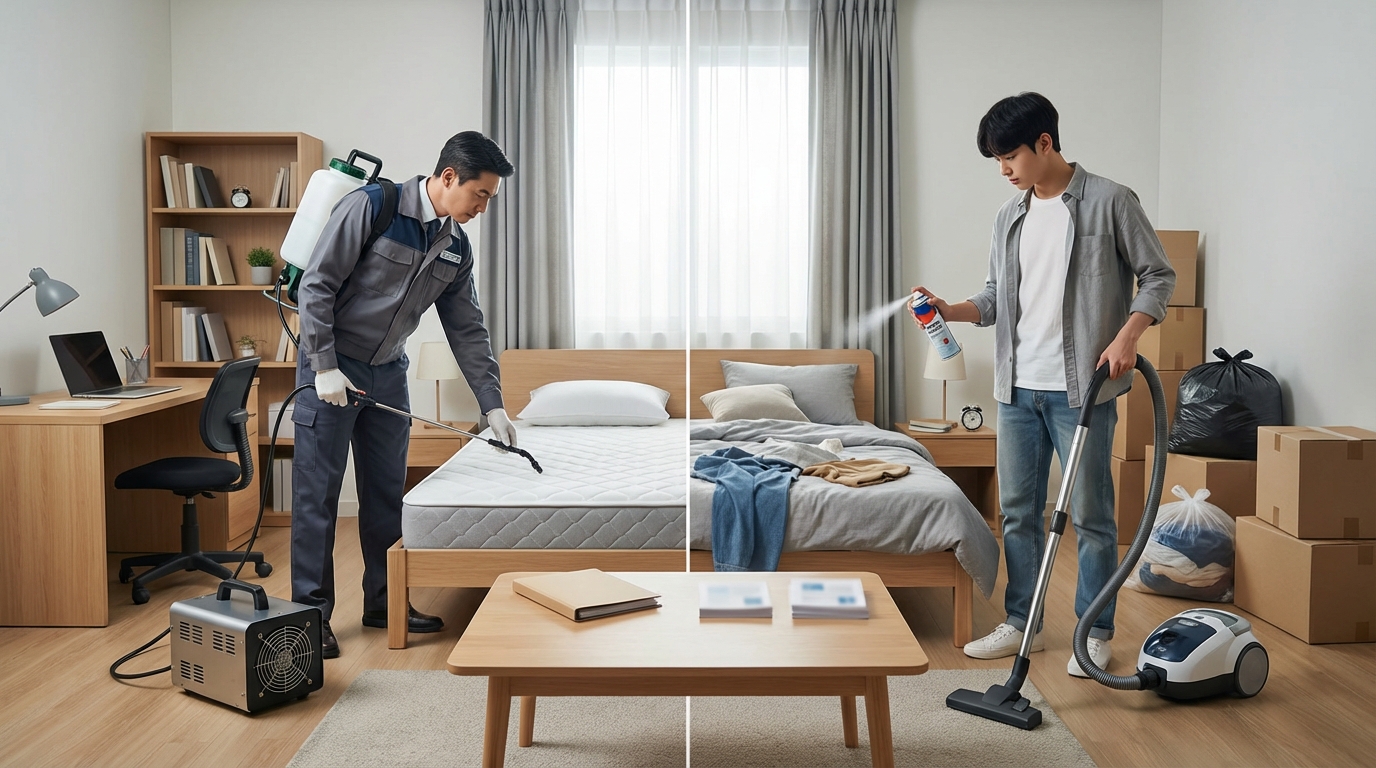
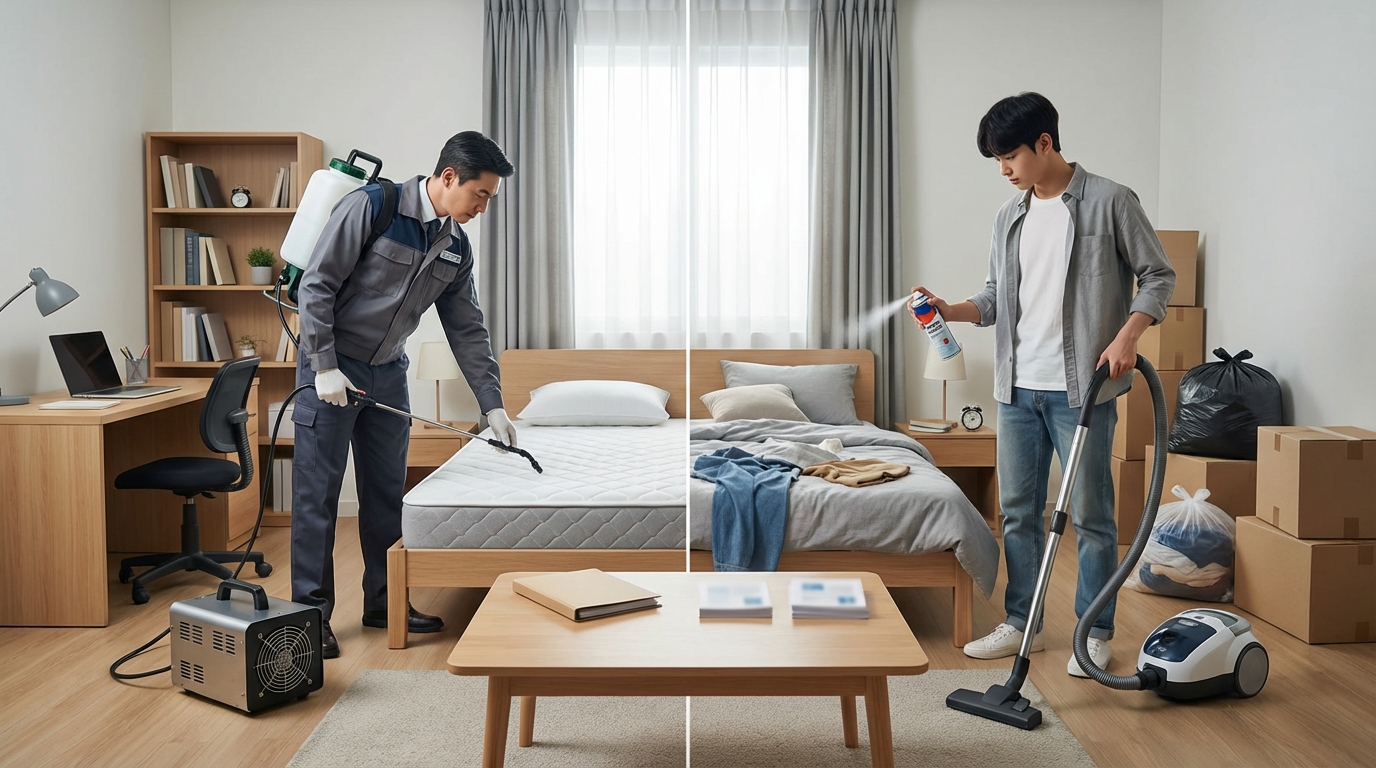
Steam cleaning against bedbugs is the most frequently cited method online. And it has a real basis: bedbugs die at 55°C and above. A steam cleaner at 100°C kills them on contact. The problem? You need to reach every insect, every egg, every nook and cranny. Mattress seams, baseboards, electrical sockets, bed hinges. With a household appliance, you're bound to miss some. And the ones you miss reproduce.
Insecticide sprays in supermarkets? Forget them. The effectiveness of these products on bedbugs is close to zero. Brussels strains are largely resistant to commercially available pyrethroids. Worse still, spraying disperses the colony. The bugs flee to neighboring rooms, neighboring kots. You turn a local problem into an infestation of the whole floor.
Diatomaceous earth? It works, but slowly. Very slowly. We're talking weeks for a partial effect. In the meantime, you keep getting stung every night.
If you add up the steam cleaner (purchase or rental: €50-150), diatomaceous earth (€15-30), bedbug covers for mattresses and box springs (€40-80 per bed), sprays (€10-25 each, often several), and the hours spent, you're looking at €200-300. For an uncertain result.
The price of professional bedbug control: what it really costs.
At Punaisesdelitbruxelles, an intervention in a kot or student studio starts at around €150 to €250, depending on surface area and level of infestation. For a 3-4-bedroom shared apartment, the price is between €400 and €900 for a complete treatment. These rates include diagnosis, treatment (targeted chemical, professional steam, or both combined), and a control visit.
The difference with DIY? The effectiveness of professional insect control is around 95% from the very first intervention, when the preparation protocol is respected. We use residual products to which bedbugs are not resistant, industrial steam equipment that rises to 180°C, and above all, we know exactly where to look. Twenty years' experience in Brussels housing is a real eye-opener.
A telling statistic: in cases where we take over after a failed self-treatment, the total cost to the student or landlord is on average 40% higher than if they had called in a professional from the outset. The infestation has had time to spread, so more rooms need to be treated, and sometimes neighbors need to be contacted.
For small budgets in shared accommodation, we offer payment facilities. Because we prefer to intervene quickly and get paid in two instalments, rather than let an infestation get worse while everyone passes the bill back and forth.
The real question is not «Can I manage on my own? It's »can I afford to miss the treatment«. When you sleep in a 12m² kot, every night with bedbugs is one night too many.
Pre-intervention recommendations: Prepare your shared apartment for guaranteed results
You get to the point that most students underestimate. You can call in the best insect killer in Brussels: if the kot isn't properly prepared, the treatment loses much of its effectiveness. The kot disinsectisation protocol is a team effort between the professional and the occupants.
Here's exactly what we ask our customers before each intervention.
Step 1: The big textile sort. All clothes, sheets, slipcovers, curtains, stuffed animals - anything made of fabric - should be tumble-dried at 60°C for at least 30 minutes. Not in the washing machine first: in the dryer directly. It's the dry heat that kills, not the water. Anything that can't be tumble-dried goes into the freezer for a minimum of 72 hours, at -18°C. Once treated, each item is sealed in a hermetically sealed garbage bag and stored out of the infested room.
Step 2: Clear treatment areas. The technician needs access to baseboards, footboards, sockets and furniture. This means moving furniture at least 20 centimetres away from walls, emptying the underside of beds, and clearing out closets. If you're sharing, every room needs to be prepared, even those where no one has been bitten. Bedbugs move between rooms, especially at night.
Step 3: Vacuum thoroughly. Before starting work, vacuum mattresses (including seams), box springs, bed frames, the floor along baseboards and behind headboards. Dispose of the vacuum bag in a closed garbage bag outside. If it's a bagless vacuum cleaner, empty the canister into a garbage bag, seal it, and clean the canister with hot water.
Step 4: Additional anti-bedbug measures. We recommend installing interceptors under the footboards (small cup-shaped traps, €15-20 per set of four). They prevent bedbugs from climbing up, and allow you to monitor the infestation after treatment. Anti-bug covers for mattresses and box springs are also a worthwhile investment: they trap any bugs remaining inside and protect against reinfestation.
Step 5: Coordinate the entire shared apartment. This is where things often get tricky. In a shared kot, if one flatmate prepares his room and the other doesn't, the treatment is compromised. Surviving bedbugs in the poorly prepared room recolonize the whole dwelling within a few weeks. We've seen it dozens of times. Preparing your home for treatment is a non-negotiable collective effort.
After the procedure, there are also rules. Do not clean the treated areas for at least 10 days (the residual product must remain active). Do not move furniture. Continue to sleep in the kot, even if it seems counter-intuitive: bedbugs are attracted by heat and CO2, and must cross treated areas to feed. If you sleep elsewhere, they'll hide and wait.
We send each customer a detailed checklist adapted to the configuration of their accommodation. For student kots in Brussels, we know the layouts by heart: the small furnished rooms with the single bed against the wall, the desk under the window, the built-in wardrobe. We know where they hide and adapt our recommendations accordingly.
One last point that really counts: report the infestation to your landlord. in writing. An e-mail, a message, whatever, but a written record. It protects your rights if the question of costs arises later, and it triggers the lessor's legal obligation to react.
Conclusion
Bed bugs in a Brussels kot are a problem that can be solved. But it can only be solved properly if you do things in the right order: clarify financial responsibilities, choose a treatment that really works, and prepare the ground for definitive intervention.
If you're a student and discover an infestation, don't waste time with supermarket sprays. Contact your landlord in writing, document what you see, and call in a professional. At Punaisesdelitbruxelles, we intervene quickly in kots and student flats all over the Brussels region, with rates to suit small budgets. One call, one diagnosis, and we'll take care of it. For all other pest problems, visit our website: https://pestpatrol.be/
Frequently asked questions
How much does bedbug removal cost?
The price of an intervention varies between €150 and €300 (excl. VAT), depending on the surface area to be treated. Several interventions are necessary to completely eradicate bed bugs.
Who should pay for the intervention for student kots?
This depends on the origin of the infestation. If the infestation was present when you arrived, it's up to the landlord to take action. If the infestation was brought in by a roommate, it's up to him or her to take responsibility.
What treatments can you do yourself?
Steam treatment, freezing your belongings, washing your clothes and insecticides such as diatomaceous earth.
Are there any treatment aids available?
Unfortunately not.

 French
  English
  Dutch
Dutch