

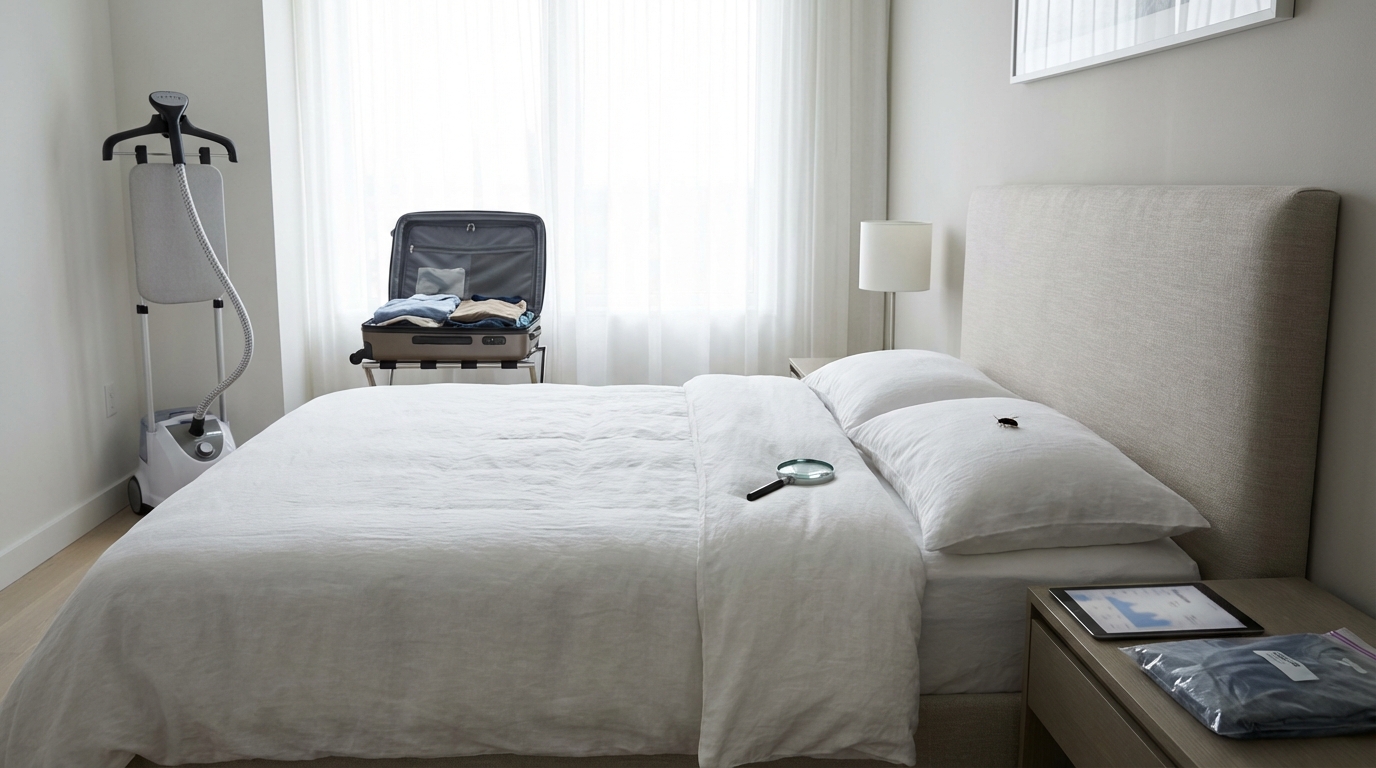
Airbnb bed bugs: Complete guide and expert solutions
Contents
You've just put down your suitcases in an Airbnb apartment in Brussels, you pull back the sheets and there: little black spots lined up along the mattress. Doubt sets in. Then certainty. Bed bugs. It's the kind of situation no one anticipates when booking a short-term rental, yet at Punaisesdelitbruxelles, we receive calls from panicked travelers almost every week.
Things to remember
-
This guide is distinguished by the local expertise of Punaisesdelitbruxelles
-
We offer an emergency protocol for travelers upon discovery and a precise analysis of financial responsibilities between hosts and tenants, while proposing professional technical solutions to stop the infestation immediately without panic.
-
the emergency procedure to follow
-
Who is legally responsible?
We've written this guide because we see too many people losing time, money and, above all, their peace of mind because they don't know exactly what to do. Whether you're the traveler who's just discovered the infestation or the landlord who receives an alarming message from his tenant, the next few minutes of reading will save you a lot of mistakes. We'll be talking about emergency procedures, financial responsibilities and concrete technical solutions to keep these bugs out of your home.
Bedbugs discovered in Airbnb: emergency procedure to follow
Three o'clock in the morning, itchy arms, stings lining the skin. Before you panic, it's time to document. It all starts with proof of infestation, because without it, you'll get nothing: no relocation, no refund, not even a serious response from Airbnb customer service.
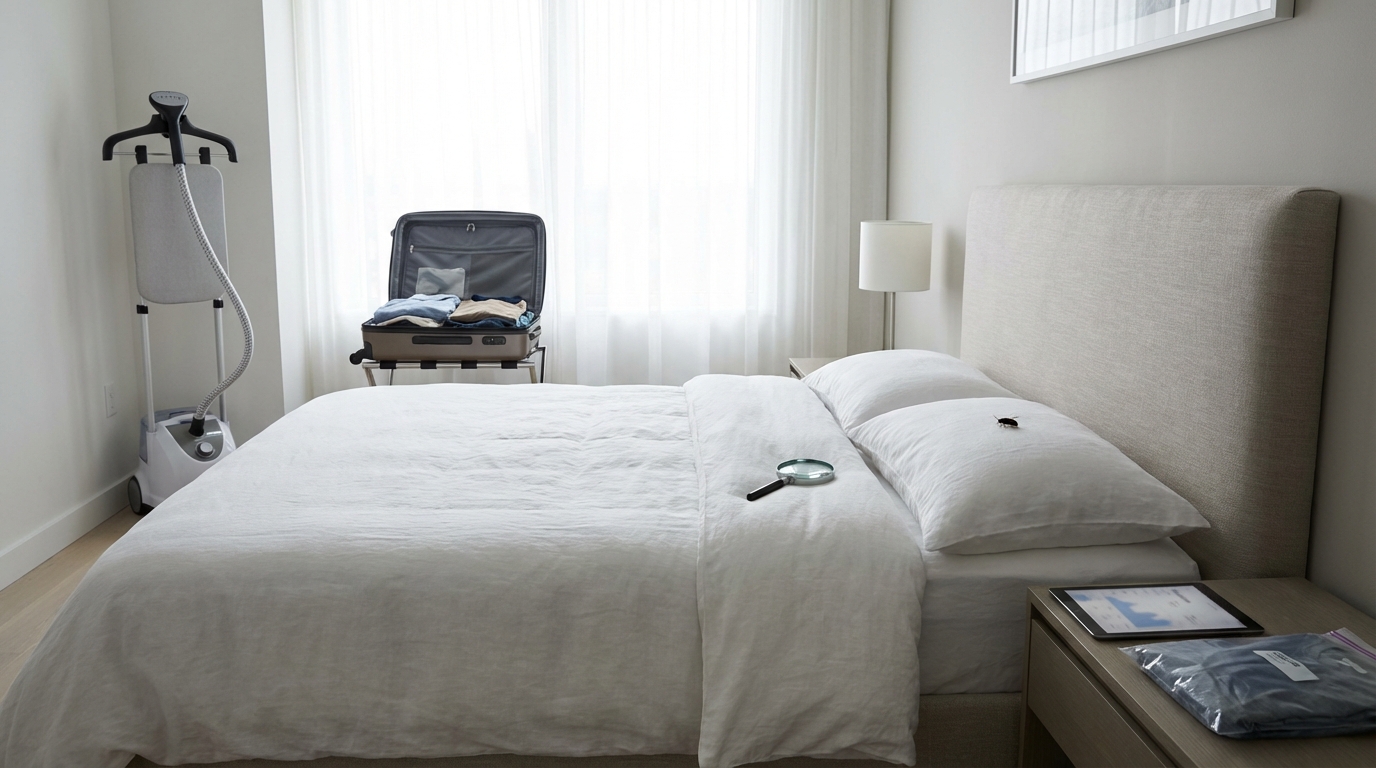
Get out your phone and photograph everything. The insects themselves, if you find any (they hide in the seams of the mattress, behind the headboard, in the baseboards). The droppings, those little black dots that look like ink marks. Traces of blood on sheets. Your bites, too, with a close-up and a wide shot to show their characteristic «path» pattern on the skin. Take videos if possible. Time-stamp every shot. These elements constitute your proof of infestation and will be decisive for the future.
Once the documentation is done, immediately contact the host via the Airbnb messaging system. Not by SMS, not by WhatsApp: only via the app. Why should you do this? Because these exchanges are traceable and can be consulted by the platform in the event of a dispute. Describe what you've found, attach photos, and clearly ask for a solution: rehousing or cancellation with refund.
If the host doesn't respond within an hour (yes, an hour, not a day), go straight to Airbnb customer service. You can reach them by phone or via the app's help center. To report bedbugs on Airbnb, you need to during your stay, ideally within 24 hours of discovery. After this time, the platform often considers that you have «accepted» the conditions of the accommodation, which seriously complicates any recourse.
Can you catch bedbugs in an Airbnb? Yes, absolutely. In fact, along with hotels, it's one of the places most at risk. The turnover of travelers, suitcases from all over the world: the perfect cocktail for an infestation. An apartment can be visually impeccable and still be harboring bedbugs for weeks without the owner noticing, especially if no one has reported any bites before you.
While you're waiting for Airbnb's response, here are a few reflexes to adopt immediately. Move your luggage away from the bed and walls, and put it in the bathtub if you can (bedbugs don't climb on smooth surfaces). Don't move your clothes from one room to another. And above all, don't try to «treat» the problem yourself with insecticide bombs bought in a hurry: they don't work and risk dispersing the insects throughout the apartment, making professional intervention more complex afterwards.
One last point that's often overlooked: if you're in Brussels, take a photo of the exact address of the property and note the rental registration number. This information will be useful if you need to make a declaration to the local health authorities, which is your right.
Disputes and disinfection costs: who is legally responsible?
It's THE question that comes up in 90% of the cases we handle: who should pay for the pest control? The answer isn't as simple as we'd like it to be, but it does point in one direction.
On Airbnb, the host has an obligation to provide decent, pest-free accommodation. This is enshrined in the platform's general terms and conditions and, beyond that, in Belgian regulations on the healthiness of accommodation. An apartment with bedbugs does not meet this condition. Point.
Bedbug refunds on Airbnb work through the platform's «Rebooking and Refund» policy. If you've properly documented the infestation and reported the problem on time, Airbnb may offer you rehousing in equivalent or better accommodation, a partial or full refund for unused nights, or even additional compensation in certain cases. We've seen travelers get a full refund of their stay, including baggage cleaning costs.
The situation is different for hosts. If a tenant reports an infestation, it's up to the landlord to take care of the pest control. No negotiation is possible. Some hosts try to bill the costs to the traveler via the Airbnb deposit, claiming that it was the tenant who «brought» the bedbugs. This strategy almost never works. Proving the origin of an infestation is extremely difficult, and Airbnb generally rules in favor of the traveler when the photographic evidence is solid.
What percentage of Airbnb accommodations are infested with bed bugs? It's hard to get a precise figure for Belgium, but European studies estimate that 5 to 10% of tourist accommodations are affected at any given time. That's no mean feat. And for owners who run several short-term rental properties, the risk is multiplied.
For short-term rentals, here's what we recommend in concrete terms:
-
Open a case via the Airbnb Resolution Center within 24 hours.
-
Attach all your proof (photos, videos, screenshots of exchanges with the host).
-
If Airbnb does not respond favorably, contest the decision. You have the right to request a reassessment.
-
As a last resort, you can contact the Mediation Service for Consumers in Belgium or lodge a complaint with the Federal Public Service Economy.
Bedbug compensation on Airbnb can also cover medical expenses related to bites (creams, antihistamines, dermatological consultation) and the cost of treating your luggage. Keep all invoices.
For owners reading this: don't bury your head in the sand. If you ignore a report, you're guaranteed a negative opinion, a potential suspension of your ad and costs that explode if the infestation spreads. Rapid professional treatment costs between 200 and 600 euros, depending on the surface. An infestation that lasts three months? Count on triple that, plus lost nights, plus reimbursements to subsequent travelers. It doesn't take long to do the math.
Professional treatments and tips to protect your luggage
Let's get straight to the point: supermarket sprays don't kill bedbugs. They temporarily repel them, which means they disperse into neighboring rooms and become harder to eradicate. If you're the owner of an affected Airbnb property, call in a bedbug expert in Brussels at the first sign of a problem.
At Punaisesdelitbruxelles, we use two main approaches, often combined. The first: steam disinsectisation. A professional device projects dry steam at 180°C directly into the nooks and crannies where bedbugs hide (mattress seams, skirting boards, bed frames, electrical sockets). Insects and their eggs die instantly above 60°C. The advantage? No chemicals, and the accommodation can be reused the same day. For an Airbnb rental with a weekly rotation of travelers, this is a powerful argument.
The second approach is global heat treatment. The entire room (or dwelling) is heated to over 55°C for several hours. Nothing survives. This is the most radical and effective method for infestations that have been in place for several weeks. The cost is higher, but the success rate in a single intervention exceeds 95%.
We also offer canine detection before and after treatment. A specially trained dog can detect the presence of live bedbugs with a reliability of 95 to 98%, even behind walls or under wooden floors. For homeowners who want to be sure their home is clean before welcoming the next traveler, this is the most reliable tool available.
Now, let's talk about you, the traveler. How can you be sure not to bring bedbugs home with you after a stay in infested accommodation? Here's the protocol we give to all our customers:
-
Never put your suitcase on the bed or carpet. when you arrive at your accommodation. Use the luggage rack (if metal) or the bathtub.
-
Inspect the bed before going to bed. Lift the sheet, look at the mattress seams, the headboard and the corners. If you see any black spots or small rust stains, don't sleep in this bed.
-
Back home, Don't bring your luggage directly into your room. Unpack everything in the hallway or garage. Put all clothes (worn or not) in the tumble-dryer at 60°C minimum for 30 minutes. It's the heat that kills, not the washing.
-
Vacuum your suitcase, Then dispose of the vacuum bag in a closed garbage bag outside.
-
When in doubt, If you have a suitcase, seal it in a large airtight garbage bag for two weeks. Bedbugs don't survive without a blood meal for more than a few weeks in a confined environment.
How can you tell if a bedbug is present in a hotel or Airbnb? The signs are always the same: small black spots (droppings), traces of blood on the sheets, translucent molting skins, and of course the insects themselves, reddish-brown, flat, about the size of an apple seed. If you see just one, assume that there are dozens of them.
For hosts who want to avoid the nightmare of a bed flea in their Airbnb, we recommend a preventive dog inspection every three months for high-turnover accommodations. The cost is modest (count 100 to 150 euros per visit) and it saves you from much heavier losses. We regularly intervene on behalf of Brussels landlords who manage between 2 and 15 properties: prevention is what makes the difference between a small inconvenience and a financial catastrophe.
Conclusion
Bedbugs in Airbnb are a problem that won't go away on its own. The good news is that solutions do exist and do work, as long as you act fast and speak to the right people.
If you're a traveler: document, report and protect your luggage. If you're a homeowner: don't downplay a report, call in a professional immediately and set up a prevention protocol. At Punaisesdelitbruxelles, we support both sides of the equation. One call is all it takes to assess the situation and plan a rapid response, often within 24 to 48 hours. Your peace of mind is our business.
Frequently asked questions
What should I do immediately if I find bedbugs in my Airbnb?
Document the infestation with photos (insects, bites, black spots) and contact the host via Airbnb messaging to demand a solution.
How do I get an Airbnb refund for bedbugs?
Report the problem to Airbnb customer service within 24 hours of discovery, providing your visual evidence to obtain rehousing or a refund.
Who pays for insect control in short-term rentals?
The legal responsibility lies with the landlord, who must provide decent, pest-free accommodation in accordance with Belgian regulations.
How do you know if an Airbnb accommodation is contaminated before you sleep?
Inspect mattress seams and headboard for small black dots (droppings) or traces of blood on sheets.

 French
  English
  Dutch
Dutch