


I found a single bedbug: Infestation or isolated?
Contents
-
Isolated bedbug vs. active infestation: The diagnostic guide
-
Self-detection or expert detection: Selection criteria and search areas
-
Pre-purchase treatments and recommendations to stop proliferation
You've just crushed a small reddish-brown insect on your sheet, and your heart has sped up. Normal. The question running through your head: is this an isolated bedbug, a stray specimen that happened to be passing by, or are there fifty other bugs hiding in your mattress?
Things to remember
-
The article analyses the real probability of having only one specimen
-
As experts in Brussels, we decipher the scenario of the ‘travelling bug’ vs. the hidden nest, offering a step-by-step diagnostic method to avoid unnecessary or overdue treatments
-
Diagnostic guide
-
Selection criteria and search areas
I'll be honest with you: in 70 to 80 % of the cases I handle in Brussels, when someone tells me «I've found a single bedbug», inspection reveals that there are others. Not always many, sometimes just a handful. But rarely zero. The scenario of the single, traveling bedbug, the one that fell out of your suitcase or a neighbor's coat in the subway, does exist. It's just a statistical minority.
This article is not intended to panic you. It's here to give you a concrete method: how to distinguish a real false alarm from the beginning of an infestation, what to check, in what order, and when to call a professional. We'll break it down step by step.
Isolated bedbug vs. active infestation: The diagnostic guide
First thing to understand: a bedbug doesn't live alone by choice. It's not a solitary insect like a spider that sits in a corner and waits. Bedbugs are gregarious. They live in groups, reproduce quickly and stay close to their food source - you - at night.
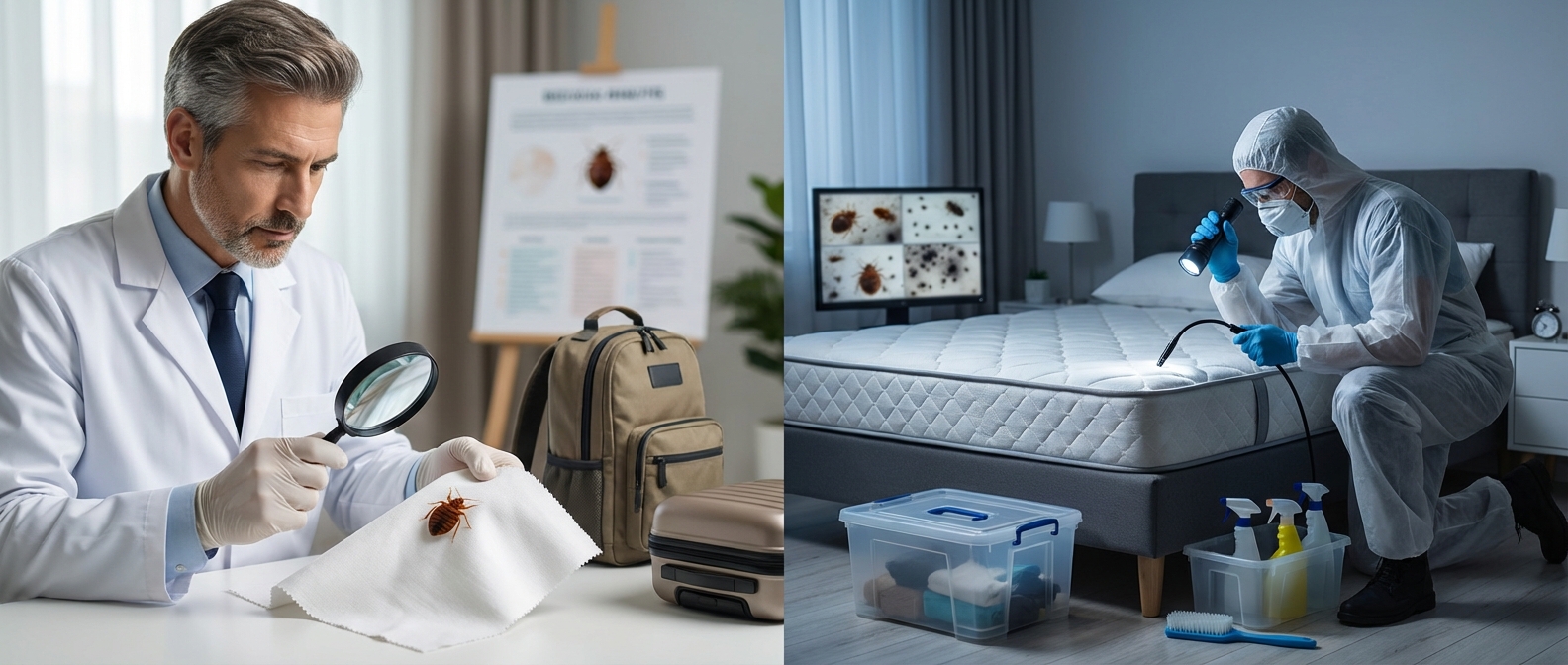
So, is it possible to have just one bedbug in your home? Technically, yes. If you've just returned from a trip and an adult female bedbug has crept into your luggage, it's possible that she's alone at this stage. The problem is that a single fertilized female can lay between 200 and 500 eggs in her lifetime. Her life cycle is formidable: from egg to adult in five to eight weeks, depending on temperature. So «one» today can become thirty in a month's time.
Signs pointing to a traveller's bug (isolated case) :
-
Returning from a recent trip (hotel, Airbnb, overnight train)
-
No bedbug bites noted before this discovery
-
The insect was found on a piece of clothing, a suitcase or a bag, not in the bed.
-
No black marks (droppings) on mattress seams or box spring
-
No small blood stains on the sheets
Signs of infestation :
-
Stings in groups of three or four, often in a line, on areas exposed during sleep (arms, shoulders, neck, legs).
-
Black spots along mattress seams, in box spring folds, or behind the headboard
-
Translucent moult skins (nymphs leave some at each growth stage)
-
An unpleasant, sweet smell in the room, a sign of a larger colony
-
Rust stains on the sheets, the result of bedbugs crushed during your sleep
A point that often comes up: is an isolated bite enough to confirm the presence of bedbugs? No. An isolated bite can be caused by a mosquito, a spider, or even an allergic reaction. The characteristic feature of a bedbug bite is the series of pimples, often lined up in a row, which appear on waking and are very itchy. If you only have one spot and no other signs, don't jump to conclusions.
Another common question: can bed bugs bite only one person in a couple? Absolutely. Some people don't react to bites; around 30 % of the population have no visible skin reaction. Your partner can be stung just as much as you without ever having a single pimple. So it's not a reliable criterion for assessing the extent of the problem.
My advice: don't rely solely on what you see on your skin. Look for physical traces. Droppings, molts, eggs (tiny, white, 1 mm). That's what really tells you where you stand.
Self-detection or expert detection: Selection criteria and search areas
Before you pick up the phone, you can make an initial diagnosis yourself. It takes an hour, a flashlight and a bit of method. Here's how to inspect your bed and its surroundings without missing a thing.
The concentric circle method :
Start with the mattress. Remove all sheets, comforter and pillows. Examine every seam of the mattress, top and bottom. Bedbugs love to get into folds, hems and sewn-on labels. Use a bank card or a butter knife to pull the folds apart slightly and look inside. Look for black dots (their droppings), brownish spots, molting skins, eggs, or the insects themselves.
Next, the box spring. If it's a slatted base, inspect every slat, every notch, every screw. Bedbugs hide in every nook and cranny. A box spring? Turn it over and examine the fabric underneath, especially the staples and seams. This is often where you'll find the nest, a grouping of individuals in various stages with eggs and concentrated droppings.
Third circle: headboard and nightstand. If your headboard is fixed to the wall, remove it. Look behind it, into the screw holes and wood joints. We empty nightstands, turn them over, inspect drawers, runners, nooks and crannies. I've found entire colonies in nightstand drawers that people open every day without noticing a thing.
Fourth circle: baseboards, electrical outlets, picture frames, curtains. At this stage, if you haven't found anything in the first three circles, there are two possibilities: either it really was a single, isolated bedbug, or the infestation is very recent and still difficult to spot with the naked eye.
When should you call in an expert?
If your inspection doesn't turn up anything, but you're still getting stings, now's the time. A professional has tools you don't have. Dog detection, in particular, is extremely effective. A trained dog can detect the presence of live bedbugs and eggs with a reliability rate of over 90 %, whereas human visual inspection is limited to around 30 % in the case of light infestation.
In Brussels, we regularly intervene with people who have searched for weeks without finding anything. The dog arrives, marks a spot in two minutes, we dismantle, and there's the nest. Often behind a skirting board, sometimes in a bed frame, or in an unsuspected crack in the parquet floor.
If you live in an apartment, an expert is also essential. Bedbugs move between apartments via electrical ducts, pipes and cracks in party walls. You can treat your home impeccably, but if your downstairs neighbor is infested, they'll be back. A professional diagnosis can identify the real source of the problem and organize coordinated treatment if necessary.
To sum up: if you've found a single bedbug, your inspection of the four circles reveals nothing, and you're not experiencing any recurring bites, monitor the situation for two to three weeks. Install interceptor traps under the foot of the bed (more on this later). If nothing happens, you've probably been lucky. If bites appear, or if you find a second specimen, call right away.
Pre-purchase treatments and recommendations to stop proliferation
90 % of products sold in supermarkets against bedbugs are ineffective. I weigh my words. Pyrethroid-based insecticide sprays? Bedbug populations in Belgium are largely resistant to them. You're going to spray, it's going to smell like chemicals for three days, and the bedbugs are just going to disperse into other rooms. Worse: you'll have turned a localized problem into a generalized infestation.
What really works in prevention and in the early stages of infestation:
The anti-flea cover. This is the first purchase you should make, without hesitation. A certified integral cover (not just a mattress protector) encapsulates your mattress and box spring. If bedbugs are inside, they can't get out to feed, and die within a few weeks. If they're outside, they can't hide in the mattress seams. Choose a cover with a secure zipper and anti-flea certification (Protect-A-Bed, Mattress Safe, or equivalent). Expect to pay between €40 and €80, depending on the size of the bed. It's an investment worth every penny.
Interceptor traps. These are small plastic cups placed under each foot of the bed. Any bedbugs climbing up from the floor fall into the trap and can't get out. Double advantage: it protects your bed and lets you monitor the situation. If you find bedbugs in the traps after a few days, you've got your answer as to the extent of the problem.
Diatomaceous earth. This is a natural powder composed of micro-fossils of algae. It works mechanically: the microscopic particles damage the bug's waxy cuticle, causing it to dehydrate and die within 48 to 72 hours. Apply a thin layer (really thin, not heaps) along baseboards, under the bed and around bed legs. Caution: don't inhale it; wear a mask when applying. And use food-grade diatomaceous earth, not the kind for swimming pools.
What not to do:
-
Sleep in another room. The bedbugs will follow you, attracted by the CO2 you breathe out. You'll just contaminate the rest of the apartment.
-
Throw away your mattress without prior treatment. You risk infesting the building's common areas and recontaminating your new mattress.
-
Insecticide bombardment without strategy. Effective treatment against bed bugs requires a methodical approach, often involving several passes.
When to switch to professional treatment?
If you have confirmed the presence of a nest, or if traps are regularly catching specimens, professional treatment becomes necessary. In Brussels, the most reliable methods are heat treatment (raising the temperature of the room to 55-60°C for several hours, which kills all stages, including eggs) and professional chemical treatment with molecules to which bedbugs are not yet resistant. The two are often combined.
A bedbug treatment in Brussels by a certified professional costs between 300 and 600 euros for a standard apartment, with generally two passes at 10-15 day intervals. This is the time needed for any eggs that may have survived the first pass to hatch and be eliminated during the second. It's not cheap, but it's incomparably more effective than 150 euros worth of sprays that will only delay the problem.
One last point on bedbug reproduction, because the question comes up all the time: can a bedbug reproduce on its own? No. You need a male and a female. Fertilization is traumatic (the male literally pierces the female's abdomen), but a female fertilized just once can lay fertile eggs for weeks. That's why a single fertilized female in your suitcase is enough to launch a colony. Time is on your side.
Conclusion
Finding just one bedbug is a warning sign, not a condemnation. The key is reactivity. Methodically inspect your bed and its surroundings within 24 hours. Install bedbug covers and interceptor traps immediately. Monitor for two to three weeks.
If the signs are confirmed, don't waste time with makeshift solutions. Contact a professional in Brussels who can make a reliable diagnosis and set up a suitable treatment. The earlier you act, the less time, money and trouble it will take. A bedbug infestation detected in its early stages can be treated in two interventions. An infestation that's been going on for six months may require four or five, with much heavier constraints on your daily life.
In doubt? Give us a call. We'd rather come to you for nothing than six months too late.
Frequently asked questions
Is it possible to have just one bedbug?
Yes, there are cases where a single bedbug has been found in a dwelling, and then nothing... but, at the risk of disappointing you right off the bat, this is the exception rather than the rule. Generally speaking, when you see a bedbug in your home, there's a good chance that others have already settled in.
Is a bedbug bite usually isolated?
Bedbug bites are rarely isolated: you'll usually see several spots, usually in a row. The explanation is simple: the bedbug follows a blood vessel! The spots are round and red in color.
Can a bedbug reproduce on its own?
No, unless an already fertilized female has entered your suitcase. In this case, the bug alone can develop an infestation.
Is it possible for bedbugs to bite only one person?
Yes, bed bugs can bite only one of the people sharing a room. They rarely bite pets.

 French
  English
  Dutch
Dutch